Gulf Shores Opens Applications for 2026-2027 Junior City Council
The City of Gulf Shores is accepting applications through Aug. 28 for its 2026-2027 Junior City Council, a leadership program for high school students in grades 10 through 12.
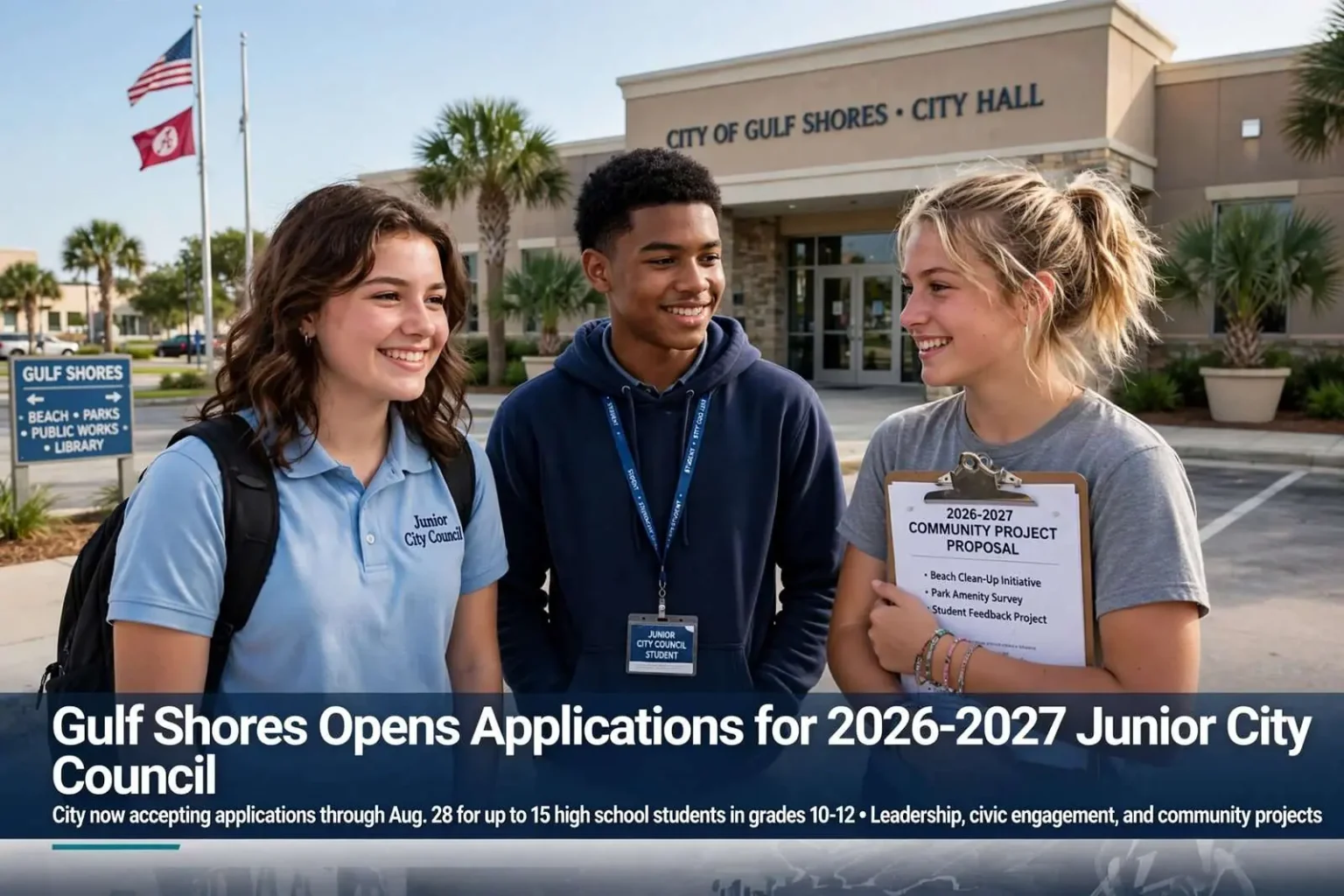
Gulf Shores has opened the application period for its 2026-2027 Junior City Council, a program that gives high school students a firsthand look at how municipal government works while building leadership skills that carry well beyond the classroom. The city will select up to 15 students to serve on the council for the upcoming term, and applications are being accepted now through Aug. 28. Interviews for finalists are scheduled for the week that follows the deadline.
The program is open to students in grades 10 through 12 who live within the Gulf Shores city limits. That residency requirement keeps the roster focused on young people whose families live in Gulf Shores and whose daily lives intersect with the city services the council oversees, from beach and park maintenance to police, fire and public works. Students who attend school in the city or elsewhere remain eligible as long as they meet the residency standard.
Once selected, members serve from September through May, a schedule that mirrors the school year and the city’s own meeting calendar. The term is designed to be substantial rather than ceremonial, with students expected to show up, contribute and complete work between sessions.
What members will do each month
Junior City Council members will meet monthly throughout the school year. Those meetings bring the students together as a working body, giving them practice with agendas, discussion and follow-through on assignments. Guest speakers are a regular feature of the monthly sessions, and the lineup typically draws on the people who actually run the city, giving members direct access to department leaders and officials they would otherwise only see at a distance.
Alongside the meetings, members collaborate on community projects that benefit Gulf Shores. The projects move the students from observation to contribution, identifying a need in the city and working as a group to address it. That project work is what separates a youth council from a simple field-trip program, because members are accountable for producing something tangible for residents.
Members will also attend regular City Council meetings, giving them direct exposure to how local government decisions are made. Sitting in on the city’s governing body shows the students how ordinances and resolutions move from proposal to vote, how public money is debated, and how residents raise concerns during public comment.
City leadership on the program’s value
City officials describe the program as an investment in the community’s future rather than a student activity bolted onto the municipal calendar. “The Junior City Council plays a vital role in shaping the future of our community by connecting students directly with city leadership,” Mayor Robert Craft said. “Each year, our student leaders bring fresh ideas, thoughtful perspectives, and a determined dedication to making Gulf Shores an even better place to live.”
“Their enthusiasm reminds us that the future of our community is bright, and we are proud to support their growth as young civic leaders,” Craft said. The mayor’s framing reflects a broader reality for coastal cities like Gulf Shores, where decisions about growth, tourism, environment and infrastructure will land squarely on the generation now entering high school.
The experience is also practical for the students themselves. Members learn how a city of Gulf Shores’ size actually operates, how many departments it takes to keep a barrier-island community running, and why decisions that look simple from the outside, such as a road improvement or a special event permit, involve trade-offs among budget, safety and quality of life. Those lessons are difficult to teach from a civics textbook and easy to absorb across a year of monthly meetings.
Why youth councils matter in Baldwin County
Gulf Shores is one of the fastest-growing cities on the Alabama Gulf Coast, and its rapid residential and commercial growth has made municipal government a larger presence in residents’ everyday lives. Planning, zoning, traffic and public safety questions that once felt distant now come before the City Council on a routine basis. A youth council gives the city’s teenagers a structured way to understand those decisions before they are old enough to vote on them, run for office or simply show up at a public meeting to be heard.
Youth councils of this kind have become a common feature of municipal government across Alabama and the broader Gulf South. The model is straightforward: the city sponsors the program, staff members coordinate the schedule, and students commit to a school year of participation. In return, the city gains a pipeline of engaged young residents who understand how their local government works, and the students gain references, civic experience and a network of local leaders they can call on later.
For college applications and early resumes, the experience carries real weight. Admissions offices and employers see a year of documented service, public speaking practice and project management on a student’s record. For students considering careers in public administration, law, planning or engineering, the program offers an early, realistic look at the field.
What the selection process looks like
The city is looking for students who demonstrate leadership qualities, strong communication skills, and a commitment to serving their community. Those criteria give applicants flexibility: leadership can come from team captaincies, church and club roles, part-time jobs or volunteer work, and communication skills show up in everything from debate and yearbook to the way an applicant carries themselves in an interview.
The process is intentionally straightforward. Students submit an application before the Aug. 28 deadline, and the city then invites finalists to interview the following week. Interviews give both sides a chance to confirm the fit: the students learn more about the time commitment, and the reviewers get a sense of each applicant’s interests and dependability beyond what is written on the form.
How to apply
Applications for the 2026-2027 term are being accepted through Aug. 28, and city officials encourage interested students to apply well before the deadline rather than waiting until the final day. Because the city selects up to 15 members from a single application window, the available seats are limited, and the interview round that follows is competitive.
Students or parents with questions about the application process can contact Lauren Traywick at 251-968-4308 for more information. The city recommends reaching out before the deadline with any questions about eligibility, residency or the time commitment, since a missed requirement is far easier to resolve before an application is submitted than after.
What the school year will look like for members
Once the new council is seated in September, members can expect a rhythm of monthly meetings, periodic guest speakers, progress check-ins on their community project, and regular attendance at City Council meetings through May. The schedule is built around the school calendar, so participation is manageable alongside coursework, athletics and other activities, though members are expected to treat their attendance commitment seriously.
The payoff comes at the end of the term. Members finish the year with a working knowledge of how Gulf Shores government functions, a completed community project with their names on it, and relationships with city staff and elected officials that most adults in the community never develop. For a city that expects its next generation of residents to lead, the Junior City Council is the entry point.
The City of Gulf Shores is now accepting applications for its 2026-2027 Junior City Council. Students in grades 10 through 12 who live within the city limits have until Aug. 28 to apply, with finalist interviews scheduled for the following week and the selected group taking their seats in September.
What membership teaches about local government
A year inside the program covers ground that most residents never see. Students learn how the city’s budget is built and approved, why beach renourishment and storm preparedness are recurring line items for a coastal community, and how departments such as public works, planning and parks coordinate on everyday decisions. They also see the pace of local government up close, where a single project can move through staff review, committee discussion and a final council vote over multiple months.
The format also builds soft skills that are hard to acquire elsewhere at that age. Monthly meetings require members to speak in front of adults, listen to opposing viewpoints, and follow through on group commitments. Guest speaker sessions give students practice asking questions of professionals, and the community project requires planning, delegation and accountability to a public audience.
How Gulf Shores compares with other civic programs
The Junior City Council sits alongside other civic opportunities available to Baldwin County students, including school-based clubs, volunteer organizations and youth leadership programs run by chambers of commerce and civic groups. What distinguishes a municipally sponsored council is access: members are connected directly to the government that makes the decisions shaping their city, rather than simulating the process in a classroom setting.
That direct access is also what the city gets in return. Members who complete the program graduate into the community with an understanding of how Gulf Shores works from the inside, and some carry that interest into careers or volunteer service in local government. For a growing coastal city, cultivating that familiarity early is a long-term investment in civic participation.