Gulf South Angels and Hatch Fairhope Connect Founders With Investors; New Hatch Hub Opens to Public Nov. 19
Gulf South Angels and Hatch Fairhope brought entrepreneurs and experienced investors together at the Oct. 1 Hatch Angel Hour, where guests previewed Hatch's new Baldwin County tech hub. A public ribbon cutting is set for Nov. 19.
UPDATE: The Oct. 1 Hatch Angel Hour has taken place, bringing local entrepreneurs face to face with experienced investors and giving guests a private first look at Hatch’s new facility in Baldwin County. The public can tour the new space during a ribbon cutting on Nov. 19. Details are below.
FAIRHOPE — The people who write the first checks into a new company are usually not institutions. They are individuals — often local, often with operating experience of their own — and next month a regional group is opening the door to anyone curious about how that works.
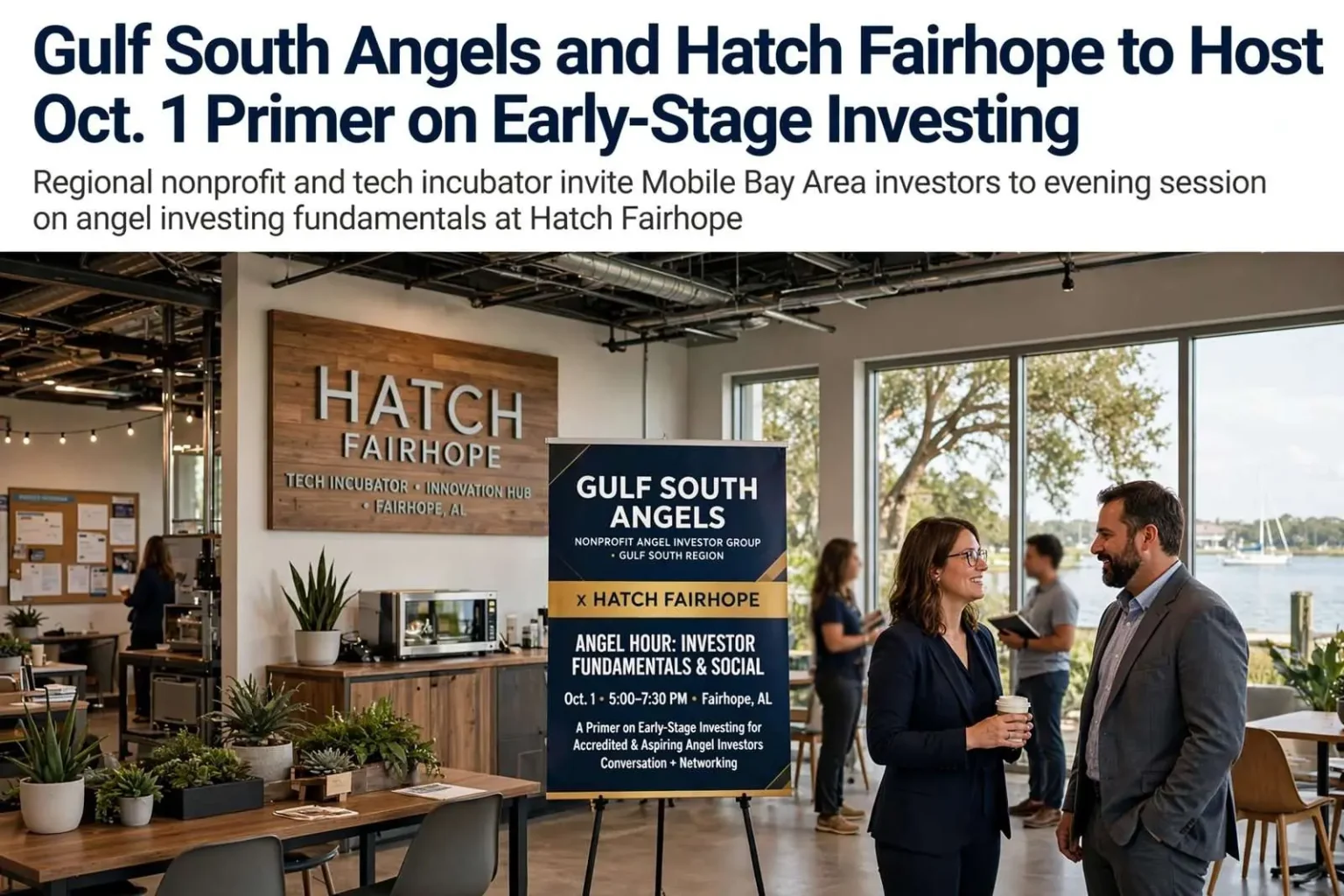
Gulf South Angels, a nonprofit that describes itself as the region’s largest angel investor group, and Hatch Fairhope, a tech incubator and innovation hub, are inviting Mobile Bay Area business leaders, accredited investors and aspiring angel investors to an evening session on early-stage investing.
Angel Hour: Investor Fundamentals & Social is scheduled for Oct. 1 from 5 to 7:30 p.m. at Hatch Fairhope.
What the Evening Involves
The program is built in two halves. The first is a casual conversation covering the fundamentals of angel investing. The second is networking with Gulf South Angels members and other members of the region’s business community.
Organizers describe the audience broadly. The event is designed for people who are curious about angel investing but do not know where to start, and equally for active investors who want to sharpen their approach, expand their portfolios or connect with other investors.
That dual framing is common in angel group recruitment, and it reflects how these organizations grow. A new member typically arrives knowing one existing member, watches a few deals go by without participating, and only then writes a check.
Who the Organizers Are
Gulf South Angels is a nonprofit angel investor group serving the Gulf South region. Hatch Fairhope operates as a technology incubator and innovation hub in Fairhope, on the eastern shore of Mobile Bay in Baldwin County.
Incubators and angel groups are natural partners because each supplies what the other needs. An incubator collects early-stage companies, gives them workspace, mentorship and structure, and eventually reaches a point where its most promising tenants need capital. An angel group has capital and needs a reliable stream of vetted companies to look at. Regions that develop both tend to keep more of their startups — and more of the eventual returns — rather than watching founders relocate to reach investors.
What an Angel Investor Actually Is
Angel investing occupies a specific position in the funding chain. It sits after a founder has exhausted personal savings and money from friends and family, and before a company is large enough to interest institutional venture capital funds.
The defining characteristic is that angels invest their own money rather than a fund’s. That has consequences in both directions. Angels can move faster and can back ideas that would not survive an investment committee, but they also bear the loss personally when a company fails, which most early-stage companies do.
The risk profile is unusual enough that it drives the entire structure of the practice. Returns in early-stage investing are highly concentrated: in a typical angel portfolio, the large majority of investments return little or nothing, and overall performance depends on a small number of companies that succeed dramatically. That mathematics is why experienced angels build portfolios of many small positions rather than concentrating in one or two companies, and why group membership is attractive — it makes broad diversification practical at a modest check size.
Money is also rarely the only thing angels bring. Many are former operators, and their value to a young company often lies in customer introductions, hiring help, pricing advice or simply having previously survived a problem the founder is encountering for the first time.
The Accredited Investor Question
The invitation specifically mentions accredited investors, a term with a precise legal meaning that anyone considering this activity needs to understand.
Most private company fundraising in the United States is done through exemptions from Securities and Exchange Commission registration requirements, and those exemptions generally limit participation to accredited investors. For an individual, the standard financial tests are an annual income above $200,000 — or $300,000 jointly with a spouse — in each of the two most recent years with a reasonable expectation of the same in the current year, or a net worth exceeding $1 million excluding the value of a primary residence.
The SEC expanded the definition in 2020 to include people holding certain professional credentials, such as active Series 7, Series 65 or Series 82 licenses, as well as knowledgeable employees of the private fund in question. The rationale for the category is investor protection: private offerings are not subject to the disclosure requirements that govern public markets, so access is limited to people presumed able to absorb a total loss or to evaluate the risk professionally.
A session on fundamentals is exactly where someone learns whether they meet that standard before, rather than after, being shown a deal.
How Angel Groups Operate
Individual angels investing alone face a workload problem. Screening companies, checking claims, reading financials, negotiating terms and monitoring an investment afterward is substantial work for a part-time investor.
Angel groups exist to spread that work. A typical group runs a recurring cycle: companies apply, a screening committee narrows the field, selected founders pitch to the membership, and interested members form a due diligence team that digs into the company’s technology, market, finances and legal standing. The team reports back, and members then decide individually whether to invest — groups generally do not vote as a bloc.
Deals at this stage are usually structured either as convertible instruments — a convertible note or a SAFE, which converts into equity at a later priced round — or as a priced equity round with a negotiated valuation. Terms of art like valuation cap, discount, pro rata rights and liquidation preference are the practical vocabulary of the field, and they are the sort of thing an introductory session exists to demystify.
Why a Region Builds an Angel Network
Access to early capital is one of the more reliable predictors of whether a region keeps the companies that start there.
A founder in a place without local investors faces a choice: raise money remotely, which is harder without existing relationships, or move to a city where investors are concentrated. Every founder who takes the second option removes future jobs, tax base and follow-on companies from the place that produced them.
Local angel networks work against that pull in a way outside capital cannot. Local investors know the region’s industries firsthand, they can meet a founder in person, and they have a non-financial stake in whether the company stays. Along the Gulf Coast, where the economy is anchored in shipbuilding, aerospace, chemicals, logistics, health care and tourism, a technology company with real customers in any of those sectors is exactly the kind of business local investors are positioned to evaluate better than a distant fund could.
Latest Developments: Angel Hour Connects Founders and Investors
The “Hatch Angel Hour” went forward as planned on Oct. 1, and organizers framed it as another step forward for South Alabama’s technology community. Local entrepreneurs were able to connect directly with investors, the kind of in-person contact that the event was designed to encourage.
Gulf South Angels and Hatch Fairhope brought experienced investors together to explain how they vet startups and how they go about funding local deals — the screening, diligence and deal-structuring questions described above, discussed by people who make those decisions with their own money.
A Preview of Hatch’s New Facility
Guests at the event also got an early look at Hatch’s new facility, which is designed as a resource hub for technology entrepreneurs in Baldwin County. That preview was limited to those attending the private event.
For incubators, physical space is a large part of the value they offer: a place for founders to work, meet mentors and potential investors, and find one another. A dedicated hub on the Eastern Shore gives Baldwin County’s startup community a central address for that activity.
What’s Next: Public Ribbon Cutting Nov. 19
- What: Ribbon cutting and public tours of Hatch’s new facility
- When: Nov. 19
- Who: Open to the public
Residents, entrepreneurs and prospective investors who missed the private preview can tour the new space during the ribbon cutting. Those interested in future Gulf South Angels programs or in Hatch Fairhope’s resources for founders should contact the organizations directly for details.