Gulf State Park’s Learning Campus Showcases Education Programs to Little Lagoon Preservation Society
Gulf State Park's Learning Campus outlined camps, homeschool days, research programs and LEED training to the Little Lagoon Preservation Society.
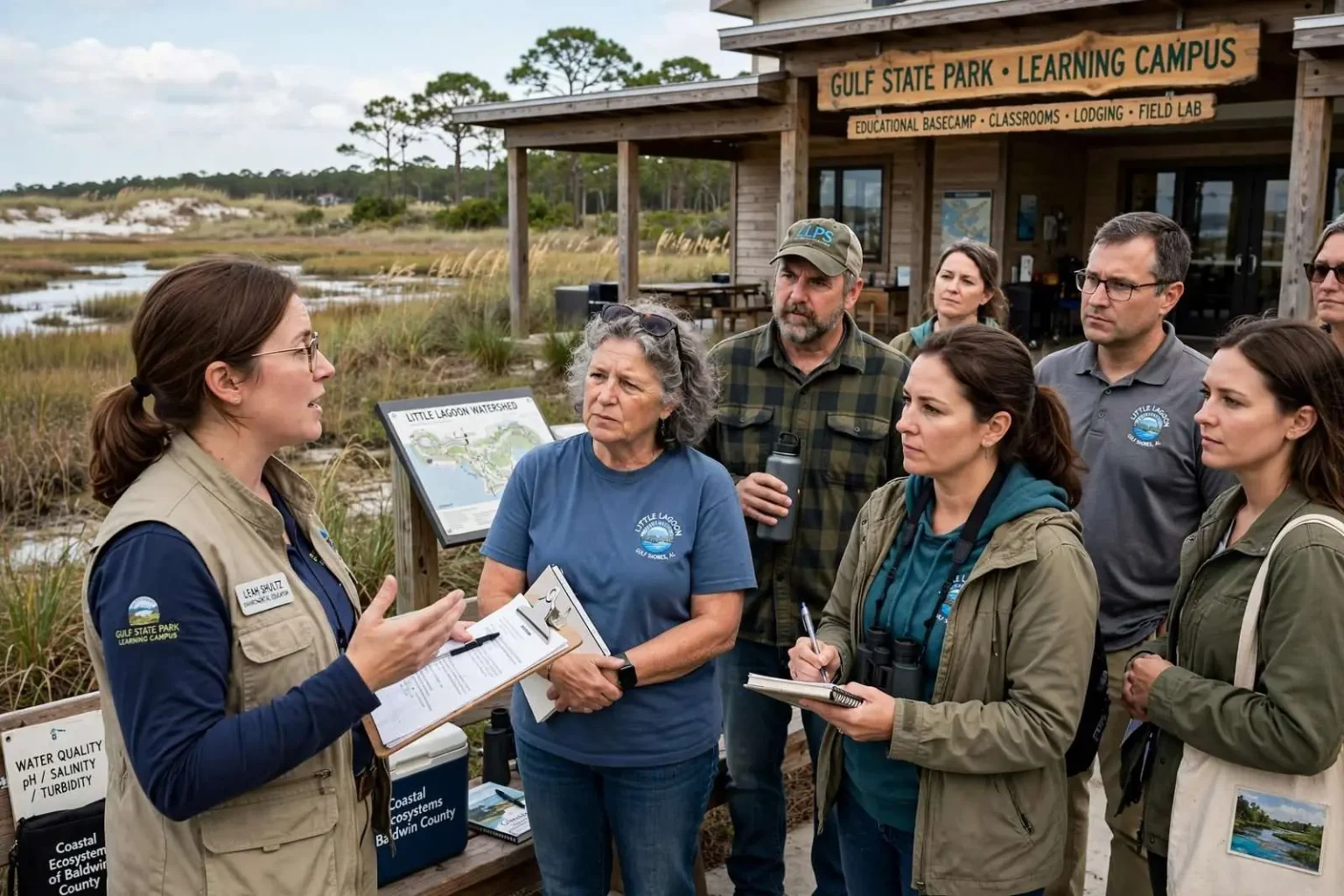
The Learning Campus at Gulf State Park is quietly becoming one of the coast’s busiest outdoor classrooms, and its lead educator recently walked the Little Lagoon Preservation Society through everything the facility offers the public. Leah Shultz, an environmental educator at the campus, spoke at the preservation society’s Nov. 7 meeting in Gulf Shores, describing the facility as an educational basecamp that widens access for visiting school groups, college students, researchers, scout troops and nature enthusiasts from across Alabama and beyond. Her presentation gave the group a detailed look at how the campus operates, who it serves and why it has grown into a destination for educators planning programs along the Gulf Coast.
The campus occupies its own corner of Gulf State Park, one of Alabama’s most heavily visited state parks and the centerpiece of outdoor recreation in Baldwin County. The park stretches across thousands of acres of beach, dunes, maritime forest and freshwater lakes between Gulf Shores and Orange Beach, and it draws visitors year-round for its beaches, trails, fishing pier and campgrounds. Within that setting, the Learning Campus functions as a dedicated education facility — a place with classroom space, lodging capacity and immediate access to the park’s natural resources, designed so that a group can arrive, unpack and be out in the dunes or along the water within minutes.
Shultz’s presentation to the Little Lagoon Preservation Society was a natural fit for the audience. The society is a Gulf Shores-based volunteer organization devoted to protecting Little Lagoon, the brackish body of water behind the dunes on the west end of town, and its members spend much of the year focused on water quality, habitat and the health of the coastal ecosystems that make the area distinctive. The group regularly brings in speakers whose work touches the lagoon and the Gulf waters around it, from researchers to agency staff, as part of its effort to keep members informed and engaged. Environmental education sits at the center of that mission, since protecting a lagoon ultimately depends on residents and visitors understanding what makes it work. Hearing how the state park introduces thousands of students to those same ecosystems gave the group a picture of how the next generation of coastal stewards is being trained just a few miles from their own projects.
An Educational Basecamp on the Coast
In describing the facility, Shultz characterized it as an educational basecamp that widens access for visiting school groups, college students, researchers, scout troops and nature enthusiasts from across Alabama and beyond. The phrase captures the campus’s practical role: rather than a single program or a single audience, it is infrastructure that many different kinds of groups build their own experiences on top of. A university class can use it as a field station, a scout troop can use it as a overnight stop on a coastal badge project, and a research team can base itself there while sampling in the park’s lakes and dune systems.
The location is a large part of the appeal for educators planning overnight and multi-day field experiences along the Gulf Coast. The park’s trails, dunes and freshwater ecosystems sit immediately outside the campus doors, which means instruction can move between indoors and outdoors without loading buses. Students studying coastal ecology can walk from a lesson into the dunes; groups working on water quality can reach freshwater lakes and nearby lagoon habitats in short order. For teachers used to planning single-day trips that spend hours in transit, the ability to lodge a class on site and spread learning across several days changes what a field experience can accomplish.
From Research Groups to Teacher Training
The program lineup Shultz highlighted runs wide. The campus hosts collegiate research groups and hands-on eco-art classes, runs dedicated homeschool days and summer camps, and works with the Alabama STEM Council. Students can pursue Leadership in Energy and Environmental Design (LEED) Green Associate certifications there, while teachers can take advantage of professional development programming. Taken together, the offerings reach audiences from elementary age through adult, and they make the campus as much a training ground for teachers and professionals as a destination for school field trips.
Each strand of the program serves a different piece of the coastal education puzzle. Collegiate research groups bring university expertise into the park, using its mix of habitats for fieldwork while giving undergraduates experience with real data collection. Eco-art classes pair creative work with environmental study, an approach that reaches students who connect with a subject through drawing, building or photography before they connect with it through a textbook. Homeschool days and summer camps extend the campus’s reach beyond the traditional school calendar, filling weekday and seasonal gaps with structured outdoor learning for families who seek it out.
The partnership with the Alabama STEM Council ties the campus into a statewide effort to strengthen science, technology, engineering and math education, connecting local programming to the council’s broader work of supporting STEM learning opportunities across Alabama. The LEED Green Associate certification track adds a professional credential to the mix — Leadership in Energy and Environmental Design is the widely used green building standard, and the Green Associate level is the credential’s entry point. Offering students a path toward that certification at a state park campus links lessons about coastal environments directly to careers in sustainable design and construction.
Teacher training rounds out the calendar. Professional development programming gives classroom educators the content knowledge and field experience to bring coastal science back to their own schools, multiplying the campus’s reach well beyond the students who visit in person. A teacher who spends a professional development session in the park’s dunes and classrooms returns to her district equipped to lead lessons on coastal ecosystems, and the campus’s staff treat that multiplier effect as central to the facility’s mission.
Classrooms Surrounded by the Park
Situated within one of Alabama’s most visited state parks, the campus gives visitors a mix of classroom space and immediate access to the park’s trails, dunes and freshwater ecosystems — a combination that has made it a draw for educators planning overnight and multi-day field experiences along the Gulf Coast. The setting does the teaching alongside the staff. A discussion of dune ecology is more durable when students have stood in the dunes that morning; a lesson on freshwater habitats lands differently after a group has sampled the edges of the park’s lakes. The campus was designed to exploit that proximity, and educators who bring groups there consistently point to it as the reason the experience works.
Gulf State Park itself carries a history that shapes what the Learning Campus can offer. The park has rebounded and expanded repeatedly over the decades, recovering from hurricanes that have battered the Alabama coast and growing into a recreation destination with lodging, camping, an extensive trail network and a fishing pier that reaches into the Gulf. That scale of operation gives an education facility room to work: groups can spread across habitats without crowding, and the park’s infrastructure handles the logistics of feeding and housing visiting classes while the campus staff focus on instruction.
For Baldwin County residents, the campus also functions as a local resource rather than a tourist attraction. Families in Gulf Shores, Orange Beach, Foley and surrounding communities can take advantage of the same programming that serves visiting groups, from seasonal camps to public education events, and the proximity means that coastal science education does not have to be something children experience only on a school trip organized months in advance. The campus’s schedule of homeschool days in particular has opened participation to families who structure education outside the traditional classroom.
The Nov. 7 meeting gave the Little Lagoon Preservation Society a chance to see that operation up close and to consider how it might connect with the lagoon work its members do. The society’s focus on a single, closely studied body of water pairs naturally with a facility that introduces thousands of visitors to the wider coastal ecosystem the lagoon is part of. Organizations like the society rely on public understanding to advance their conservation goals, and a steady pipeline of students and visitors who have learned about dunes, freshwater systems and coastal water in the park makes that task easier over time.
Shultz’s walkthrough made the case that the Learning Campus has grown into more than an amenity — it is now a working part of the region’s education infrastructure, hosting research, training teachers, certifying students and connecting Alabama families to the environments at their doorstep. As the campus’s programs continue to expand, the society and other coastal organizations are positioned to draw on a public that arrives increasingly familiar with the ecosystems they work to protect. The meeting closed with the two organizations’ shared territory — education and conservation — looking more connected than when the evening began.