Artist’s Massive Silk Sail Sculpture Takes Flight Inside New GulfQuest Museum
A 21-by-30-foot silk batik artwork depicting Mobile Bay was permanently installed in the rotunda of the soon-to-open GulfQuest museum in Mobile.
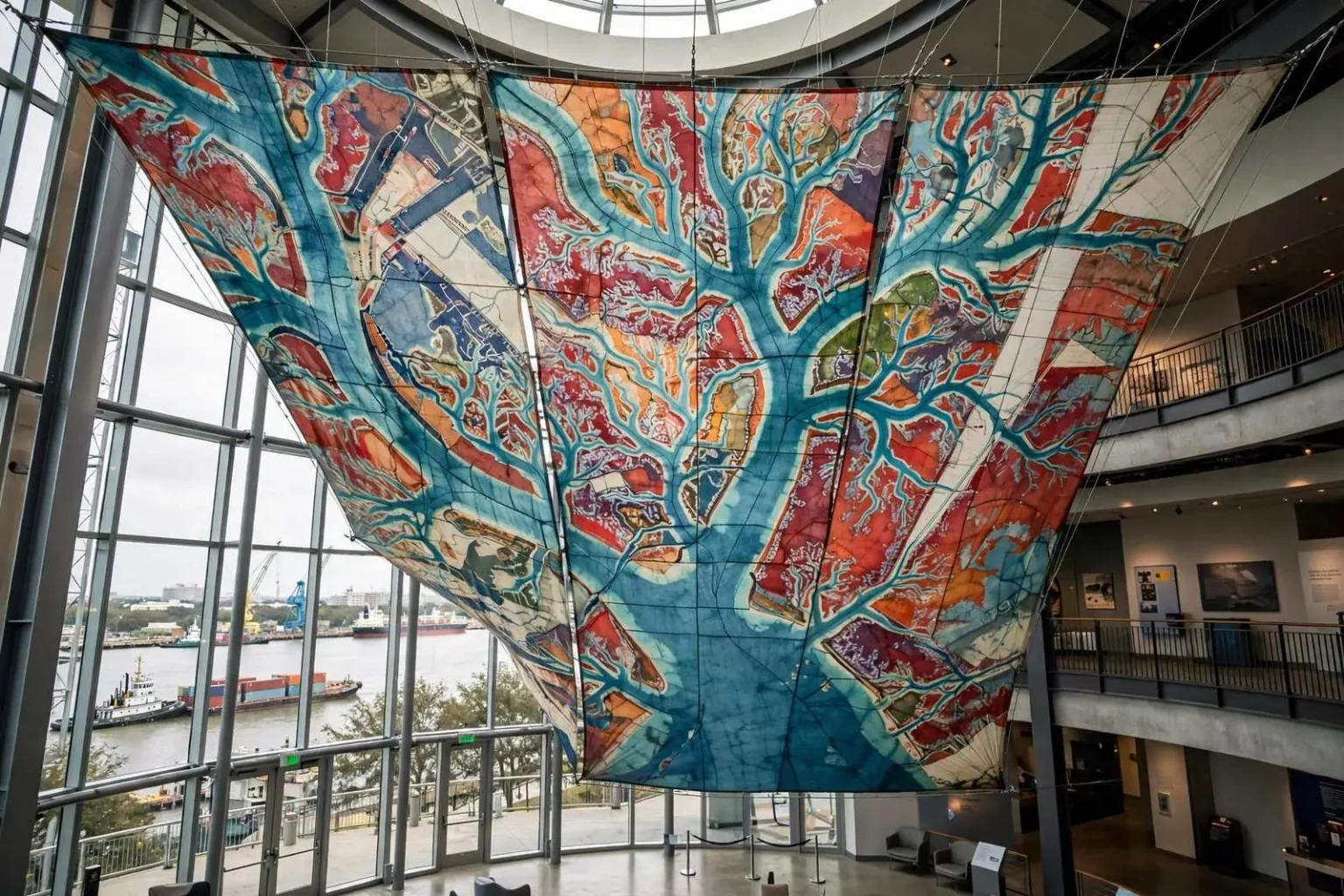
A massive, hand-dyed silk artwork depicting an aerial view of Mobile Bay has found its permanent home in the rotunda of the GulfQuest National Maritime Museum of the Gulf of Mexico, the $62 million downtown Mobile museum set to open to the public later this fall. The installation of the sweeping 21-by-30-foot silk batik marks one of the final artistic touches to a building that has risen along the city’s riverfront as the centerpiece of a broader effort to make the downtown waterfront a destination for visitors and residents alike.
The artist behind the piece, a South Carolina-based creator known for large-scale aerial artwork, spent a full day carefully installing the work after it had hung finished in her home studio for roughly a year, waiting for the museum building itself to be ready to receive it. The long wait between completion and installation is common for large commissioned pieces, but for this artwork the delay carried a particular irony: a work depicting the bay and its shipping channels from above was rolled up and stored while the museum dedicated to the Gulf’s maritime life took shape just a few blocks from the water it celebrates.
From Seven Lengths of Silk to Three Panels
The physical construction of the piece was a project in its own right. The artwork was created from seven separate 45-inch lengths of silk, sewn together into three large panels. Each panel was then rolled onto cylinders so the delicate fabric could be moved without creasing or damage, and the artist personally transported the rolled panels from South Carolina to Mobile, unwilling to trust the one-of-a-kind work to handlers unfamiliar with its fragility.
Before the panels could be raised, the artist ironed out wrinkles from the heavy silk inside the rotunda, a task that unfolded against a fitting backdrop: through the museum’s plate-glass windows, tugboats could be seen pushing barges up and down the river outside, a daily reminder of the working waterfront the museum was built to interpret. Once the fabric was smooth, museum staff attached the three panels using wire cables suspended from a perch 60 feet above the rotunda floor, gradually pulling the edges taut until the silk panels resembled ship sails catching the wind — an effect that ties the piece directly to the building’s nautical architecture.
A Commission Years in the Making
The artist was first connected to the project in 2010 through an architectural firm that had previously commissioned her work for a transportation center in Charleston, a collaboration that gave the museum’s designers direct evidence of her ability to translate sprawling landscapes into fabric. She signed the formal contract for the GulfQuest commission in 2012, committing to a piece that would become one of the most visually prominent artworks in any public building on the Alabama coast.
To prepare, she did not rely on maps or photographs alone. The artist flew over Mobile Bay and the Mobile River Delta in an ultralight aircraft, studying the winding waterways, the shipping channels and the patchwork of land and water that defines the region, and she did so before construction on the museum had even begun. The final design was based on satellite imagery, offering a bird’s-eye perspective of the bay and its surrounding rivers and tributaries rendered in dyed silk rather than ink.
Forty-Six Colors Drawn From the Port
Color was treated as a design problem of its own. Each of the piece’s 46 distinct colors, including 16 shades of red, was chosen to complement the museum’s own branding, with hues echoing the colors found on the container ships that pass through the Port of Mobile. The choice grounds the artwork in the industrial reality of the waterfront it depicts: the same spectrum of hull reds, stack colors and container shades visible from the museum’s windows now reappears overhead in silk.
The panels were dyed individually using a specialized process before being seamed together, and the seams themselves borrow techniques from traditional sailmaking — a craft whose methods were developed precisely because fabric under sustained stress must be joined without weak points. Applying sailmaking knowledge to fine art gave the finished piece both the durability to hang as a permanent installation and the visual language of the sails it was designed to evoke.
A Soft Counterweight to a Working Waterfront
The artist has described the piece as a deliberate counterbalance to the museum’s industrial, maritime character, offering a softer visual element inside a building otherwise centered on shipping, shipbuilding and Gulf Coast commerce. That tension — between the hard edges of cargo cranes and container terminals and the flowing forms of dyed silk — is central to the way the rotunda now reads to visitors entering from the street.
The contrast reflects a broader truth about Mobile itself, a city where one of the nation’s most active deepwater ports operates within walking distance of historic districts, theaters and an expanding downtown entertainment scene. The museum, positioned on the river’s edge, was conceived as a bridge between those worlds, and the artwork suspended in its rotunda makes the pairing literal: the bay seen from above, rendered in a material associated with sails rather than steel.
GulfQuest and the Waterfront Vision
The museum has been one of the most closely watched civic projects in the region, representing a years-long effort to give the Gulf of Mexico an institution dedicated to its maritime heritage, ecology and economy. Its downtown location places it alongside the Alabama Cruise Terminal and within sight of the port facilities that animate the river throughout the day, allowing visitors to move from exhibits about shipping and navigation to the real thing simply by looking out the window.
Large-scale public art has become an increasingly common feature of museum lobbies and civic buildings across the country, but few pieces combine the scale, material and subject matter of the GulfQuest rotunda work. Aerial-view art of this kind asks viewers to reorient themselves, to see a familiar body of water not from the Causeway or the beaches but from hundreds of feet above, where rivers braid into deltas and shipping channels cut straight lines through the landscape.
Scarves, Sunlight and a Farewell to the Coast
The commission will not end with the installation. The artist plans to produce silk scarves inspired by the design for sale in the museum’s gift shop once it opens to the public, extending the artwork’s reach beyond the rotunda and giving visitors a portable piece of the bay’s overhead geometry.
Watching the final panel settle into place as afternoon sunlight streamed through the rotunda’s skylight, the artist said the finished installation captured exactly the effect she had envisioned years earlier when the project first began. The moment closed out a process that had spanned more than a year of studio work, a cross-country drive with rolled silk, and a morning of ironing and cable work high above the museum floor.
She said her time working on the commission had left her with a deep appreciation for the Mobile area beyond the museum itself, citing the region’s food, warmth and welcoming character among the things she had come to love most about the project. For a museum still putting finishing touches on its exhibits ahead of opening day, the rotunda now holds its defining image: Mobile Bay, rendered in 46 colors of hand-dyed silk, hanging like a sail filled with river wind.
Why Aerial Artwork Fits the Gulf Coast
The choice of an aerial perspective carries particular weight along the Gulf Coast, where the boundary between land and water is famously fluid. Mobile Bay receives the flows of the Mobile, Tensaw, Spanish and Blakeley rivers, and the delta north of the bay forms one of the largest river deltas and wetland ecosystems in the country. From ground level, that geography reads as a series of bridges, causeways and shoreline roads; from above, it becomes a single connected system of channels, marshes and open water — precisely the perspective the artwork freezes in silk.
Public artworks that celebrate regional geography have found a natural home in Gulf Coast civic spaces in recent years, but the medium used here remains unusual. Batik, a technique of applying dye to fabric with wax resist, produces layered color and texture that printed reproductions cannot match, and scaling the technique to a 21-by-30-foot panel demanded the kind of specialized dyeing process the artist employed for each of the three panels separately.
The Museum’s Opening Season
With the rotunda artwork now in place, attention turns to the museum’s public debut later this fall. Institutions of this scale typically spend their opening months balancing visitors’ first impressions against the practical demands of launching dozens of interactive exhibits at once, and GulfQuest’s staff has spent the final stretch of construction preparing for exactly that transition from building site to destination.
For downtown Mobile, the museum’s arrival adds a major anchor to a riverfront district that already draws crowds for cruise departures, festivals and waterfront events. City leaders have long argued that cultural attractions along the water help convert port-city infrastructure into a visitor economy, and the rotunda piece gives arriving guests an immediate visual introduction to the landscape they came to explore.
A Lasting Portrait of the Bay
Unlike temporary exhibitions, the silk installation is built to hang in the same position for the life of the building, its sailmaking seams and individually dyed panels designed to hold their form high above the floor. Visitors passing beneath it will see the bay’s rivers, channels and shorelines spread overhead in colors borrowed from the very ships that keep the port running.
The work stands as both art and document: a snapshot of the region’s geography, its maritime industry and its identity, produced by an artist who studied it from an ultralight aircraft, translated it through satellite imagery, and spent a full day rigging it into place by hand. As GulfQuest prepares to open its doors, the piece ensures that every visitor’s first step into the building begins with the same view — Mobile Bay from above, caught mid-flight in silk.