Gumbo, Revenge and Mercy: A Mobile Grandmother’s Verdict on Canned Salmon
When a Mobile attorney sent a canned-salmon gumbo recipe to his daughter's West Coast newspaper column, his mother wrote back with a letter that doubled as a lesson in Gulf Coast culinary orthodoxy.
Few subjects on the Alabama coast are defended as fiercely as gumbo, and in the summer of 2006 a Mobile family produced a small, perfect illustration of why.
A Mobile attorney sent a recipe for gumbo made with canned salmon to his daughter, who worked as the editor and food columnist for a weekly newspaper on the West Coast. She published it. Then the paper reached his mother, her grandmother, back home. What arrived in reply was a letter that ought to be pinned to the wall of every kitchen from Bayou La Batre to Bon Secour.
The chain of events was ordinary right up until it wasn’t. A son sharing a recipe with a grown daughter hundreds of miles away is one of the ways Southern families stay knit together; the recipe happened to be the family dish, and the daughter happened to have a column to fill. The publication was the spark. The verdict came from Mobile.
The Letter
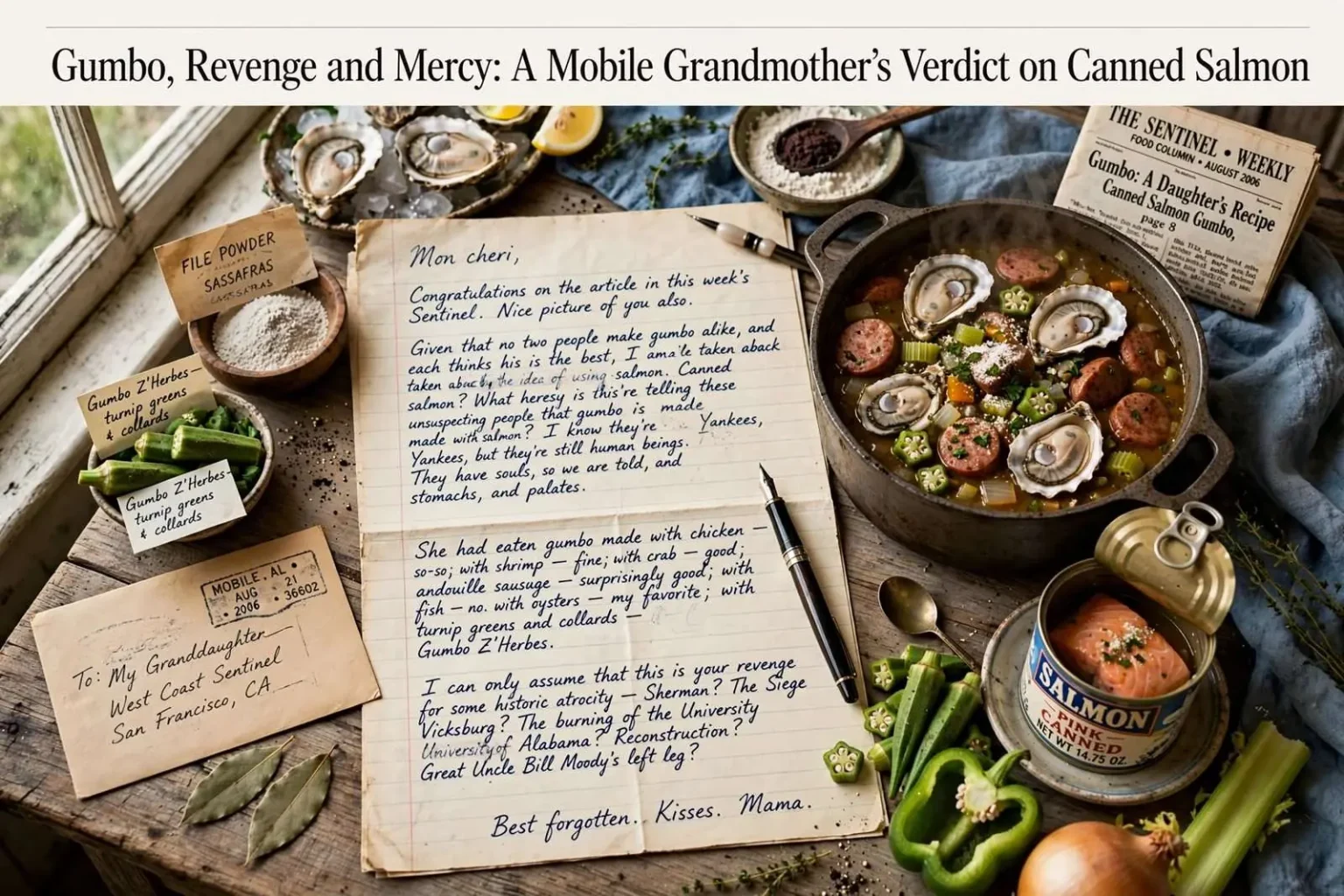
“Mon cheri,” it began, with the affectionate French that survives in Mobile households as a legacy of the city’s colonial founding. “Congratulations on the article in this week’s Sentinel. Nice picture of you also.”
The pleasantries did not last.
“Given that no two people make gumbo alike, and each thinks his is the best, I am a little taken aback by the idea of using salmon. Canned salmon? What heresy is this? You’re telling these poor unsuspecting people that gumbo is made with salmon? I know they’re Yankees, but they’re still human beings. They have souls, so we are told, and stomachs, and palates.”
She then laid out her credentials, which is to say her lifetime of eating. She had eaten gumbo made with chicken, which she rated so-so; with shrimp; with crab; with andouille sausage, which she conceded was surprisingly good; with fish, which drew a one-word review; with oysters, which she named her favorite; and with turnip greens and collards, in the form known as Gumbo Z’Herbes.
Canned salmon appeared nowhere on that list, and she drew the obvious conclusion.
“I can only assume that this is your revenge for some historic atrocity,” she wrote, before offering a menu of candidate grievances: Sherman. The Siege of Vicksburg. The burning of the University of Alabama. Reconstruction. Great Uncle Bill Moody’s left leg.
Then, having delivered the indictment, she granted clemency in four words: “Best forgotten. Kisses. Mama.”
The humor in the letter works because every part of it is real: the French that Mobile’s old families still scatter through their correspondence, the genuine ranking of gumbos that anyone who has eaten at a dozen coastal kitchens carries in their head, and the Civil War grievances — Sherman’s march, Vicksburg, the 1865 burning of the campus at Tuscaloosa — recited not as history but as a comedian’s list of plausible motives. Only a family with a Great Uncle whose left leg carried a story could deploy that detail so casually.
Why Gumbo Provokes This
The grandmother’s opening concession, that no two people make gumbo alike and each thinks his is the best, is the whole truth of the dish and the reason it generates such heat. Gumbo is not a recipe so much as a framework: a roux, a stock, the trinity of onion, bell pepper and celery, a thickener of okra or file, and whatever the water and the season provided.
That flexibility is precisely why the boundaries are policed so carefully. If the dish can hold chicken, sausage, shrimp, crab, oysters and even a pot of greens in Lent, then the question of what it cannot hold becomes a matter of identity rather than technique. Canned salmon is not from here. That, in the end, was the charge.
The roux is where every family’s signature begins — flour browned in oil to a color each household names differently, from peanut to mahogany, with the cook standing guard because a moment’s inattention burns it and starts the pot over. From there the variations multiply: the color of the roux, the darkness of the stock, whether okra goes in the pot or file powder goes in the bowl, whether the seafood goes in early or at the very end. Two cooks can follow the same written recipe and produce different gumbos, which is why coastal cooks argue from their pots rather than their cards.
The dish arrived in south Alabama through multiple channels at once. Creole cooking came up from New Orleans through the bayou country, French and Spanish colonial kitchens left their mark in Mobile itself, and the Gulf’s own harvests — shrimp, crab, oysters, whatever the boats landed — supplied the main ingredients. Each community that adopted gumbo bent it toward its own table, and the result is a dish with no single authority, only strong opinions.
A Mobile Document
The letter is also a small piece of local cultural history. The French endearments, the casual command of Gumbo Z’Herbes, the ready inventory of Civil War grievances deployed entirely for comic effect, and the family lore compressed into the phrase Great Uncle Bill Moody’s left leg all belong to a particular kind of Gulf Coast household, one where food, faith, family and a long memory sit at the same table.
Gumbo Z’Herbes, the green gumbo of turnip greens, collards and other leafy vegetables, is a dish with its own rituals elsewhere on the Gulf Coast, where it is traditionally associated with Lent and with the Creole kitchens of New Orleans. Its appearance on the grandmother’s list — offered without explanation, as if no one in the family would need one — marks the letter as coming from a kitchen where that tradition still lives.
The French that opens the letter is a Mobile artifact more than a Louisiana one. The city was founded as a French colony decades before New Orleans existed, and fragments of the language survived in its older households long after English took over public life — in endearments, in kitchen vocabulary, in the names of dishes. A grandmother who opens a letter “Mon cheri” without thinking about it is passing along three centuries of the city’s history in two words.
It captures, too, a familiar Southern migration story: the child who moves away, the parent who sends recipes to keep the connection alive, and the grandmother back home who reads the transplanted version of the family dish and recognizes, with horror, what the distance has done to it.
The attorney’s recipe was, in its way, an act of homesickness — a man sharing with a distant newspaper’s readers the food that meant home to him, adapted to what a pantry on the Pacific coast could plausibly hold. Canned salmon was the compromise the geography demanded. His mother’s reply was the reminder that the family’s standards had not moved with her granddaughter.
Food columns have carried exactly this traffic for as long as newspapers have had them: regional dishes explained to distant readers, home cooks writing in, families arguing in print by proxy. The weekly newspaper on the West Coast that published this particular recipe got, without knowing it, a second act that was better than the first.
What the Letter Teaches About Gulf Cooking
Read as criticism, the grandmother’s ratings are a miniature guide to the coastal kitchen. Chicken gumbo — rated so-so — is the everyday pot, the one made when the freezer holds meat but the bay has not given up anything that week. Andouille, the smoked sausage that traveled down from the Cajun country of Louisiana, earns her surprise; her exact words concede it was surprisingly good, the verdict of a Mobile palate granting a Cajun ingredient a hearing. Fish draws a one-word review, the kind of dismissal a coastal cook reserves for a protein that cannot stand up to a dark roux.
And oysters, her favorite, are the local favorite’s favorite — the bivalves that come out of the bay in the cool months, that the oyster houses along the coast serve by the tray, and that turn a gumbo into something worth a special trip. In a letter otherwise full of jokes, that ranking is sincere, and it tells the reader exactly which pot this grandmother would make if she were cooking for someone she loved.
The greens gumbo holds its own place in the ranking by tradition rather than taste: Gumbo Z’Herbes is food for a season of discipline, a meatless pot for Lenten tables, and its presence on her list says the household kept the old calendar. A dish made of garden greens sounds like the tamest entry until one remembers that it carries as much family argument over proportions as any seafood pot.
The Verdict
She could have simply been offended. Instead she wrote a letter that convicted her son of heresy, offered him a choice of historical motives, and then pardoned him with a kiss. That combination, absolute conviction about the correct way to make gumbo, paired with an equally absolute refusal to let it damage a family, may be the most Mobile thing about the entire episode.
The recipe, presumably, ran anyway. Somewhere on the West Coast, unsuspecting readers made gumbo with canned salmon. And in Mobile, mercy was extended.
The episode has outlived the summer it happened in because it compresses the whole culture of the Gulf Coast table into one page: the French of the founding, the harvest of the water, the memory of the war, the humor that keeps conviction from becoming cruelty, and the kiss at the end. Families from Bayou La Batre to Bon Secour could each produce their own version of the letter by nightfall, which is the surest sign that the grandmother spoke for more than one kitchen.
And the standing question — what belongs in gumbo — remains open on the coast as it has always been, settled nowhere, argued everywhere, and enforced nowhere more fiercely than at the tables where the dish means family. The only settled point, apparently, is canned salmon: not from here, never from here, whatever a magazine on the far side of the country may print.