Gulf Shores to Host ‘Hands Across the Sand’ Anti-Drilling Rally
A nationwide demonstration against offshore drilling was set to reach Gulf Shores, where participants planned to gather on the public beach to oppose drilling and call for clean energy in the shadow of the Gulf oil spill.
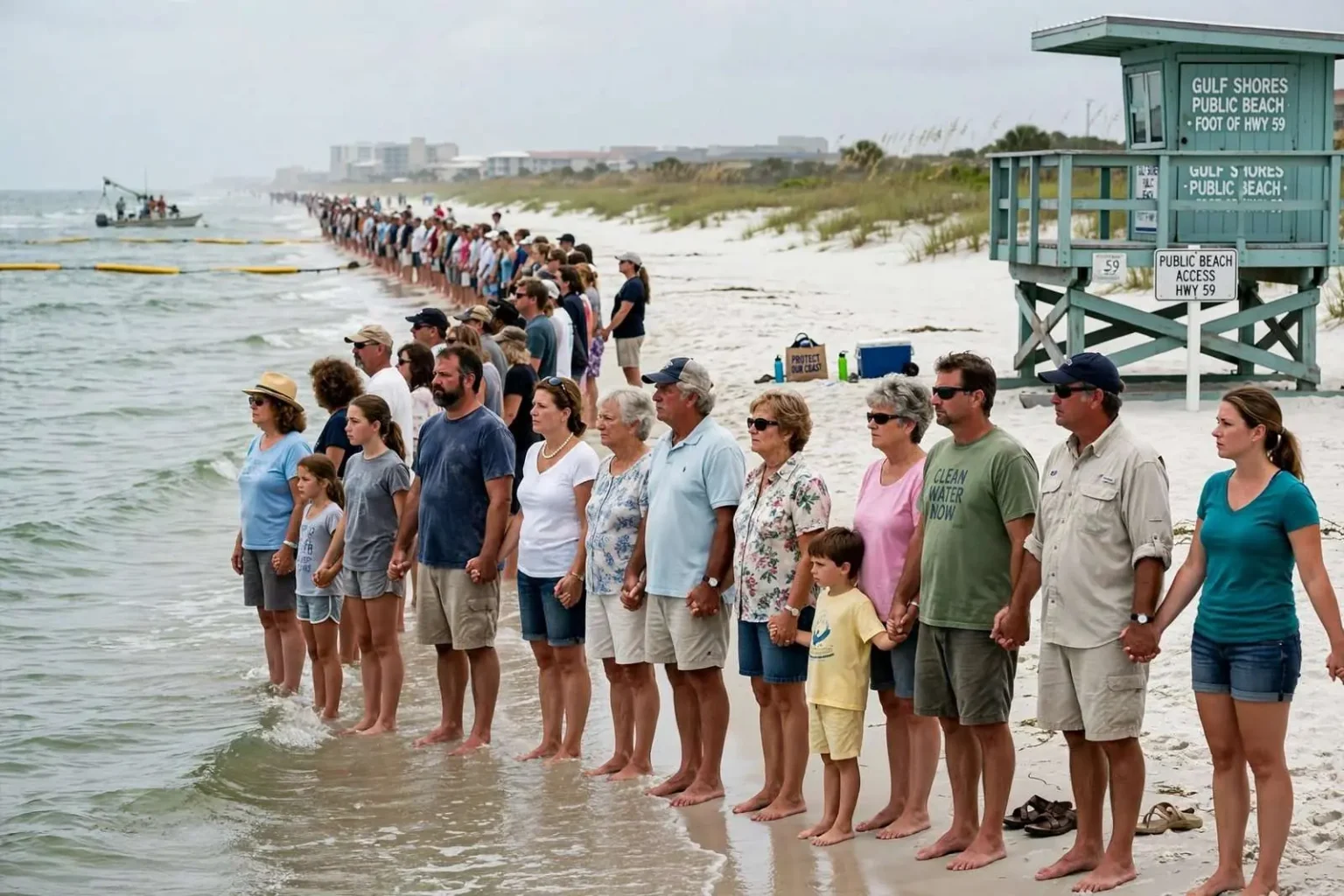
A national wave of protest against offshore drilling was set to wash up on the Alabama coast, with a “Hands Across the Sand” demonstration planned for the Gulf Shores Public Beach as the Gulf oil spill continued to foul the region’s shores. The event was scheduled for Saturday from 11 a.m. to 1 p.m. on the Gulf Shores Public Beach at the foot of Highway 59, one of the most recognizable stretches of shoreline on the Alabama Gulf Coast. Organizers billed it as part of a nationwide effort to oppose offshore drilling and to promote clean energy, with participants across the country planning to join hands along their beaches at the same time.
The gathering arrived at a moment when the Alabama coast had become synonymous with the consequences of offshore drilling. The Deepwater Horizon disaster, which began in April, had sent oil drifting toward the Gulf Coast for months, and Baldwin County’s beaches — long advertised with images of sugar-white sand and emerald water — were instead appearing in national coverage behind cleanup crews and containment boom. Against that backdrop, a symbolic act of standing hand in hand at the water’s edge carried a weight it might not have held in an ordinary summer.
The Symbolism of a Human Chain
The symbolism was simple and pointed: lines of people, hand in hand at the water’s edge, forming a human barrier between the sand and the sea to dramatize their opposition to drilling and their determination to protect coastal waters. Participants were not asked to carry signs or chant slogans. The image itself was the message — ordinary residents, visitors, families and business owners physically linking themselves to the shoreline they hoped to defend.
That format was a deliberate part of the movement’s design. Hands Across the Sand had taken shape earlier in the year along Florida’s Gulf Coast before spreading to beaches across the country, and its founders emphasized an event that anyone could join without special equipment, training or political affiliation. In Gulf Shores, that accessibility mattered. The city’s population swells dramatically in summer with visitors from across the Southeast, and an event on the public beach at the foot of Highway 59 — the corridor that funnels travelers straight from Interstate 65 to the water — placed the demonstration directly in the path of the tourists who anchor the local economy.
Organizers scheduled the Gulf Shores gathering for a two-hour window around midday, the hours when beach traffic is heaviest and the crowds thickest. Coordinated timing was central to the concept: participants on the Gulf Shores Public Beach would be joining hands at the same moment as demonstrators on beaches from the Florida Panhandle to the Atlantic seaboard and beyond, creating a chain of images that organizers hoped would register with policymakers and the public alike.
The Message from Organizers
Organizers framed the demonstration as a stand for coastal communities rather than a partisan exercise. “No one industry should be able to put an entire coastal economy, marine and coastal environment at risk,” the Hands Across the Sand campaign stated. “It is not about politics; it is about the protection of our oceans, gulfs and seas. This is the coastal legacy that we must leave our children and grandchildren.”
That framing reflected the makeup of the communities the movement hoped to reach. Coastal Alabama’s economy is built on a foundation of tourism, commercial and recreational fishing, and real estate — industries that all depend on the same essentials — clean water and healthy beaches. The campaign’s argument was that the debate over drilling was not an abstract clash between energy production and environmentalism, but a question of whether the economic engine of places like Gulf Shores, Orange Beach and the rest of Baldwin County could survive the risks that come with it.
The language about legacy — about what is left for children and grandchildren — resonated in a city where many families have lived and worked on the water for generations. Fishing charters operating out of nearby marinas, condominium managers along West Beach, restaurant owners along the Beach Express and Highway 59, and shopkeepers in the town’s tourist districts all had a direct stake in how the summer’s events would shape the coast’s reputation for years to come.
Why the Appeal Carried Weight in Gulf Shores
That appeal carried particular weight in Gulf Shores. The Deepwater Horizon disaster in the Gulf of Mexico had already begun to damage the beaches, waters and tourism economy that defined the city and the surrounding Baldwin County coast. For residents who depended on clean sand and healthy water for their livelihoods, the spill had turned an abstract national debate over energy policy into an immediate local ordeal.
The stakes were visible everywhere. Booking agents fielded cancellations from vacationers unsure of what they would find when they arrived. Charter fishermen watched portions of state and federal waters close to fishing. Towns along the coast braced for the kind of economic ripple that follows when the nation’s television screens show oil washing onto the very beaches a destination advertises. In Gulf Shores, where the visitor economy supports jobs in lodging, food service, retail and recreation across the city, even the perception of contaminated water could translate directly into lost income.
City officials had spent the spring and summer coordinating with county, state and federal agencies on response plans, staging boom and equipment, and communicating constantly with residents about what was being done to protect the shoreline. The demonstration offered residents something different from those official channels: a public, visible expression of what the crisis felt like on the ground, delivered from the sand rather than a briefing room.
A Coast in the Spotlight
Throughout the summer, the Alabama Gulf Coast had become a focal point for the national reckoning over offshore drilling. Beaches that ordinarily drew families and vacationers were instead drawing cleanup crews, boom lines and reporters. Demonstrations like Hands Across the Sand gave residents and visitors a way to register their alarm and to press for policies they believed would prevent another such catastrophe.
The gathering placed the city alongside communities up and down the nation’s coastlines in a coordinated show of concern. From the Gulf of Mexico to the Atlantic and Pacific coasts, participants joined hands at the same hour, producing a synchronized display that organizers said was designed to show the breadth of opposition to new offshore drilling and the breadth of support for investment in cleaner forms of energy. Gulf Shores, whose name had become shorthand in national coverage for the spill’s impact on tourism towns, was a natural venue for the Alabama portion of that effort.
For Baldwin County as a whole, the summer of 2010 became a defining chapter. The county’s coastal communities — Gulf Shores, Orange Beach and Dauphin Island among them — each dealt with the spill’s effects in ways that varied with tides, winds and currents, but all shared the same underlying anxiety about the future. The demonstration on the Gulf Shores Public Beach gave that shared anxiety a common outlet.
More Than a Moment of Protest
Whether or not it changed any policy, the event offered a moment for people to stand together on the beach they were fighting to protect, at a time when the future of that beach felt uncertain. Participants ranged from lifelong residents to first-time visitors, and many described the simple act of linking hands with strangers as a way of transforming private worry into shared resolve.
The event also underscored the relationship between the coast’s environment and its identity. Gulf Shores had built its brand on family beaches, fishing tournaments, music festivals and outdoor recreation — all of which presuppose clean water. The demonstration’s message was that protecting that environment was not opposition to the Gulf’s working economy but a defense of it, a distinction organizers returned to again and again.
Organizers invited the public to take part, asking only that participants come to the public beach at the appointed hour and add their hands to the line. For a coast weary of watching oil approach its shores, the demonstration was a chance to face the water not in resignation but in protest — and, in the view of those who organized it, a first step toward a longer conversation about how the Gulf’s waters are used and protected in the years ahead.
The two-hour window on the public beach also reflected the practical rhythms of a resort town. Midday is when families break from the water for shade and lunch, when shop owners can step out for a moment, and when visitors wandering the boardwalk and sand near the foot of Highway 59 are most likely to stop, ask questions and join in. Organizers counted on that passing foot traffic as much as on committed participants, believing that every additional pair of hands strengthened both the image and the argument.