
Health Officials Urge Precautions as Mardi Gras Crowds Meet Peak Flu Season in Mobile
Mobile County health officials share precautions as Mardi Gras crowds meet peak flu season and a Hepatitis A outbreak along the Gulf Coast.
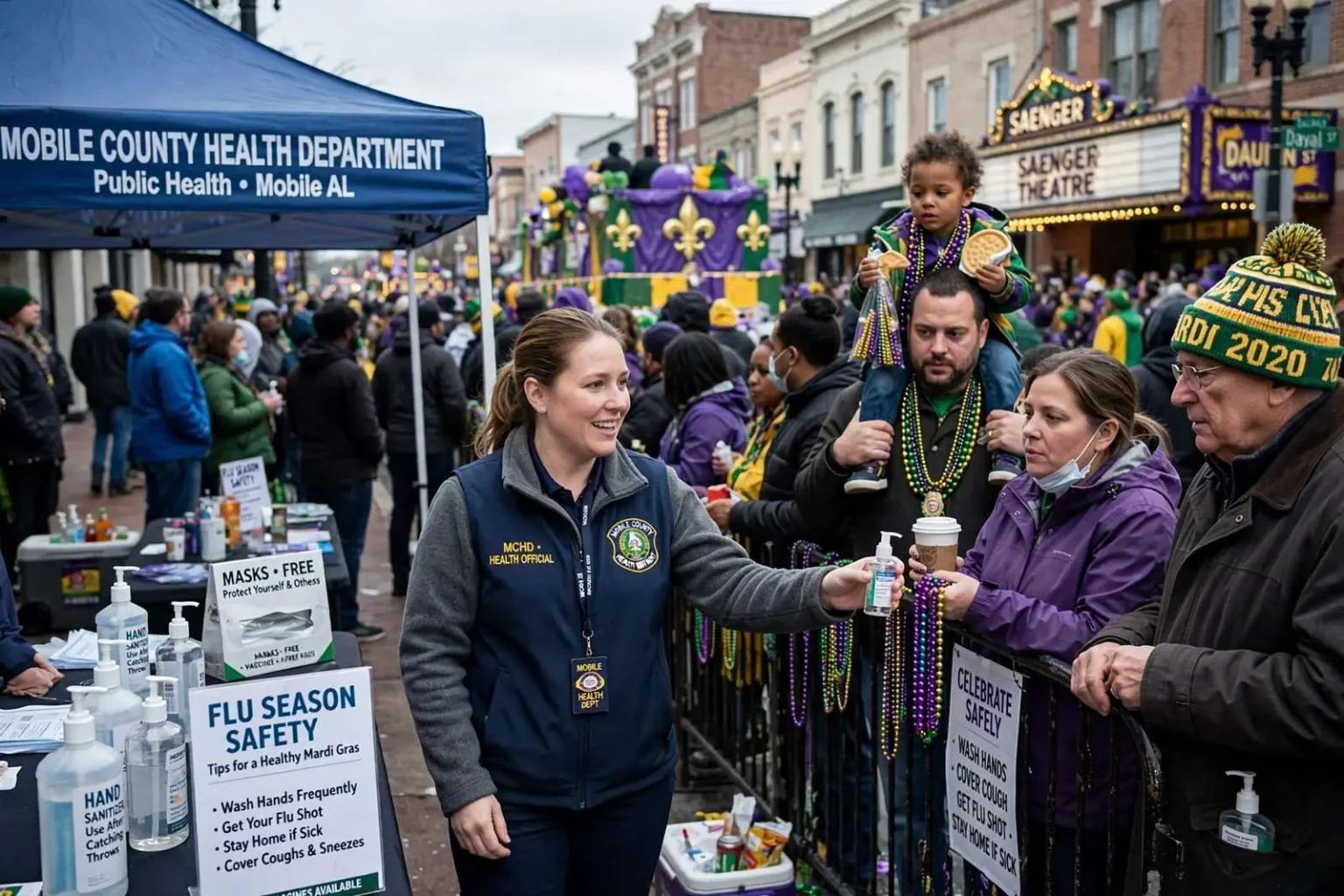
MOBILE, Ala. — Mardi Gras season and flu season collide in Mobile every February, and health officials want revelers to enjoy the parades without bringing home an illness. With more than a dozen parades scheduled across the Gulf Coast in a single weekend, the Mobile County Health Department is reminding the public that big crowds make it easier for germs to spread — from the beads being passed hand to hand to the barricades everyone leans on.
Mobile’s carnival season is the oldest in the United States, predating New Orleans’s celebrations by more than a century and a half, and it has grown into a weeks-long calendar of parades, balls and gatherings that draws spectators from across the region. That scale is the city’s signature celebration — and, from a public health standpoint, it is one of the largest recurring mass-gathering events on the Gulf Coast each year, arriving precisely when influenza activity across the Southeast typically peaks.
Elevated flu activity meets peak carnival season
The department reported elevated flu activity across the Mobile area at the height of the 2020 carnival season, compounding concerns already raised by a Hepatitis A outbreak in the region. The timing meant the two public health concerns overlapped with the heaviest stretch of the parade calendar, when downtown sidewalks are packed shoulder to shoulder and families camp out for hours along the routes.
Influenza spreads primarily through respiratory droplets, and mass gatherings supply the conditions it needs: prolonged close contact, shared surfaces and crowds drawn from across a multi-state region. Health departments across the country track the same collision of calendars every winter — Mardi Gras in Mobile, the Super Bowl, big conferences — and use the moments to remind the public that celebrations and precautions are not opposites.
Why parade crowds spread illness
The mechanics of a parade night are tailor-made for transmission. Beads and moon pies are passed from floats by the thousands, moving hand to hand through the crowd; barricades collect the touch of everyone leaning on them; and families share blankets, snacks and space for hours at a stretch. None of that stops the fun — but it all adds up to exactly the kind of contact network that lets a respiratory virus move through a crowd in a single evening.
Hand-to-hand celebrations also create secondary exposure back home: beads carried in a child’s hands end up in a toddler’s mouth, and a commuter who rode a packed parade shuttle brings whatever was circulating in that crowd to an office the next morning. Health officials describe the pattern as predictable, which is why the reminders come before the season’s peak rather than after it.
The Hepatitis A outbreak circulating in the region at the time added a second layer of concern. Hepatitis A is a liver infection spread through the fecal-oral route — most often through close personal contact or contaminated food and drink — and outbreaks of the disease had been moving through populations across the Southeast for years. Unlike influenza, which spreads through the air, Hepatitis A underscores the same practical advice from a different direction: hand hygiene protects against both, which is why health departments bundled their messaging rather than issuing separate warnings.
Vaccination, health officials note, remains the most effective protection against Hepatitis A, and the vaccine is widely available through healthcare providers and the health department itself. For influenza, annual vaccination is recommended for everyone six months and older, with the season in Alabama typically stretching from fall into spring — a window that fully contains the carnival calendar.
The health department’s standing advice
Officials stressed there is no reason to stay away from the festivities, but urged parade-goers to take simple precautions — such as regular hand washing and avoiding close contact with people who are visibly sick — to protect themselves and their families from viruses while celebrating. The guidance reflects the health department’s long-standing approach to mass gatherings: the goal is risk reduction, not cancellation, and the most effective steps are the ones individuals can take without changing their plans.
Those steps translate to carnival season in practical terms. Wash or sanitize hands after handling throws and before eating; keep young children’s hands clean after they collect beads; carry hand sanitizer in the parade bag alongside the snacks; stay home from the route when sick; and make sure the family’s flu vaccinations are current before the season’s busiest weekends. None of it diminishes the experience, officials note — it just keeps the memories from including a week of fever afterward.
A season unlike any other
Mobile’s celebration is a months-long enterprise that sustains float designers, seamstresses, band directors and the small businesses of downtown through the winter. The parades themselves — from the family-friendly early-season processions to the signature mystic societies that close the season — operate on schedules set months in advance, and the crowds they draw are a cornerstone of the local winter economy. Restaurants, hotels and parking operators across downtown plan their year around the season’s peaks.
That economic weight is one reason health officials frame their advice as empowerment rather than restriction: a healthy crowd is the crowd that keeps coming back. The department’s message during the 2020 season carried no suggestion of staying away — only the standing advice that has accompanied mass celebrations for generations, updated for an outbreak environment that made it more relevant than usual.
The collision of Mardi Gras and flu season will arrive again next February, as it does every year, and the Mobile County Health Department’s advice will sound much the same: celebrate the season that belongs to Mobile, wash your hands, look after your neighbors — and let the only thing anyone brings home from the parade route be the beads.
Simple precautions for parade nights
The department’s guidance for the season distills to habits that fit easily into a parade night. Bring hand sanitizer and use it after catching throws, before eating and after touching shared surfaces. Keep beverages covered and avoid sharing food. Carry tissues or cover coughs with a sleeve. And if a family member is visibly sick — feverish, coughing, visibly unwell — keep the distance that protects both them and everyone around them, even if that means watching from the edge of the crowd rather than the middle of it.
Parents of young children face the season’s particular challenge: beads, moon pies and stuffed animals are handed to children by strangers on floats and fellow spectators alike, and those treasures go straight to little hands and mouths. The advice for families is straightforward — sanitize the haul and the hands, and treat the parade bag as something that touches the sidewalk and nothing else. These are small routines, but they interrupt the transmission chain at exactly the points where crowds and children meet.
Hepatitis A in the region
The Hepatitis A outbreak that concerned health officials during the season was part of a broader pattern that public health agencies across the Southeast had tracked for years, concentrated among populations with limited access to hygiene and vaccination but capable of reaching the general public through food service and close contact. The response across affected states combined vaccination campaigns with the same basic message the Mobile County Health Department delivered during carnival season: hand washing is the single most effective barrier available to the public.
For parade-goers, the practical overlap with influenza season is what made the department’s combined guidance efficient. The precautions that limit flu transmission — clean hands, distance from the visibly sick, staying home when ill — also limit the fecal-oral transmission route that spreads Hepatitis A. One set of habits, applied across a season of crowded celebrations, addressed both threats at once.
The Mobile County Health Department, one of Alabama’s oldest county health agencies, delivers that guidance year-round through its clinics, outreach teams and public communications. Its role during carnival season extends beyond messaging: department staff monitor disease reports across the county during the peak weeks, watching for the upticks in influenza-like illness and other reportable conditions that a mass-gathering season can produce. The data the department collects feeds state surveillance and helps clinicians across the area know what is circulating.
That surveillance matters because the season’s crowds come from everywhere. Mardi Gras in Mobile draws visitors from across Alabama, the Florida Panhandle and Mississippi — and sends them home the same way — meaning an illness circulating on Royal Street on a Saturday night can surface in clinics three states away by the following week. Regional health departments coordinate their seasonal messaging for precisely that reason, aware that their populations share parade routes, highways and waiting rooms.
The takeaway for revelers
The department’s bottom line for the season is a reassurance as much as a warning: there is no reason to stay away from the festivities. Mobile’s carnival belongs to everyone who lines the routes, and the precautions that health officials recommend are the kind that fade into the evening — a bottle of sanitizer in a coat pocket, a little distance from the person coughing behind you, hands washed before the moon pies become a late supper.
What officials ask is that the season’s joy not become a household’s February illness. The parades will return next year, as they have for three centuries; the flu season will return with them. The Mobile County Health Department’s advice meets them both at the barricades: celebrate long, celebrate well, and wash your hands — so that the only thing the crowds carry away from downtown on a parade night is what they came for.


