

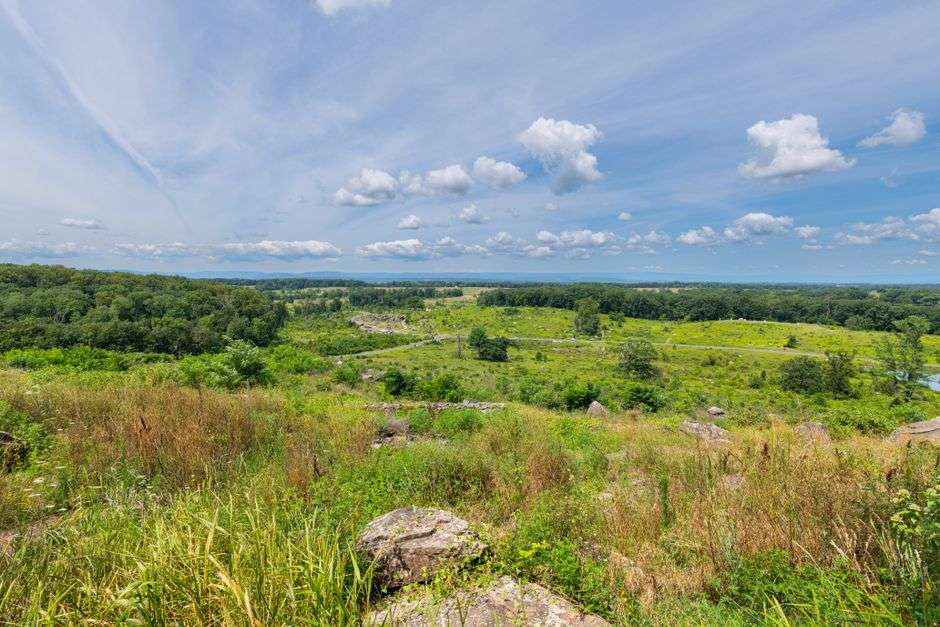
On a bluff above the Tensaw River, a few miles north of Spanish Fort, sits the site of one of Alabama’s most remarkable double lives. Two centuries ago, Blakeley was a boomtown river port that rivaled Mobile itself before yellow fever and economics emptied it out. Today, 2,000-plus acres of that vanished city form Historic Blakeley State Park — Alabama’s largest Civil War battlefield, a network of Delta waterways, and, under Director Mike Bunn, one of the Gulf Coast’s busiest cultural destinations, drawing more than 50,000 visitors a year.
The Historian Who Runs the Park
Bunn has led the park since 2017, but his path there ran through the region’s history institutions. A history buff since childhood — raised on his grandmothers’ stories — he earned two master’s degrees from the University of Alabama, one in history and one in higher education administration, then spent four years with the Mississippi Department of Archives and History developing programming and curating exhibits. He was recruited home to Columbus, Georgia as Curator of History at the Columbus Museum, and after seven years became Director of the Historic Chattahoochee Commission in Eufaula, Alabama, one of the country’s only bi-state commissions at the time.
He arrived at Blakeley in 2015, recruited by the retiring director, and took the top job two years later. His formal title undersells the job: he is equal parts historian, fundraiser, trail-builder, and boat-tour dispatcher. “I recognized that this was a facility with amazing potential, and if we applied ourselves with a plan, we could transform Blakeley Park into a top-notch attraction and educational resource,” he says.
His own origin story explains the obsession. His grandmothers fostered his interest; he wanted to hear their stories, and he realized that events like the Great Depression, World War II, and even the Civil War sat within a couple of generations of living memory. Tintype photographs on a grandmother’s wall dated to the mid-1800s; an uncle he never met vanished in the 1950s when a Navy plane he was aboard disappeared without a trace — his grandmother woke that morning from a dream of a coffin on her front porch, and the Navy arrived that morning to confirm her son was missing. “That story really made me realize how individual stories impact people over the years,” Bunn says. “The past is essentially a collection of stories of individual experience, and each matters to someone.”
A Park Unlike the State’s Others
Blakeley is not part of the Alabama Department of Conservation and Natural Resources system. It is an independent state agency — a peer, institutionally, of the USS Alabama Battleship Memorial Park — which meant it never had to close during the pandemic. Its 2020, in fact, was a record year.
The ground itself is the headline exhibit. The park preserves the largest Civil War battlefield in Alabama, where the Battle of Fort Blakeley ended on April 9, 1865 — the same afternoon Robert E. Lee surrendered at Appomattox — and effectively sealed the campaign to capture Mobile, which surrendered three days later, the last major Southern city to fall. Blakeley also holds a designated USCT Heritage Trail honoring the United States Colored Troops; more African American soldiers were positioned on this field than at almost any other Civil War battlefield.
Before the war, there was the town. Founded in 1814, Blakeley grew into a serious rival to Mobile as a port, then faded as disease and commerce moved elsewhere — leaving behind one of the South’s most intact ghost towns, now mowed paths and street names threading through woods.
Boats, Trails, and a Full Calendar
Under Bunn the park’s offering has expanded far beyond battlefield walking. The operation runs more than 30 different guided boat tours a year — on the Mobile-Tensaw Delta, Mobile Bay, and the Mobile River — departing from the Blakeley dock, Five Rivers Delta Center, Cooper Riverside Park, and Live Oak Landing in Stockton. Many sell out. There are birding cruises and animal ambassador cruises, trips to Middle Bay Lighthouse, tours to the Bottle Creek Indian Mounds with historian and author John Sledge, a lunch cruise to the Bluegill on the Causeway, and a dinner cruise that docks at the Original Oyster House. Private charters run up to 49 passengers.
On land, the park maintains some 30 miles of hiking, biking, and horseback riding trails, including the mountain-bike network volunteers call “the Cannonball Run.” Four cabins stay booked months ahead. The park has become a destination for low-cost weddings. Auburn University brings a raptor program, Alabama Author Day draws writers and readers, and one Friday a month in spring and fall a music series with food trucks takes over the evening.
The park also stages the region’s most popular Civil War reenactment every other year, plus annual living-history events depicting soldiers’ lives, muskets and cannons included. Self-guided options — including cell phone tours with short video clips — let visitors move at their own pace.
What Comes Next
Bunn describes the current state as “just getting started.” Plans call for an interpretive center on site with a museum, educational space, and staff offices. Most of the operating cost is self-generated through park fees, memberships, and public and private grants — a funding model Bunn defends as an investment in the community.
The balancing act is environmental. The park sits in one of the most ecologically significant landscapes on the Gulf Coast, and expansion plans — more lodging, more campsites — come with an explicit promise to preserve and protect what makes the place rare. “We are a special historic site and unique natural habitat providing outstanding recreational opportunities,” he says. “We don’t take that for granted.”
For Bunn, who lives in Daphne with his family, the region is both home and subject matter. “It’s home. It’s growing and it’s a great place to raise kids. For me, as a historian, I find this area particularly fascinating. It has a rich cultural heritage that is rare.”
Historic Blakeley State Park is open year-round, with schedules, tour bookings, and memberships available through the park’s website and social media.
Four Centuries Piled Into One Place
Part of what makes Blakeley unusual is how much history stacks onto a single landscape. The site holds evidence of Native American settlement centuries before Europeans arrived; the colonial-era rivalry between French Mobile and British and Spanish control of the coast; the boomtown port of the 1810s and 1820s, when Blakeley competed head-to-head with Mobile for river trade; the Civil War campaign that decided the city’s fate; and the 19th- and 20th-century farm and timber eras that followed.
The layering continues to make news. In September 2026, the Daughters of the American Revolution dedicated a Revolutionary War Patriots marker at the park, formally recognizing that the story told on the grounds stretches back to the founding era itself — a reminder that “four centuries of history overlap” is not a marketing line but a literal description of the acreage.
The DAR dedication fits the park’s broader role as a keeper of stories that would otherwise dissolve. Bunn’s own family story — the tintypes, the vanished uncle, the grandmother’s dream — is the template he applies to the park: history as a collection of individual experiences, each of which mattered to someone, each of which can be recovered and told.
Why It Works: Programming Over Preservation Alone
Lots of historic sites preserve ground. Fewer than a handful in Alabama turn it into a year-round production calendar. The difference at Blakeley is deliberate: when Bunn arrived, the park was relatively undeveloped as an educational and recreational facility, and he set out to reinvent every aspect of the operation — more programming, better visitor experiences, a push to become a genuine educational resource, and a staff hired for a shared vision.
The numbers track the strategy. Annual visitation has doubled to more than 50,000, a rise Bunn credits to the expanded tour lineup and the work of the staff. Memberships — family and corporate — underwrite facilities and programs. Lectures and naturalist-led walks fill the shoulder seasons. The park’s marketing runs through its website, Instagram, Facebook, and Twitter/X, and regulars plan around the calendar the way they would around a small performing-arts season.
The lesson the park offers the region’s other attractions is practical. A ghost town, a battlefield, and a river delta are assets — but assets only earn their keep when someone schedules something on them every week. Blakeley’s bet, a decade into it, is that history plus habitat plus a boat dock equals a destination. Fifty thousand annual visitors and a waitlist for cabins suggest the bet is being won.