

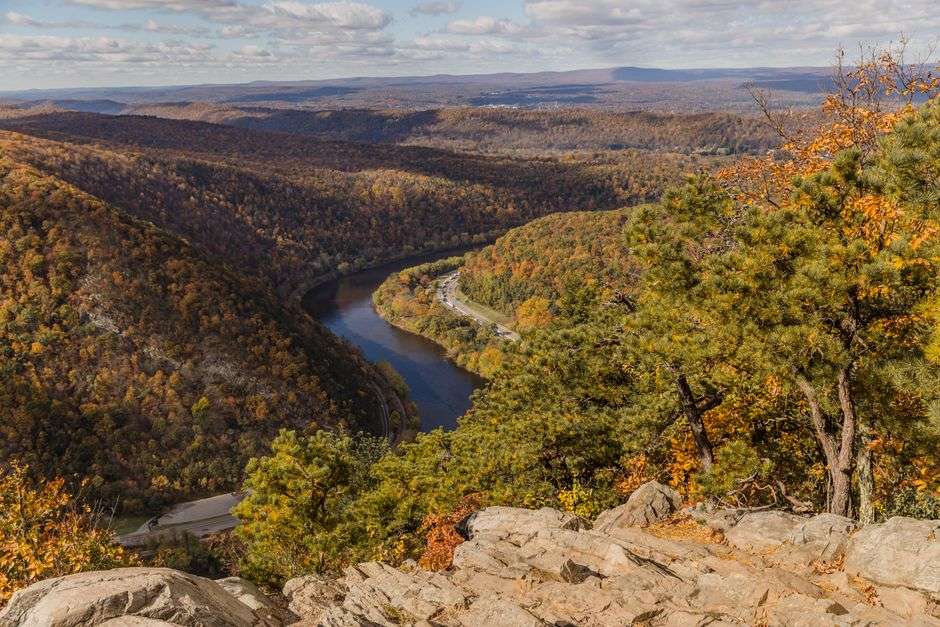
When an Alabama August turns the coast into a sauna, the state’s oldest escape is at its other end: Cheaha State Park, home to the highest point in Alabama at 2,407 feet above sea level. Tucked against the Talladega National Forest about four and a half hours north of Baldwin County, the park runs ten to fifteen degrees cooler than the Gulf Coast in late summer — and trades humidity for mountain air.
Alabama’s oldest park
Cheaha opened to the public in 1933, making it Alabama’s oldest continuously operating state park. Much of what visitors see today — the stone cabins, the lodge, the original trails — was built by the Civilian Conservation Corps, the Depression-era works program that put young men to building parks across the country. The cabins, constructed in 1930, were quarried from local Cheaha Quartzite and furnished with hand-hewn wooden furniture; they look old because they are, and they remain among the most requested overnight stays in the state park system.
The name Cheaha comes from a Creek-Muskogean word meaning “high place,” a fitting description for a summit that offers panoramic views across the surrounding forest. The park straddles Clay and Cleburne counties, a few miles northwest of the town of Delta.
Trails, lakes, and waterfalls
The park maintains more than a dozen hiking trails, several ending in waterfalls, ranging from easy strolls to strenuous climbs. The most accessible of the signature routes is Bald Rock, a boardwalk trail near the group lodge that is wheelchair accessible and ends at a spectacular overlook; hikers who want more mileage can take the parallel dirt trail. Anglers can fish Cheaha Lake for bass, catfish, bream, and crappie with a freshwater license, and a swimming area sits on the lake’s beach. A swimming pool adjacent to the park motel offers a second option on hot afternoons.
Rainy days have their own itinerary. The lake property includes an interpretive center covering the park’s flora and fauna, while two museums preserve deeper history: the CCC Museum, with artifacts and photographs of the Civilian Conservation Corps crews who built the park, and the Native American Relic Museum, displaying arrowheads, pottery shards, and tools from the Creek-Muskogean era found within the park.
Where to stay
Lodging ranges from the historic stone cabins — one-bedroom cottages up to A-frame chalets, all equipped with kitchenware, gas logs, and televisions — to the Cheaha Lodge, which sleeps 32 and suits family reunions or destination weddings, with a dining hall that seats roughly 100. Several cabins are pet-friendly for a modest nightly fee, with the usual leash rules in effect. A new hotel has been under construction at the park, planned with a rooftop bar and bistro. The Mountain Store near the summit stocks gifts, picnic supplies, and fishing bait.
For dinner and groceries, the gateway towns of Delta, Lineville, and Oxford offer options along the drive, but most visitors plan to cook — the cabins are set up for it, and the nearest full grocery run is worth making before the climb up State Road 9, a two-lane roller coaster that is half the adventure.
Planning the trip
Fall is the park’s high season. Leaf season peaks roughly from mid-September through October, when the surrounding Talladega National Forest turns gold and crimson, and park staff report that visitors book accommodations for peak weekends as much as a year in advance. Summer remains the value season: cooler temperatures than the coast, fewer crowds midweek, and all the trails open.
The park is managed by the Alabama Department of Conservation and Natural Resources, and reservations run through alapark.com. Day visitors can drive to Bunker Tower at the summit for the view without lacing up hiking boots.
For Gulf Coast residents wilted by September humidity, the math is simple: a half-day’s drive buys a dozen degrees and a horizon of ridgelines. Cheaha has been offering that trade since 1933, and the stone cabins at the top of the mountain are still the best deal in Alabama weather.