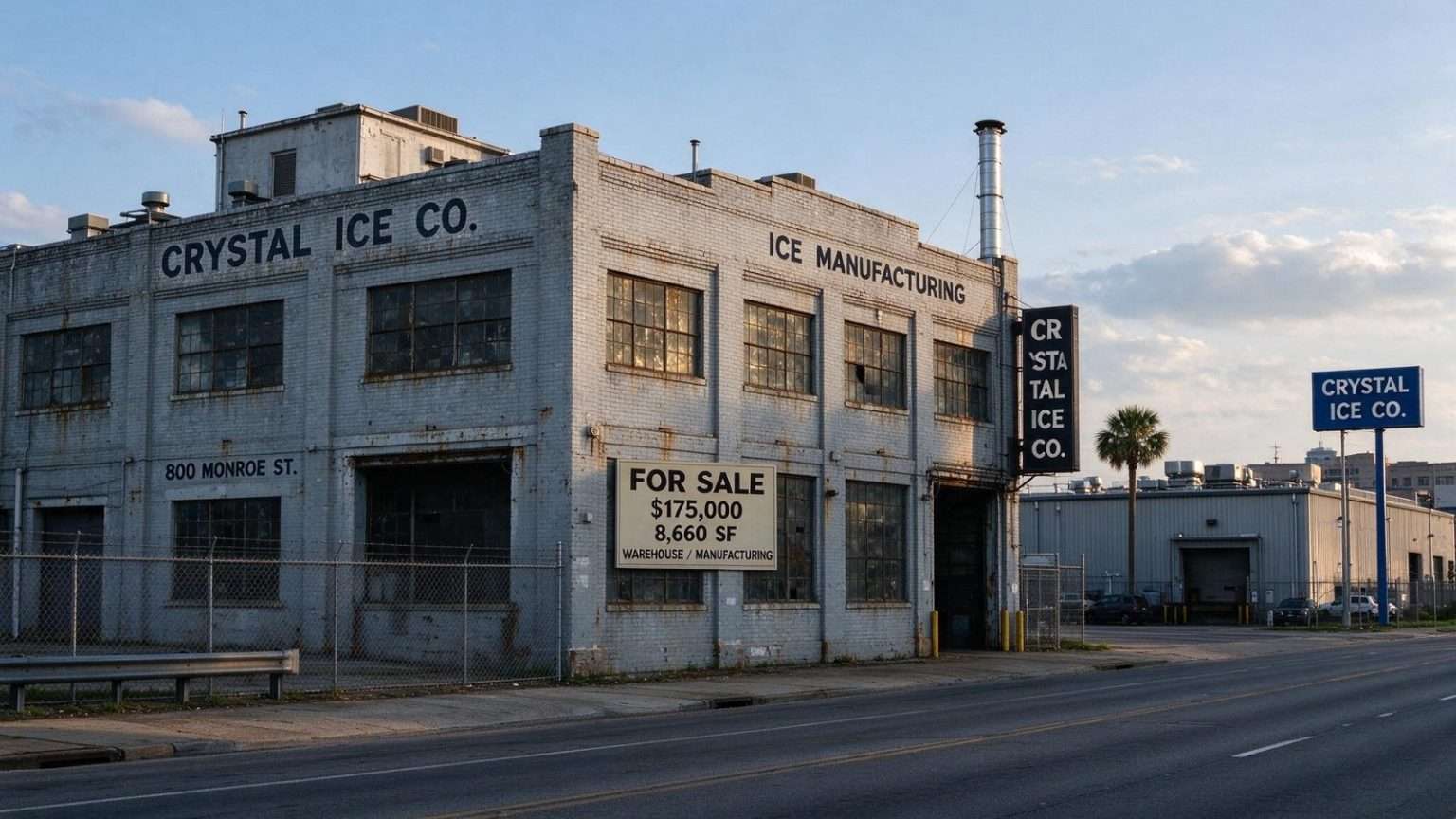
A piece of downtown Mobile’s industrial history is on the market. The 114-year-old Crystal Ice Company building at 800 Monroe St. was recently listed for sale at $175,000, offering a new owner an 8,660-square-foot property that includes both warehouse and manufacturing space in the heart of the city.
The building sits directly across from the newer Crystal Ice Co. plant operated by Mobile’s Quinlivan family, who have run the ice business for multiple generations. The original plant traces back to the turn of the 20th century, a period selling agent John Peebles of NAI Mobile described in vivid historical terms.
“Shortly after American troops embarked in Mobile to battle Spanish colonialists for sinking our battleship in Havana harbor and before we sent the 167th Alabama Army infantry division over to France to fight the Germans in WWI, the Quinlivan family opened this ice house in downtown Mobile,” Peebles said.
As industrial ice-making technology evolved, the Quinlivan family’s third generation began producing ice at a new plant built directly across the street from the original site where the business got its start. The old plant, no longer needed for production, still contains two large wells where massive blocks of ice were once frozen before being run through industrial cutters that produced millions of ice cubes for Mobile-area customers over the decades.
“Mr. Quinlivan believes that it is time for this unique facility to launch a new creative vendor for downtown Mobile’s needs. He’s still pumping out the ice across the street, but we need somebody new and visionary to continue to serve the city,” Peebles said, signaling that the family hopes the historic building will find a new purpose that keeps it active as part of Mobile’s downtown business fabric rather than sitting vacant.
Commercial real estate picking up across Mobile
The listing adds to a broader wave of activity in Mobile-area commercial real estate. At McGowin Park, Pratt Thomas of the Merrill P. Thomas Company represented Z Wireless, an independent Verizon dealer, in leasing 1,800 square feet of retail space. Z Wireless joins big-box tenants including Costco, Field and Stream, Dick’s, Ashley Furniture and Home Goods at the development, with landlord representation handled by Buff Teague of JLL.
Reports indicate construction at McGowin Park has stayed ahead of schedule. The west Mobile retail center has become one of the area’s busiest shopping destinations since opening, drawing national tenants to a corridor along Airport Boulevard that anchors much of the city’s west-side retail economy.
Elsewhere in the region, independent insurance agency Autosurance leased 1,120 square feet of office space at 940 Schillinger Road N. in the Aaron’s Rental Shopping Center, a deal also handled by Pratt Thomas.
Lenny’s Sub Shop, meanwhile, leased the former Los Tacos building in Hillcrest Square Shopping Center at 1175 Hillcrest Road, with plans to relocate from its current location at 257 Azalea Road. Local Lenny’s franchise owners Steven and Chad Brady said they intend to expand aggressively across the central Gulf Coast, where they already operate locations in Pascagoula, Mobile and Baldwin County.
The Brady brothers’ expansion plans reflect a franchise segment that has grown steadily across the Gulf Coast, where fast-casual sub shops compete for a market that stretches from Mobile Bay to the Mississippi line. Moving into Hillcrest Square — a center that serves the fast-growing neighborhoods of west Mobile along Hillcrest Road — puts the brand closer to residential traffic than its current Azalea Road site.
The Civic Center question looms downtown
Downtown, city officials have also been weighing the future of the 51-year-old Mobile Civic Center. Estimates put the cost of demolishing the aging facility at roughly $500,000, a fraction of the approximately $1.8 million a year it reportedly costs to maintain.
That gap in cost helps explain Mayor Sandy Stimpson’s decision to close the underutilized multi-purpose venue, with sources suggesting the city has set a 12-to-18-month window to attract investors before a possible demolition, which could come as early as late 2016 if no redevelopment deal materializes.
Proposed ideas for the site have included a mixed-use residential and retail development similar to the Wharf in Orange Beach, an idea some see as complementary to Mobile’s growing downtown business district and the nearby Airbus plant expected to employ thousands.
“The city is looking for $150 to $200 million dollar expenditure from whoever chooses to invest in repurposing the property. My thoughts are that the better option would be for a massive company — similar to RSA — to take a good, hard look at it,” said Cameron Weavil, vice president of the Weavil Company.
The Civic Center, which opened in the mid-1960s and has hosted everything from concerts and circuses to Mardi Gras balls and graduation ceremonies, sits in the middle of downtown just blocks from the waterfront. Its fate has become a symbol of the broader question facing downtown Mobile: how to convert aging mid-century infrastructure into development that matches the growth the city has seen in aerospace, shipping and port commerce.
Any large-scale redevelopment of the site would rank among the biggest private investments in downtown Mobile in decades, and the city’s 12-to-18-month marketing window gives prospective investors a clear deadline. Civic leaders have pointed to the Airbus final assembly line at Brookley and the continued growth of the Port of Mobile as evidence that the demand exists — if the right project comes along.
The Crystal Ice listing itself fits that downtown story. Buildings like the 800 Monroe St. ice house — early 20th century industrial shells with open interiors, heavy construction and historic character — have become prime candidates for adaptive reuse in cities across the country, whether as restaurants, breweries, artist studios or small manufacturing startups. The two surviving ice wells inside give the property a feature no modern building could replicate.
Monroe Street sits in a corridor of surviving industrial buildings north of Dauphin Street that once served Mobile’s produce, ice and warehouse trade. Preserving those structures in active use has been a recurring theme in downtown planning discussions, and the Quinlivan family’s decision to seek a “new creative vendor” rather than let the building go dark aligns with that goal.
Gulf Coast employers honored on the national stage
In other regional business news, Huntington Ingalls Industries announced that ten employees across its Ingalls and Newport News shipbuilding divisions were honored at the 29th annual Black Engineer of the Year Award STEM Global Competitiveness Conference, held Feb. 7 in Washington, D.C.
Two of the honorees work at Ingalls Shipbuilding in Pascagoula: Derrick Scott, an engineering manager overseeing life-cycle engineering for several classes of Navy vessels who holds a mechanical engineering degree from Auburn University and has worked at Ingalls for 27 years, and Dannon Butts, a quality engineering manager with 13 years at the shipyard who holds both bachelor’s and master’s degrees in industrial engineering from Mississippi State University.
“HII is a proud sponsor of the BEYA Conference because of its extensive support for STEM in schools and in the workplace. We’re proud of our hard-working engineers who lead our company in STEM innovation, so we celebrate and congratulate them on this achievement,” said Bill Ermatinger, HII’s corporate vice president and chief human resources officer.
Ingalls is the largest industrial employer on the Mississippi Gulf Coast and a major presence in the central Gulf Coast economy, building destroyers, amphibious assault ships and National Security Cutters for the U.S. Navy and Coast Guard. Its workforce draws heavily from Mobile, Baldwin County and south Mississippi, making recognition for its engineers a point of pride well beyond Pascagoula.
Taken together, the week’s commercial real estate news sketch a Mobile economy moving on several fronts at once: a historic downtown building seeking reinvention, new retail and restaurant leases in the fast-growing western suburbs, a decision pending on one of downtown’s largest properties, and a regional shipbuilding workforce earning national recognition.
For investors, the common thread is momentum. Retail landlords at McGowin Park and Hillcrest Square are signing tenants ahead of schedule; downtown property owners like the Quinlivans are betting that creative buyers will pay for character and location; and city officials are actively shopping the Civic Center site to anyone willing to commit nine figures to downtown’s future.
The asking price on the Crystal Ice building — $175,000 for 8,660 square feet in the heart of the city — underscores how affordable early-20th-century industrial space remains in Mobile compared with peer cities, a point local brokers frequently raise when courting small manufacturers and makers. Whether the next occupant of the old ice house turns it into a restaurant, a brewery or a workshop, the Quinlivan family’s condition is the same one they have kept for 114 years: the building should keep serving the city.