

Homecoming Harmony: How a Fairhope Violinist Built a Free Chamber Music Festival on Mobile Bay
For most of the year, violinist Sahada Buckley lives the life of a working orchestral musician in the Midwest — performing with the Illinois Symphony Orchestra, teaching a full studio of violin and viola students in Madison, Wisconsin. But every summer, she comes home to Fairhope with a suitcase of sheet music and a mission: three weeks of professional chamber music, performed along the Eastern Shore of Mobile Bay, entirely free of charge.
Buckley, who co-founded the Eastern Shore Chamber Music Festival with her husband, cellist Trace Johnson, has been pursuing that mission since 2022. “I have always dreamed of bringing classical music to Fairhope,” she says. “There are musical events in the area, but one must travel to larger cities to experience live classical music. This is our third year of bringing classical music to my hometown.”
From Bayside Academy to Interlochen
Buckley’s path began early. A daughter of the well-known Chef Jules of Fairhope Chocolate, she attended Bayside Academy, where she first sat down at a piano and picked up a violin. The steps from there were, in her words, “random” — but each one pointed toward music. Three years of high school at the prestigious Interlochen Arts Academy in Michigan sharpened her playing, and joining the Mobile Symphony Youth Orchestra, she says, “opened up a whole new world for me, and I found other musicians who felt the same way I did about music.”
The most important musician she met along the way was Trace Johnson, then a doctoral student in cello performance at the University of Wisconsin. The couple married and made their home base in Madison, where Johnson performs with the Madison Symphony Orchestra and the Wisconsin Chamber Orchestra and teaches cello to students across the area.
Buckley’s own credentials grew quickly. She earned dual bachelor’s degrees in violin performance and music theory from the University of Georgia, winning the school’s 2018 concerto competition and performing as a soloist with the University of Georgia Symphony Orchestra. She completed a master’s degree in violin performance at the University of Wisconsin–Madison, studying with Pro Arte Quartet first violinist David Perry as a member of the graduate Marvin Rabin String Quartet. In September 2024 she was appointed to the first violin section of the Illinois Symphony Orchestra, and in 2025 she joined Madison’s Ancora String Quartet as violist.
Then there is the detail that has little to do with conservatory training: in 2019, Buckley through-hiked the entire Appalachian Trail — with a violin strapped to her backpack.
A Cellist’s Growing Resume
Johnson, a Wisconsin native, has appeared as a chamber musician, soloist, and orchestral musician in the United Kingdom, the Netherlands, Canada, China, and the United States, with past positions including the Madison Symphony Orchestra, Wisconsin Chamber Orchestra, Sarasota Orchestra, Sarasota Opera, and Miami City Ballet. In 2025, PARMA/Albany Records released his debut album, Works for Cello, which featured the premiere recording of Limbic Notes by Pulitzer Prize-winning composer Melinda Wagner. The couple has recorded together as well, including a Schulhoff duo for violin and cello released on CD in July 2025.
What Chamber Music Is — and Why It Fits Fairhope
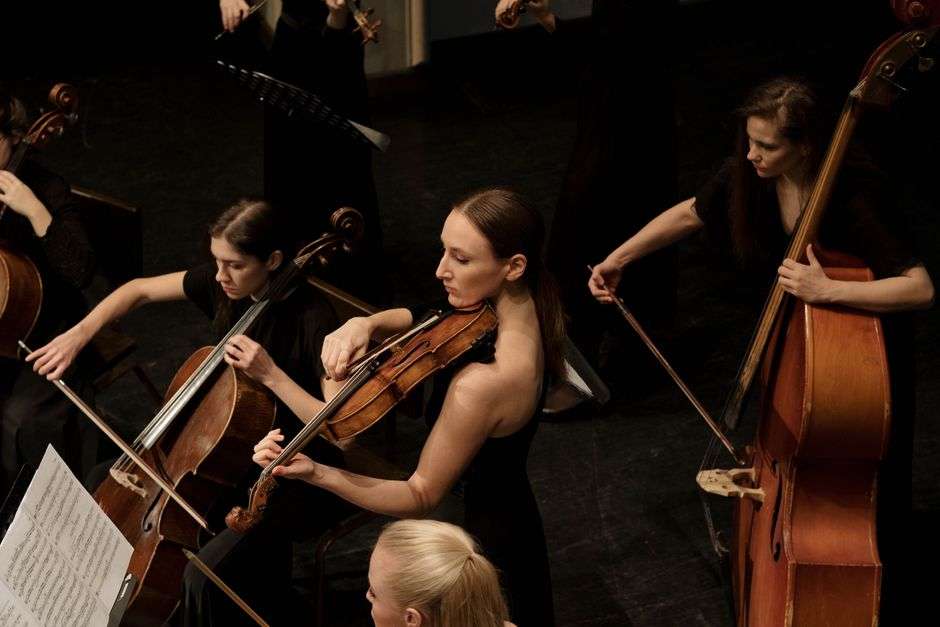
For audiences new to the form, chamber music has a straightforward definition: instrumental music played by a small ensemble, one player to a part, with the string quartet as its most famous example, developed in the 18th century. The name comes from the days when only so many musicians could fit in a room — a “chamber.” In practice, Buckley explains, it usually means nine or fewer musicians performing in an intimate concert setting, close enough to the audience that listeners can see the conversations happening between instruments.
That intimacy suits Fairhope’s venues perfectly. Festival concerts have been staged at the Fairhope Unitarian Fellowship — where Buckley gave her first violin recital as a child — along with the Eastern Shore Art Center, St. James Episcopal Church, and Saint Francis at the Point. “I had my first violin recital at Fairhope Unitarian, so this space has a special place in my heart,” she says.
Three Weeks, Dozens of Performers, Zero Dollars at the Door
The festival’s signature is its schedule: three different concerts each weekend across Friday, Saturday, and Sunday, stretched over three consecutive weeks. Pulling that off requires serious preparation. Buckley sends the music to her guest artists in January so they arrive familiar with the repertoire. The musicians, drawn from orchestras and chamber groups in Connecticut, Wisconsin, Atlanta, New York, and Florida, arrive on Monday, rehearse Tuesday through Thursday, and are stage-ready by Friday.
Where do a dozen traveling musicians rehearse, eat, and stay during festival weeks? At her mother’s home in Fairhope. The support of her mother and Fairhope Chocolate, Buckley says, has been tremendous — and the chocolate shop doubles as a fundraising venue, hosting benefit events in the fall and spring.
That community scaffolding is what makes the free admission possible. The festival relies on community support, sponsors, donations, and ticket-free fundraising; it received its 501(c)(3) nonprofit status in December 2024 and has since begun pursuing grants. Its reach has grown accordingly: the festival has been awarded two grants totaling $25,300 from the Alabama State Council on the Arts, funding that supports its summer concert series and the festival’s expanding educational programming across Baldwin County.
Themes With a Playful Side
The 2025 festival, titled Sea Level — Chamber Music Along Mobile Bay, With Some Gulf Waters Mixed In, ran May 29 through June 15 with water as its guiding theme. The programming leaned into playful wordplay as much as masterworks. “This Ain’t My First Shrimp Boil,” staged on June 13 at St. James Episcopal Church, paired familiar pieces, some centuries old, with the festival’s coastal setting. “Desert Island,” presented June 14 at the Fairhope Unitarian Fellowship, gathered the artists’ favorite works — the pieces they would take to a deserted island. “It’s fun to come up with themes, sort of like a play on words,” Buckley says.
The festival also experiments with format. During the first two weeks, concerts run about an hour with no intermission — an approachable length for first-time classical listeners — while the third week tests a longer 90-minute format with a short intermission.
Investing in the Next Generation of Musicians
Education runs through everything the festival does. As working music educators themselves, Buckley and Johnson partner with organizations including Mobile Symphony Youth Orchestra Education, the Fairhope Public Library, and the Steinway Piano Gallery in Spanish Fort to produce master classes and workshops for student classical musicians. Young string and piano students rehearse with visiting professionals throughout festival weeks and are featured in their own showcase performance at the Eastern Shore Art Center.
The model — world-class players, small rooms, no admission fee — has become the festival’s signature. Classical music, Buckley believes, “nurtures the mind, touches the heart, and anchors us to our shared cultural roots.” Each summer along Mobile Bay, Fairhope audiences get to test that proposition for the price of a seat: nothing at all.
The Eastern Shore Chamber Music Festival performs each summer at venues across Fairhope and the Eastern Shore, with schedules and artist lineups posted on the festival’s website.