Hopjacks Closure on Dauphin Street Prompts Questions About Mobile’s Entertainment District
Hopjacks closed its Dauphin Street restaurant July 28 after financial trouble, idling 27 workers and renewing debate over downtown Mobile's entertainment.
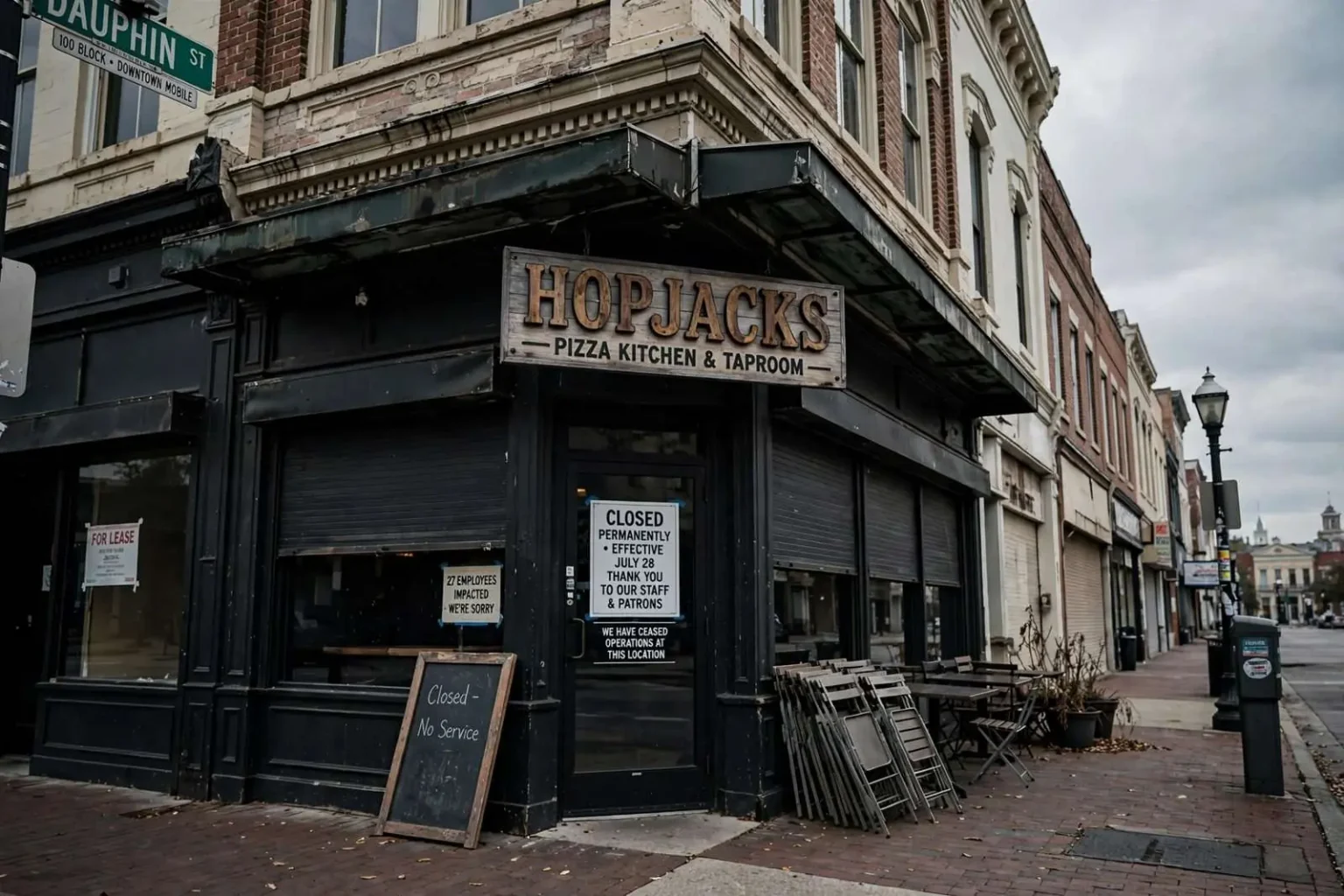
Hopjacks Pizza Kitchen & Taproom shut the doors of its Dauphin Street restaurant in downtown Mobile on Saturday, July 28, leaving another storefront dark along the city’s lower Dauphin entertainment corridor — and setting off a wider argument about whether Mobile truly supports one.
According to the restaurant’s ownership, the closure stemmed from financial distress after an embezzlement left Hopjacks unable to pay its taxes. About 27 employees lost their jobs in the shutdown, adding the casual pizza-and-beer spot to a stretch of lower Dauphin Street that has seen businesses come and go for years.
The closing stung twice. Not only did a popular downtown gathering place disappear overnight, but what followed turned the closure into a public embarrassment for the city: Hopjacks offered bus service carrying Mobilians to downtown Pensacola, promoting the trips with a statement praising Pensacola as “a TRUE entertainment district that a City cares about” — a pointed jab at Mobile from a business that had just closed there.
A closing that stung twice
Public reaction was divided. Much of the online chatter debated the quality of the pizza and the service rather than the shutdown itself, and at least one West Mobilian dismissed the news with a blunt “good — one less drunk on the road.” Others treated the closure as evidence of a deeper problem: a corridor with genuine assets that has struggled to hold onto the bars, restaurants and venues that give an entertainment district its energy.
Lower Dauphin Street sits at the heart of Mobile’s historic downtown, within walking distance of Bienville Square, the Saenger Theatre and the city’s convention traffic. City leaders have spent years pointing to the corridor as the natural center of a walkable entertainment district, the kind of concentrated strip of restaurants and nightlife that peer cities along the Gulf Coast have cultivated with visible success.
Pensacola’s Palafox Street corridor, a few blocks from the water, has become a regional comparison point — a compact district of restaurants, breweries and shops that draws crowds from across the Panhandle and, as the Hopjacks bus trips made plain, from Mobile itself.
Beyond duck fries
Whether or not residents mourned the restaurant, ownership argued the episode raised questions that could face any small business in one of Mobile’s most underdeveloped areas — pointing to the long-stalled Cruise Terminal project as a cautionary comparison. The terminal, once promoted as a downtown anchor that would bring regular ship traffic and crowds to the foot of the city, has sat largely dormant, a standing reminder that announced investments do not always arrive on schedule.
To work through those questions, Hopjacks president and owner Joe Abston joined Mobile City Councilman William Carroll and former Hopjacks Mobile manager Chris Hall for a wide-ranging interview. Among the questions addressed: whether Mobile has a genuine entertainment district and whether city government cares about it; why the Pensacola bus service and statement were launched; whether Mobile and Pensacola should compete or cooperate; and whether the city and state tried — or should have tried — to arrange a payment plan that would have kept Hopjacks open.
What the interview covered
Broader policy questions followed: whether City Hall and state development offices, along with the business community, have done enough to cultivate downtown small business, and what a real entertainment district would require beyond a collection of individual venues. The discussion put a city councilman and a business owner who had just pulled out of downtown at the same table, an unusual pairing that reflected how much attention the closure had drawn.
Carroll, whose district includes downtown, has been among the council members most vocal about the need to keep the lower Dauphin corridor active, and the interview gave him a chance to address criticism that city government treats the strip as an afterthought. Abston, for his part, was able to explain the sequence of events — the embezzlement, the tax debt that followed and the decision to close rather than operate while insolvent.
The bus service to Pensacola, Abston acknowledged, was designed partly as a statement: if Mobile would not support the business, the business would demonstrate where its customers were willing to go. The promotion drew both laughs and criticism online, with some Mobilians buying seats and others calling the gesture ungrateful toward the city where the restaurant had operated.
The embezzlement problem
The Hopjacks closure also highlighted a risk that small restaurant owners rarely discuss publicly: employee theft. Embezzlement at a restaurant of that size can drain cash flow quietly over months, and the resulting tax liability — in this case, obligations the company said it could no longer pay — is what typically forces the door to close. Tax authorities have fewer options for flexibility than private lenders, and once a business falls behind on taxes, penalties and interest compound quickly.
Restaurant economics compound the problem. Thin margins, high labor costs and a dependence on weekend nightlife traffic mean a single setback can be fatal, particularly in a district where foot traffic rises and falls with the calendar of downtown events. Operators in comparable districts often point to that volatility when explaining why some venues survive a slow season and others do not.
Twenty-seven jobs and a corridor’s momentum
The loss of roughly 27 jobs is significant for a single storefront, and it lands on a corridor where each vacancy makes the next lease harder to fill. Downtown business districts tend to operate on momentum: full storefronts draw crowds, crowds draw new tenants, and dark windows do the opposite. Mobile’s lower Dauphin strip has experienced both directions of that cycle over the past decade.
City officials have at times discussed incentives, facade programs and marketing pushes for the corridor, and the Hopjacks episode gave those conversations new urgency. Whether a payment plan between the restaurant and its tax creditors could have saved the business became one of the central questions of the public debate — and a test case for how the city and state handle similar situations in the future.
Compete or cooperate with Pensacola?
The question of whether Mobile and Pensacola should compete or cooperate ran through the discussion as well. The two cities sit about an hour apart along the Gulf Coast, close enough that they draw on overlapping pools of diners, concertgoers and weekend travelers. Pensacola’s downtown has in recent years become a destination in its own right, and the Hopjacks bus promotion made that draw explicit — rounding up Mobilians and delivering them to another city’s nightlife.
Supporters of a cooperative approach argue that regional marketing, shared festivals and cross-promotion grow the pie for both cities. Others counter that Mobile has enough anchor attractions of its own — a revitalized waterfront, a growing biomedical corridor, established festivals — that its priority should be fixing its own district rather than shuttling customers out of town.
What an entertainment district requires
Urban planners and downtown advocates generally describe the same ingredients for a working entertainment district: density of venues within walking distance, reliable and safe transportation, consistent hours, and a city government that treats the corridor as a priority rather than a collection of individual businesses left to fend for themselves. Mobile has pieces of that formula, but the Hopjacks closure underscored how quickly gaps in it become visible.
Alabama’s cities have also experimented in recent years with designated entertainment districts that relax open-container rules within defined boundaries, an approach credited in several municipalities with boosting downtown foot traffic. Mobile’s own district rules have evolved over time, and debates over how far they should extend along Dauphin Street have surfaced periodically at City Hall.
For now, the stretch of lower Dauphin where Hopjacks operated has one more vacancy, and the questions its ownership raised remain unanswered. The closure served as a reminder that downtown revitalization is measured not only in new construction and announced projects but in whether the existing businesses — the pizza kitchens, taprooms and shops that give a street its character — can survive long enough to see the promised growth arrive.
Looking ahead
The interview’s participants left the central dispute unresolved: whether Mobile’s government and development offices bear responsibility for the corridor’s struggles, or whether the Hopjacks closure was a private business failure that any city would have witnessed. What the episode did accomplish was to force a public conversation about downtown Mobile’s direction at a moment when the lower Dauphin corridor can ill afford another setback.
Residents watching the debate will get their answer over time, one lease at a time — in whether the dark storefronts fill, whether the crowds return on weekend nights and whether the next business that stumbles in the district finds a city hall willing to pick up the phone before the doors close for good.