Horn Island Plane Crash: Divers Recover All Six Aboard Cessna as Coast Guard Ends Search
Divers found all six people, including two young boys, inside the fuselage of a Cessna 210 that went down about 2 miles northeast of Horn Island, ending a multi-agency search in the Mississippi Sound.
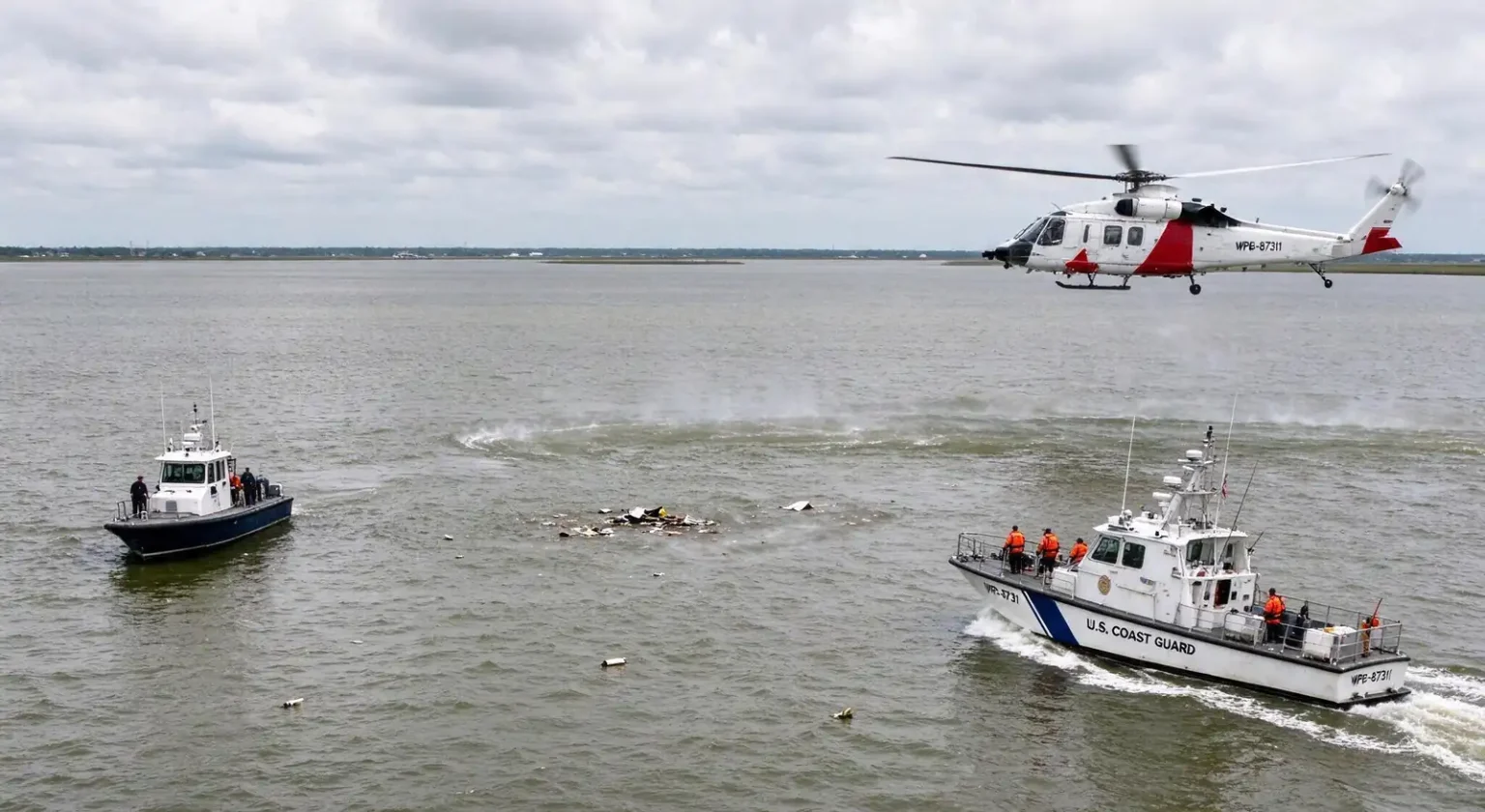
JACKSON COUNTY, Miss. — Divers have recovered the remains of all six people who were aboard a small plane that went down in the Mississippi Sound near Horn Island, bringing an end to a multi-agency search that began Tuesday afternoon. The Horn Island plane crash claimed the lives of four adults and two boys between the ages of 8 and 10, the Coast Guard said.
Dive teams from the Mississippi Department of Marine Resources found the six victims on Wednesday inside the fuselage of the aircraft, a Cessna 210, which rested about 2 miles northeast of the barrier island. With everyone aboard accounted for, the Coast Guard and the agencies working alongside it formally closed out the search.
The identities of the victims had not been released by authorities.
What is known about the flight
The single-engine plane had taken off from New Orleans Lakefront Airport and was bound for Page Field, a general aviation airport in Fort Myers, Florida. Its route carried it east along the northern Gulf Coast, over the waters that separate the Mississippi mainland from its chain of offshore islands.
Air traffic controllers lost contact with the aircraft at about 3:45 p.m. Central time on Tuesday, Nov. 24. Coast Guard Sector Mobile received word of the lost contact from the regional air traffic control tower in Mobile at roughly that time. According to the Coast Guard, Federal Aviation Administration data indicated the plane was losing altitude at a rate of about 10,000 feet per minute when communication ended.
To put that figure in perspective, a typical airliner on a normal approach descends at well under 1,000 feet per minute. A rate ten times that or more points to a rapid, uncontrolled loss of altitude, although investigators have not announced what caused the plane to go down.
Key facts at a glance
- Aircraft: Cessna 210, a single-engine plane
- Departure: New Orleans Lakefront Airport
- Destination: Page Field, Fort Myers, Florida
- Contact lost: about 3:45 p.m. CST, Tuesday, Nov. 24
- People aboard: six, including four adults and two boys ages 8 to 10
- Location of wreckage: about 2 miles northeast of Horn Island, Mississippi
- Outcome: remains of all six recovered from the fuselage on Wednesday
How the search unfolded
Once the alert reached Sector Mobile, the command center there coordinated the launch of Coast Guard boats and aircraft and brought in federal, state and local partners. Coast Guard Station Pascagoula sent two small boats toward the area. The Coast Guard Cutter Cobia, an 87-foot patrol boat with the hull number WPB-87311, also responded, as did an air crew from Coast Guard Aviation Training Center Mobile.
The Mississippi Department of Marine Resources put two of its own boats on the water. The Pascagoula Police Department launched a boat at about 4:15 p.m., roughly half an hour after contact with the plane was lost.
By about 5:40 p.m. Tuesday, searchers had located a field of debris that included the cabin of the plane, three life jackets and a life raft. No one was found on the surface at that time, and all six people remained unaccounted for into the evening. Around 6:30 p.m., a staging area for response officials was set up at Singing River Island near Pascagoula.
The Coast Guard said its crews and partner agencies carried out roughly four hours of coordinated search work. The effort ended Wednesday when the marine resources dive team reached the submerged fuselage and found all six people inside.
Agencies that took part
- U.S. Coast Guard Sector Mobile Command Center
- U.S. Coast Guard Station Pascagoula boat crew
- U.S. Coast Guard Aviation Training Center Mobile air crew
- Crew of the U.S. Coast Guard Cutter Cobia (WPB-87311)
- Mississippi Department of Marine Resources, including its Marine Patrol officers and dive team
- Harrison County Divers
- Pascagoula Police Department boat crew
- Federal Bureau of Investigation
- U.S. Air Force C-130 aircrew
Officials offer condolences
A Coast Guard official described the result as heartbreaking and extended sympathy to the families of those who died. The official said the outcome was not the one responders had hoped for, but that close cooperation among the agencies allowed searchers to find the victims quickly and give their families some measure of closure.
Leaders of the Mississippi Department of Marine Resources also offered condolences on behalf of the agency. An agency official said recovering the victims is a serious duty and that the department’s Marine Patrol officers and divers were working with federal and local partners to carry out the recovery with care and respect.
About Horn Island and the waters where the plane went down
Horn Island is one of the barrier islands that line the southern edge of the Mississippi Sound, the shallow body of water between the Mississippi coast and the open Gulf. It lies offshore from Jackson County, south of the Pascagoula and Ocean Springs area, between Ship Island to the west and Petit Bois Island to the east.
The island is part of Gulf Islands National Seashore, which is managed by the National Park Service. It has no permanent residents, no roads and no bridges connecting it to the mainland, and it is reached only by boat. Its long beaches, dunes and marshes are a draw for boaters, campers and anglers, but the island’s remoteness means emergency crews responding there must travel by water or air.
The Mississippi Sound is relatively shallow compared with the Gulf beyond the islands, which can help divers reach wreckage on the bottom. Even so, recovery work in open water is difficult. Visibility below the surface is often limited, currents and weather can change conditions quickly, and November brings shorter daylight hours, cooler water and the chance of passing fronts.
The role of the Coast Guard in a case like this
Coast Guard Sector Mobile oversees search and rescue for a large stretch of the northern Gulf Coast, including coastal Alabama, Mississippi and part of the Florida Panhandle. When an aircraft or vessel is reported in distress over water, the sector’s command center acts as the hub, assigning boats, cutters and aircraft, setting search patterns and coordinating with state and local agencies.
Coast Guard Aviation Training Center Mobile, located at Mobile’s Brookley area near the downtown airport, is the service’s primary flight training center for helicopter and fixed-wing crews, and its aircraft frequently take part in real-world search cases along the Gulf Coast. Station Pascagoula operates small response boats suited to the shallow waters of the sound.
Search and rescue cases that involve a downed aircraft often draw in several layers of government. State marine resources agencies bring local knowledge of the waters and trained divers, while county dive teams and city police departments can put additional boats and personnel on scene. Federal law enforcement and military aircraft may also assist when a search area is large or when a case requires specialized resources.
The Cessna 210
The Cessna 210, often called the Centurion, is a single-engine, high-wing airplane with retractable landing gear. It can carry up to six people, including the pilot, and has been popular for decades with private pilots and small businesses because of its speed, range and cabin space. The model was produced from the late 1950s into the 1980s, so many examples still flying today are several decades old and are maintained under federal aviation rules for general aviation aircraft.
A flight from New Orleans to Fort Myers is a trip of several hundred miles, and a route along the coast toward Florida commonly crosses the Mississippi Sound and Mobile Bay before continuing across the Gulf Coast region.
What happens next
In the United States, the National Transportation Safety Board is responsible for investigating civil aviation accidents, and the Federal Aviation Administration typically assists by gathering information about the aircraft, the pilot and the flight. Investigators generally examine the wreckage, maintenance records, weather conditions, radar and air traffic control data, and the pilot’s training and experience.
In fatal general aviation crashes, the safety board usually publishes a short preliminary report within a few weeks of the accident. That early report lays out basic facts but does not assign a cause. A final report with a probable cause determination often takes a year or more to complete.
Authorities had not announced the names of the six people who died or released information about where they lived. Officials also had not said what may have caused the plane to descend so rapidly before it struck the water.
A loss felt along the coast
The crash comes during the busy Thanksgiving travel week, a time when many families take to the roads and the skies to visit relatives. For the coastal communities of Jackson County and the wider Mississippi Gulf Coast, the response drew boats and crews from Pascagoula, Harrison County and beyond, as well as resources based across the state line in Mobile.
Anyone with information that could assist investigators is generally encouraged to contact the agencies involved. Residents and boaters who come across debris in the water or along the shoreline of the barrier islands should avoid handling it and report its location to the Coast Guard or local authorities so it can be documented as part of the investigation.