
45 Days in New York: Former Baldwin Sheriff Hoss Mack on Identifying 9/11’s Dead
Former Baldwin County Sheriff Huey 'Hoss' Mack deployed with a federal disaster mortuary team on Sept. 13, 2001, and spent 45 days at the New York medical examiner's office identifying victims — work he still describes to students each year.
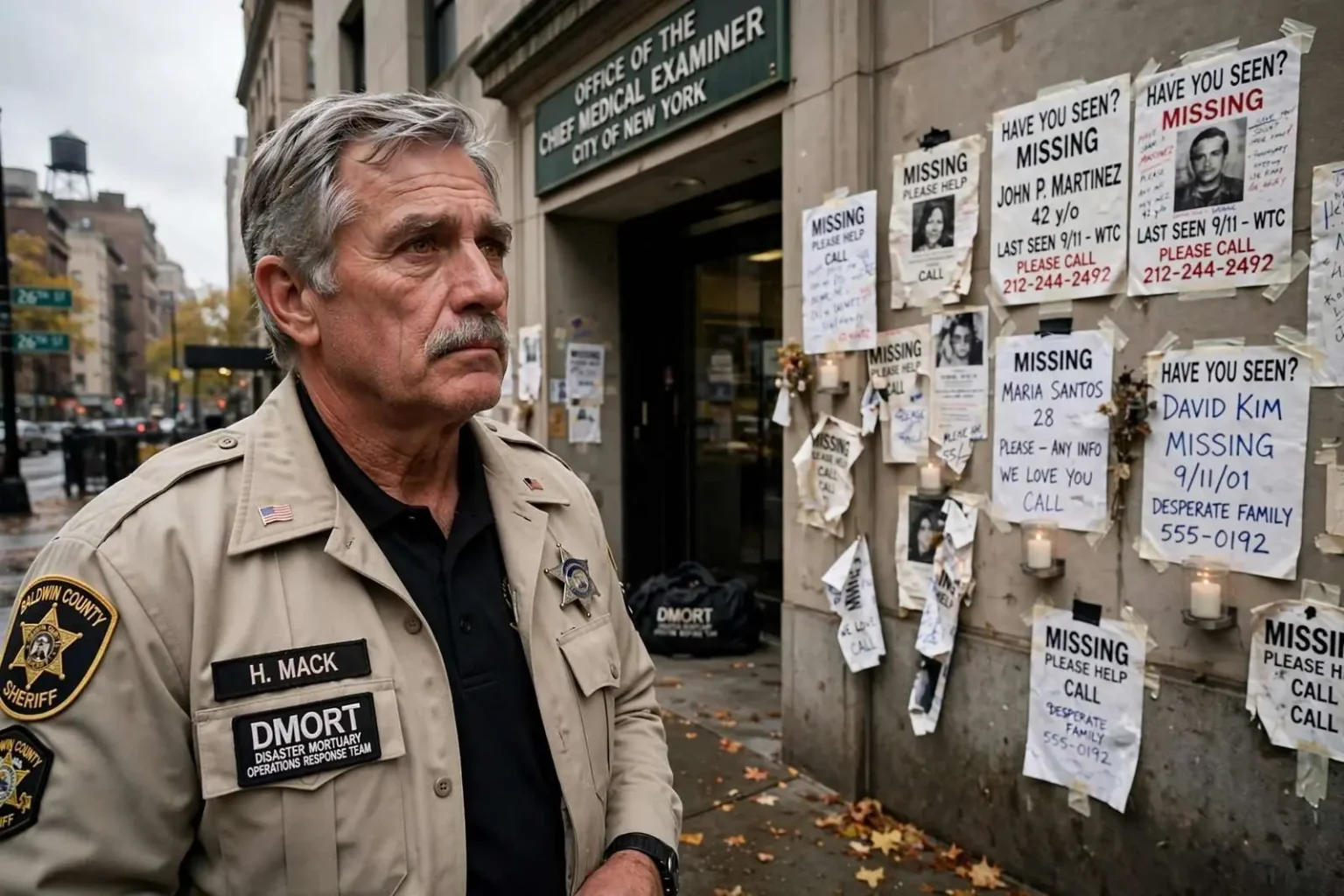
Huey “Hoss” Mack was in New York City by Sept. 13, 2001. He stayed 45 days.
The former Baldwin County sheriff, who is also a medical examiner, was activated as part of the federal Disaster Mortuary Operations Response Team in the hours after the attacks. His assignment was the one almost no one volunteers to describe: identifying the dead, and giving families an answer.
“Then I got to New York City on September the 13th,” Mack said.
Thirty Blocks From Ground Zero
Mack’s team worked about 30 blocks north of the World Trade Center site, at the New York medical examiner’s office.
“We were about 30 blocks up from Ground Zero, so our process was that we were handling all the remains that were being recovered and brought in to the New York medical examiner’s office,” he said.
DMORT teams exist for precisely this scenario. When a mass fatality event exceeds what a local medical examiner can process, the federal government deploys portable morgue units and specialists — pathologists, dental examiners, fingerprint technicians, funeral directors — drawn from around the country. They are not search crews. They are the people who turn recovered remains into names.
At the World Trade Center, that work was extraordinarily difficult. The collapse of two 110-story buildings left remains that were fragmented, commingled and, in many cases, never recovered at all. Identification depended on dental records, fingerprints and DNA rather than visual recognition.
The Posters Outside
The detail Mack returns to is not inside the building. It is on the wall outside it.
“Outside the medical examiner’s office, families would post posters of their loved ones and they would say ‘help us locate’ because they did not know,” Mack said. “We would work in there at night, we would come back out in the morning. We would see these posters and we would go like, ‘that’s one of the ones that we just identified.'”
The missing-person posters that covered Lower Manhattan in the weeks after the attacks became one of the era’s defining images. For most people they were a symbol of collective grief. For the team working overnight shifts a few feet away, they were a daily accounting — a face on a flyer matched against a file closed hours earlier, while the family who taped it up did not yet know.
Mack described 45 days of matching identities and watching families search.
‘There Was No Such Thing as Race’
What Mack chose to emphasize about that month is not the horror of the work but the conduct of the people doing it.
“Following those attacks in the 45 days that I worked up there, there was no such thing as race. There was no such thing as differences in religion, sexual orientation. It was just all American,” he said.
That observation carries a particular weight coming from someone whose job during those weeks was handling the remains of people whose differences had, in the end, protected no one and mattered to no one.
Twenty-Five Years of Telling It
Mack has not treated the deployment as a private memory. He speaks every year — to news outlets, to schools, at community events — and he has been doing it long enough that his audiences now consist largely of people who were not alive in 2001.
This week he spoke to students at Foley High School.
That choice reflects a calculation many first responders of his generation have made. A student entering high school in 2026 was born more than a decade after the attacks. For them, 9/11 is a chapter in a textbook, the way Pearl Harbor was for the generation before. The only thing that converts it from history into something felt is a person in the room who was there.
What He Asks People to Take From It
Mack’s annual message is consistent, and it is aimed less at the attack than at the response.
“Take that moment and just reflect upon what it was and how resilient America was following that,” Mack said, “and how that it served as a point of unity of people coming together after such a enormous tragedy. That can be an example that if we ever have to deal with this again, that we know that we can be united and we can get through it together.”
The framing is deliberately forward-looking. He is not asking for mourning. He is arguing that the country demonstrated a capability 25 years ago, that the demonstration is documented, and that it therefore remains available.
Baldwin County’s Connection
First responders and medical examiners from across the country were called to New York after the attacks, and Mack was among them. His deployment is the reason a Baldwin County sheriff’s career includes 45 days inside one of the largest forensic identification efforts in American history.
It is also why, a quarter-century later, high school students in Foley heard the story from someone who did the work rather than from a documentary.