
How Alabama Power Restores Power After a Storm Like Hurricane Sally
After Hurricane Sally, Alabama Power restored service to most Mobile County customers within four days. A spokesperson explains how the process works.
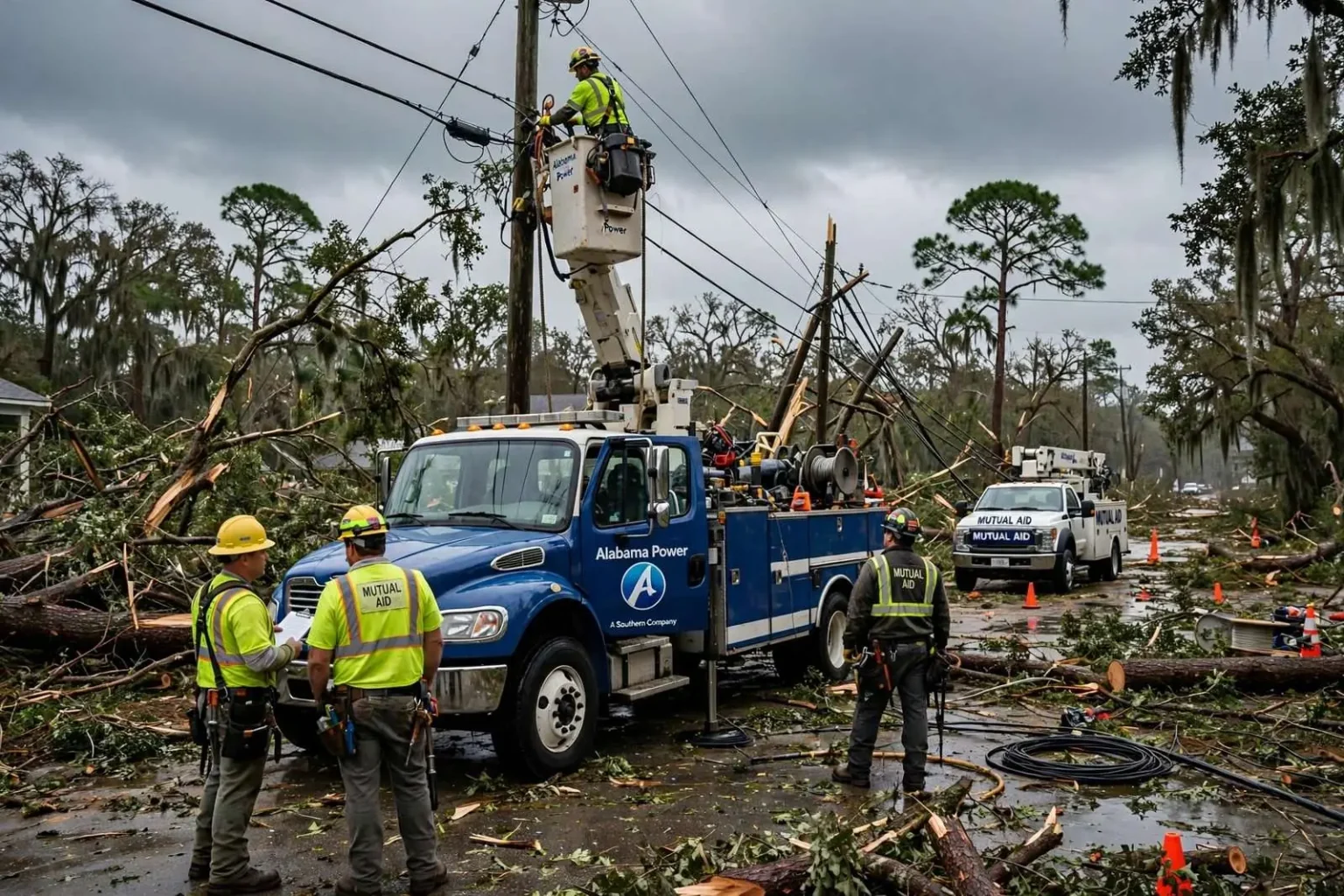
Alabama Power had most of its Mobile County customers back on the grid within four days of Hurricane Sally, but the pace of restoration varied by neighborhood — and the company says that is by design. Utility restoration follows a deliberate sequence rather than a race along the most visible streets, and understanding that sequence explains why one block lights up while the next stays dark, even when trucks are working nearby.
Safety comes first, Alabama Power spokesperson Beth Thomas said, followed by the customers who keep communities running. “Hospitals, police and fire stations, and water treatment plants are restored first so they can provide essential services,” Thomas said. Those facilities are the backbone of a community’s response to a disaster: they treat the injured, keep order, fight fires, and supply the clean water that makes everything else possible. Repairing the lines and equipment that serve them happens before crews move into residential areas, no matter how many homes are waiting.
How the Restoration Sequence Works
After those priorities, crews focus on the high-voltage lines that feed neighborhoods, aiming to restore power to the largest number of people in the shortest time. A single transmission line or substation circuit may carry electricity to thousands of homes, so repairing one span of wire there accomplishes more than hours of work on an individual service line. Once the backbone is energized, crews work down to smaller distribution lines — the wires along residential streets — and finally to the individual service drops that connect each home to the pole in its yard.
That hierarchy is why progress can look uneven from the curb. Thomas noted that seeing a truck pass by does not mean a home has been skipped — crews often are clearing problems a block or a mile away that are causing an outage. Electricity follows a path from generation through transmission, substations and main lines before it ever reaches a meter, and any break anywhere along that path leaves the homes downstream without power even if the street itself looks intact. Homeowners sometimes discover that a crew working blocks away has actually restored their service without ever stopping in front of the house.
Sally complicated that work with a large number of downed trees. The hurricane’s winds snapped pines and oaks across roads, yards and right-of-ways, dropping limbs onto power lines and toppling entire trees through the distribution system. “Downed trees must be removed for trucks to get to the area and for new power poles to be installed,” Thomas said. In heavily wooded neighborhoods, line crews cannot even begin electrical repairs until tree crews cut a path, which stretches the timeline on streets where vegetation is dense and mature.
The Scale of the Damage
The numbers behind the repair effort show how much of the system Sally wrecked. The company replaced more than 400 poles, 500 transformers and 1,500 spans of damaged or destroyed power lines in the aftermath. Each pole is a crew, a truck and an hour or more of work; each span of line must be strung, tensioned and connected between poles. Set against a single neighborhood outage caused by one fallen limb, that inventory represents damage spread across an entire county grid.
At the storm’s peak, about 75 percent of Alabama Power customers in Mobile lost power. Sally came ashore on the Alabama coast as a Category 2 hurricane but moved slowly, and its prolonged winds and flooding pushed storm surge into communities around Mobile Bay. A storm that lingers does as much damage through duration as through peak intensity — soil softens around pole butts, limbs load with rain, and wind gusts have hours longer to find weaknesses in the system.
The Mutual Aid Army Behind the Four-Day Recovery
Thomas credited mutual-aid crews for the swift recovery: 4,000 linemen and support personnel from 14 states helped in the aftermath, with 1,800 of them staged ahead of the storm before it ever came ashore. Mutual aid is the utility industry’s standing promise to one another — when a storm threatens one company’s territory, neighboring utilities and contracted crews from across the country move equipment and personnel toward the projected impact zone in advance. Pre-staging matters enormously: after a hurricane, fuel stations are closed, roads are blocked with debris, and lodging is scarce, so having workers and material already in place near the damage zone saves days.
The crews that arrived represented a cross-section of the American utility workforce — line workers, vegetation specialists, damage assessors, safety observers, and the logistics staff who keep thousands of workers fed, housed and supplied. Coordination on that scale is a discipline of its own, with restoration runs planned each morning, work orders dispatched by geography, and progress tracked pole by pole. For a company the size of Alabama Power, a subsidiary of the Southern Company system that serves customers across the southeastern United States, the mutual aid network multiplies its own workforce several times over when a storm demands it.
Some Alabama Power crews had just returned from restoring power in Lafayette, Louisiana, after an earlier storm had knocked out that region’s grid. Utility crews in hurricane country spend an entire season moving from storm to storm, and the rhythm of the 2020 hurricane season — one of the most active on record in the Atlantic — meant crews were cycling between restoration assignments across the Gulf states for months. That experience matters: veteran storm crews work faster and safer, and their familiarity with the sequence and logistics shortens recovery for everyone.
What the Process Means for Customers
For residents waiting in a dark neighborhood, the company’s guidance is practical. Report the outage rather than assuming it has been logged. Stay away from downed lines, which should always be treated as energized, and never touch a tree or limb entangled with a wire. Keep generator use outdoors and far from windows and doors, because improper generator operation causes carbon monoxide deaths after nearly every major Gulf Coast storm. And leave restoration work to the professionals — backyard repairs to service equipment can injure the homeowner and the crew working upstream.
Customers can also prepare for the next storm by understanding their own side of the meter. The utility is responsible for the line, the pole and the equipment up to the weatherhead; the homeowner’s electrical panel, weatherhead and service entrance are the customer’s to repair, and a licensed electrician must sometimes complete that work before the utility can safely reconnect service. Knowing where that dividing line sits prevents confusion when a crew has finished the street but a home remains dark.
The four-day turnaround for most of Mobile County stands as one of the faster recoveries of the 2020 hurricane season, and company officials attribute it to the combination of pre-staging, the mutual aid workforce and the disciplined repair sequence. None of it was luck: the same playbook — protect critical facilities first, rebuild the backbone, then work down to the individual home — will govern the next restoration, whatever storm delivers the damage.
Hardening the System for the Next Storm
Each major outage feeds back into how the utility builds and maintains its system. Utilities across the Gulf Coast have spent years strengthening the parts of the grid that hurricanes attack first — replacing wooden poles with stronger classes of pole in high-wind corridors, trimming and removing hazard trees along rights-of-way before storm season rather than after, upgrading substations, and installing automated equipment that can isolate a fault and reroute power so an outage touches fewer homes. None of that hardening makes a system hurricane-proof, but it shortens the repair list a restoration crew faces when the winds die down.
Storm season preparation is a year-round cycle on the Gulf Coast. Before June 1, crews inspect equipment, test storm response plans, and review mutual aid agreements so the machinery of a large-scale restoration is ready to move on short notice. When a storm enters the Gulf, utilities begin line-specific preparations: fueling vehicles, staging wire, poles and transformers at yards near the projected path, and moving crews into position before conditions make travel dangerous. The 1,800 workers staged ahead of Sally were the product of that advance planning, and they represented the difference between starting repairs on day one and starting them on day three.
The costs of a storm like Sally also ripple beyond the utility itself. Outages shutter grocery stores, gas stations and pharmacies, interrupt medical equipment that depends on household power, and force schools and businesses to close for days. Each day without electricity carries an economic price for a community on top of the physical damage, which is why the restoration sequence puts essential services at the head of the line. Getting a hospital or water treatment plant back online does more for recovery than restoring any residential street, no matter how loudly a dark neighborhood might wish otherwise.
For Mobile County, the storm reinforced a lesson coastal residents have absorbed across generations: the recovery begins the moment the storm passes, and it succeeds or fails on preparation that happened long before landfall. Alabama Power’s four-day restoration of most of its Mobile County customers was the visible result of staging, mutual aid and a disciplined sequence of repairs — a playbook that will be pulled from the shelf again the next time a hurricane aims at the northern Gulf Coast.


