How Alabama’s Bet on Trump Paid Off at the Republican National Convention
Sessions' early endorsement and a record Alabama primary won the state a front-row role at the 2016 Republican National Convention in Cleveland.
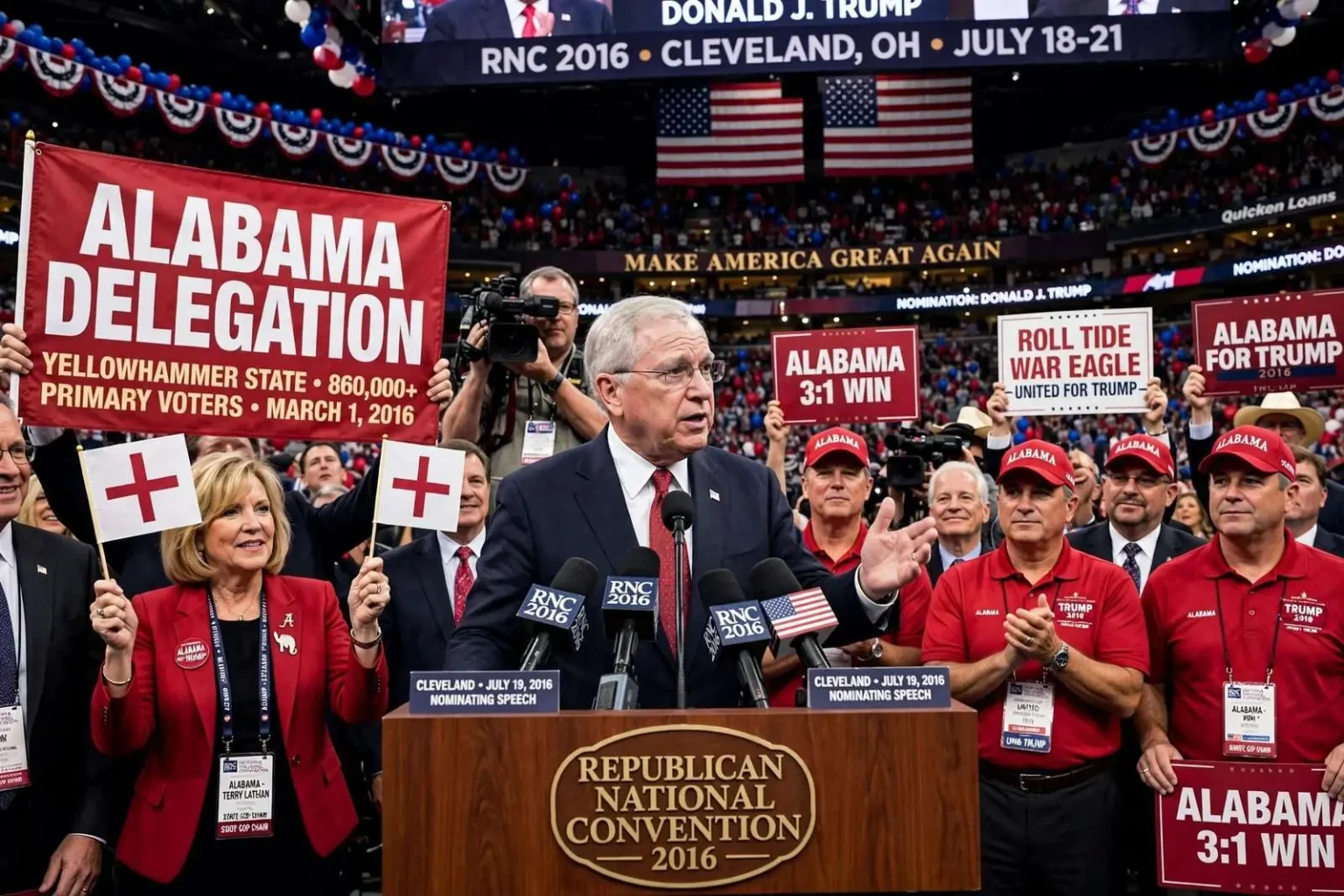
When Sen. Jeff Sessions endorsed Donald Trump for the Republican presidential nomination at the end of February 2016 — before any consensus candidate had emerged — Alabama was an outlier among early endorsers. Two days later, state voters backed him up: Trump rolled to a record-breaking March 1 primary win in Alabama at roughly a 3-to-1 margin, drawing more than 860,000 primary voters. The two moves together set the shape of Alabama’s role in Cleveland months before the convention gaveled in.
That combination of an early endorsement and overwhelming primary support earned Alabama a front-row seat and a marquee role at the Republican National Convention, where Sessions formally nominated Trump for president. State GOP chairwoman Terry Lathan opened the nomination with a nod to both sides of the state’s football rivalry — a deliberate piece of Alabama political theater that framed the delegate class as one state rather than two warring camps, and that got one of the convention’s loudest in-state responses.
“It’s great to have them in a front-row seat,” Sessions said in an interview on the convention floor, minutes before Trump accepted the nomination. “It was those two big rallies that Trump had in Alabama that were stunning. I think both of them helped. The first one was in Mobile last August and then Huntsville had one that I endorsed him at.” Sessions pointed to the enormous crowds at Ladd-Peebles Stadium in Mobile and later at Madison City Stadium outside Huntsville as proof of Trump’s unusual pull in the state — stadium-scale turnouts at a point in 2015 when most candidates were drawing banquet halls.
A Break From Convention History
The prominence was a first for a state that had spent recent cycles backing runners-up. In 2008, Alabama went for Mike Huckabee; in 2012, it chose Rick Santorum. Without electoral leverage or headline endorsements, the delegation was seated far from the action in both Tampa and Minneapolis, arriving at conventions whose nominees had already been decided elsewhere. The state’s delegates had grown used to watching the pageant from the back rows of the hall, and the 2016 seating chart flipped that positioning overnight.
“By the Alabama delegates, their response to me — a lot of them, they are loving it,” said Lathan, a seven-time convention attendee. “This is a little bit out of our pattern, to tell you the truth. Alabama went with the eventual nominee of the party… That was a record-breaking primary we had on March 1. We had over 860,000 primary voters. I mean, that’s not an accident. That’s a message.” Her framing captured what the party establishment in Montgomery saw: a state that had finally picked the winner early, and been rewarded with a speaking role for its trouble.
The record March 1 turnout also said something about Alabama’s primary calendar. The state votes on what Southerners call the SEC primary, the March 1 Super Tuesday date when a block of Southern states goes to the polls together, and Alabama’s place in that block turns its primary into a genuine regional contest. More than 860,000 voters showed up statewide — a number Lathan repeated as evidence that the state’s Republican electorate was engaged, expanding and sending a signal beyond its own borders.
Against the Establishment Grain
Trump’s strength in Alabama came despite most of the state’s Republican establishment lining up elsewhere: Gov. Robert Bentley backed John Kasich, Rep. Mike Rogers supported Jeb Bush, and 31 state legislators endorsed Marco Rubio. The divide ran through the party’s elected class rather than its voters, and it made the primary results — a 3-to-1 margin — all the more emphatic a rebuttal. Alabama Republicans went to the polls with their governor, congressman and legislative leadership spread across three other candidates and still delivered one of Trump’s largest margins anywhere.
Sessions’ early bet, ratified by voters, is what put the Yellowhammer State center stage in Cleveland. The senator’s endorsement carried weight in his home state that few could match — he had represented Alabama in the Senate for two decades, built a national following on immigration policy, and his move to Trump converted a significant share of conservative Alabama into early Trump country. When he stood at the convention podium to formally place Trump’s name in nomination, Alabama’s role in the campaign was on national display in a way it had never been in the modern primary era.
The convention positioning also rewarded the state party’s organizational work. Delegates, alternates and party staff spent the Cleveland week in the middle of the hall’s action, hosting events and drawing national media attention to a delegation accustomed to being a footnote. For Lathan, finishing a seventh convention at the center of the show rather than its edges marked the difference an early, unanimous-feeling state can make in a contested nomination.
The Rallies That Started It
The two rallies Sessions cited — Ladd-Peebles Stadium in Mobile, then Madison City Stadium outside Huntsville — became the founding artifacts of Trump’s Alabama campaign. Stadium rallies in August 2015, months before a single primary vote, gave the candidate footage and scale that early-state rivals could not match, and they signaled to Alabama’s political class that the enthusiasm was real. Sessions’ endorsement followed at the end of February 2016, and the March 1 primary confirmed it with a margin that ended the competitive phase of the Republican contest in the state.
Mobile’s place in that story is a familiar one for Gulf Coast political watchers. Ladd-Peebles has hosted the events that draw the city together for decades — football games, festivals and the political mega-rallies — and a capacity crowd there in the middle of a presidential summer put Mobile in national campaign coverage. Huntsville’s follow-up, in the Tennessee Valley on the other side of the state, completed the picture: Trump drawing huge crowds in both of Alabama’s metropolitan anchors, a geographic spread that the March primary results mirrored.
Sessions’ convention-floor interview tied the sequence together explicitly — the rallies, the endorsement, the primary — as a cause-and-effect argument for why Alabama had earned its front-row seat. In a cycle when most states’ delegations arrived in Cleveland as spectators, Alabama’s story was one of the few that began with a choice and ended with a role in the program.
What the Moment Meant
The 2016 convention marked a turn in Alabama’s national Republican identity. A state that had spent two cycles championing social-conservative alternatives found its political identity folded into the Trump realignment, with Sessions as the bridge figure. The senator’s national profile had been built on issues that Trump’s campaign made central, and Alabama’s voters — as the primary showed — were ready to follow. The delegation seated in the front rows of the Cleveland arena represented a party in transition, and the state’s leadership leaned into it.
Lathan’s line about the pattern — that going with the eventual nominee was “a little bit out of our pattern” — doubled as a statement about leverage. Early primary states and big delegations trade on their ability to shape the outcome; Alabama, voting deep into the Super Tuesday block, normally arrives after the wind has been taken out of the sails. In 2016 the state’s 860,000-plus voters made March 1 a statement rather than an afterthought, and the convention’s treatment of the delegation reflected it.
For the state’s Republican infrastructure, the convention capped a primary season that had strained relationships — a governor on one candidate, legislators on another, and a senator on the nominee — without breaking them. The reconciliation was the convention itself: delegates who had fought for different candidates in March stood together in Cleveland, joined in nominating the man Alabama had backed at 3-to-1, with the state party chairwoman and its senior senator sharing the marquee. Whatever came next in the general election, Alabama’s 2016 convention story was settled: the bet had paid off, on time and in full view.
The convention itself supplied the images that made the argument. When Lathan took the microphone to open the nominating speeches with the football rivalry reference, the Alabama section of the hall responded as one, and the moment played on national television as a portrait of party unity — the same unity the primary had lacked when Bentley, Rogers and the legislators spread their endorsements across the field. Sessions then delivered the formal nominating speech in his deliberate Senate cadence, placing Trump’s name before the convention minutes before the nominee himself appeared. For a delegation that spent 2008 and 2012 seated far from the action, the sequence — open, nominate, accept — ran the whole show through Alabama hands in the space of a single evening.
The scenes in Cleveland — a football-rivalry nod opening the nomination, a senator from Alabama doing the nominating, and a delegation seated where the cameras could find it — traveled home as proof for the state party’s argument that engagement pays. Alabama’s Republicans had spent a generation attending conventions as believers in candidates who fell short. In 2016 they attended as the state that called it early, and everyone in the hall knew it.