
How ALDOT and Mobile Traffic Engineers Keep Mardi Gras Parade Traffic Moving
For the past three years, ALDOT and Mobile city engineers have run a joint traffic monitoring center during Mardi Gras season, adjusting signals in real time and powering the city's parade-season text alert service.
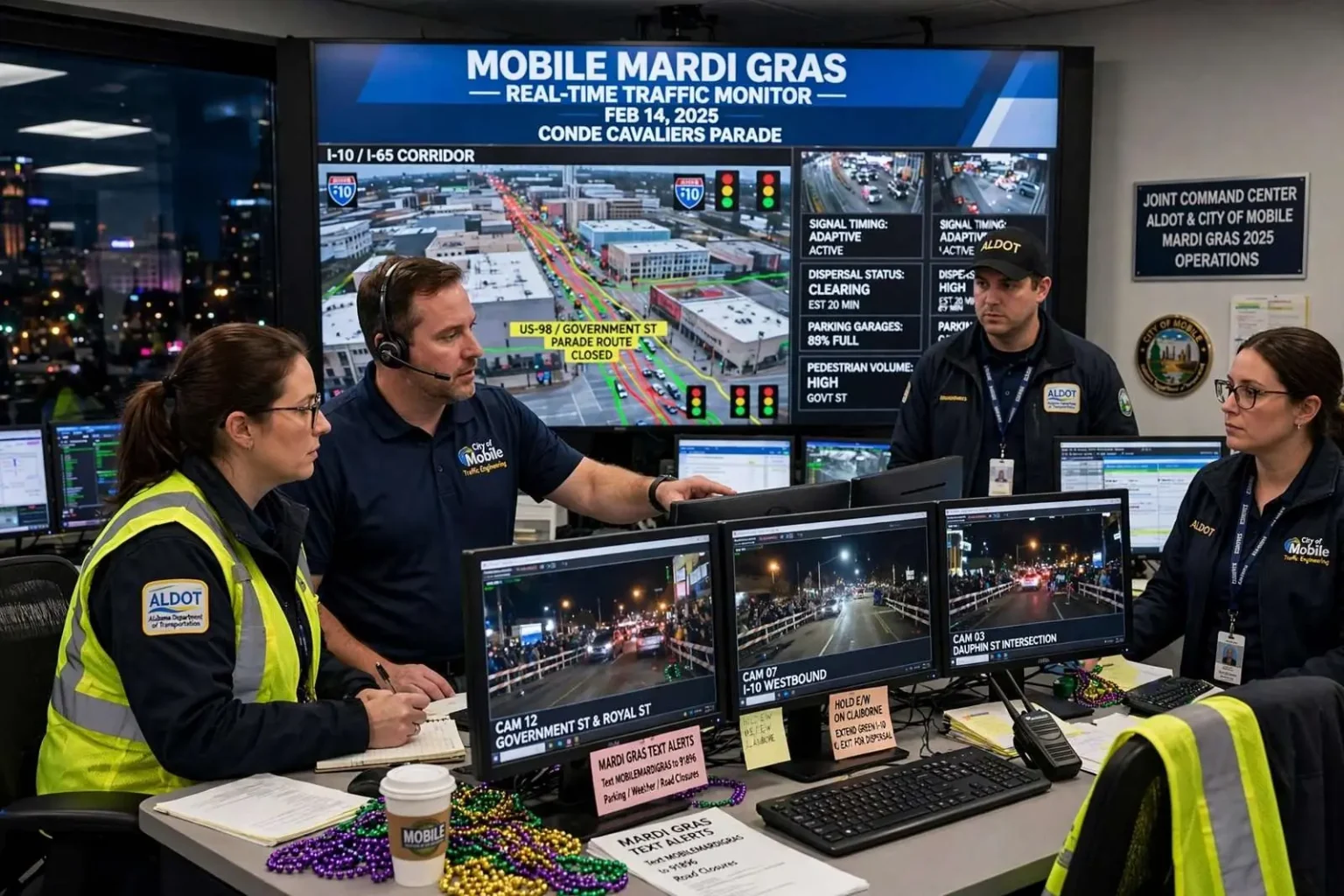
Mardi Gras season brings some of the biggest crowds of the year to downtown Mobile, and with those crowds comes a predictable side effect: traffic. To keep parade-goers moving instead of stuck in gridlock, the Alabama Department of Transportation and City of Mobile traffic engineers have spent the past several years running a coordinated, real-time traffic monitoring effort built specifically for parade season. The partnership was on full display during the 2025 Mardi Gras season, which kicked off Feb. 14 with the Conde Cavaliers parade, drawing thousands of revelers downtown for the first of many nights of parades, beads and moon pies.
Behind the scenes, ALDOT and city engineers worked from a joint command center to keep traffic signals synced with the flow of parade crowds rather than fighting against it. The idea sounds simple and is anything but: a downtown signal network designed for daily commuting has to be rethought night after night for streets that close for routes, flood with pedestrians and empty all at once when a parade ends.
A Command Center Built for Parade Season
From that command center, engineers monitor traffic signals across the city and make real-time adjustments as conditions change. If key corridors such as US-98, also known as Government Street, or the interstate system through Mobile start backing up, engineers can shift signal timing plans on the fly to relieve pressure and keep vehicles, pedestrians and parade traffic moving as safely as possible.
That kind of flexibility matters in a city where Mardi Gras isn’t a single event but a weeks-long series of parades, each one temporarily reshaping traffic patterns downtown. A fixed timing plan built for a normal Friday commuter rush is worse than useless on a parade night, when Government Street is a staging area, the route streets are closed, and thousands of cars converge on a compressed downtown footprint that was laid out two centuries before anyone imagined an automobile.
Rather than relying on fixed signal timing that doesn’t account for parade routes, road closures or surges in pedestrian traffic, the monitoring center allows engineers to respond to what’s actually happening on the ground in the moment. When a parade lets out and a wall of cars heads for the interstates at once, the difference between a 20-minute exit and a two-hour one can be made in the signal timing choices engineers make in those first crucial minutes.
The effort has been running for three years, according to the agencies involved, making it one of the more established examples of ALDOT and a city government coordinating on a single, recurring traffic challenge tied to a cultural event as significant as Mardi Gras is to Mobile, widely recognized as the birthplace of Mardi Gras in the United States. The celebration began in the city in the early 1700s, and the modern season stretches across weeks of parades staged by the city’s mystic societies — a scale of event that few American cities of Mobile’s size attempt, and one that turns traffic engineering into a seasonal craft of its own.
Real-Time Data Also Powers Text Alerts
The value of the monitoring center extends beyond signal timing. The City of Mobile also draws on the traffic data it generates to power its Mardi Gras text alert service, which sends residents and visitors real-time updates on weather, parking availability and other information they need to know before heading downtown for a parade.
During parade season, ALDOT monitors traffic signals on every parade day, giving engineers a continuous window into how traffic is moving around the parade routes and allowing them to make adjustments throughout each event rather than only at scheduled intervals. The monitoring does not end when a parade rolls; it runs through the dispersal, when the worst congestion hits, and continues until the downtown network returns to its normal rhythm.
For residents and visitors who want to stay informed, the city’s text alert system remains one of the simplest ways to get real-time updates. Anyone interested can text “MOBILEMARDIGRAS” to 91896 to receive information on weather conditions, parking and other logistics for the parade season — a tool that turns the same data feeding the command center into something a family in the parking garage or on the parade route can use before they commit to a drive downtown.
The coordination between ALDOT and Mobile’s traffic engineers reflects a broader reality of hosting a major recurring event downtown: infrastructure planning doesn’t stop once the parade route is set. Keeping thousands of vehicles and pedestrians moving safely through a compressed downtown footprint takes continuous monitoring, quick decision-making and communication tools that reach the public directly, all of which have become standard parts of how Mobile manages its signature season.
Why the Partnership Works
The division of labor is what makes the effort function. ALDOT controls the state-owned corridors that carry traffic into and out of downtown — the interstate system and routes like Government Street — while city engineers manage the local signal grid where parade crowds actually form. A surge on the interstate becomes a surge on the downtown streets within minutes, so an approach where each agency adjusted in isolation would simply move the bottleneck back and forth. The joint command center lets them treat the network as one system instead of two.
Three seasons of running the operation have also built something harder to engineer: institutional knowledge. Engineers who have watched several years of parade nights develop a feel for how crowds move on a Friday in February versus a Tuesday, how weather thins or swells a crowd, and how quickly each route empties. Each season’s data sharpens the next season’s timing plans, which is why the agencies describe the effort as established rather than experimental.
The 2025 season’s Feb. 14 kickoff with the Conde Cavaliers parade set the pattern for the weeks that followed. The opening-night parade is a familiar drill: thousands of families staking out spots along the route hours early, the streets around the route closing in stages, and the signal network shifting into its parade-season posture. By the time the season reaches its closing nights, the operation runs like the well-rehearsed production the celebration itself has become over three centuries of Mobile tradition.
What It Means for Parade-Goers
For the people actually navigating the season, the engineering has a practical bottom line. Arriving downtown for a parade means competing with thousands of other vehicles for a limited supply of parking; leaving afterward means every route out of downtown filling at once. Real-time signal management trims both ends of that experience, and the text alert service gives parade-goers a way to check conditions before they leave home rather than discovering gridlock from a windshield.
The approach also reflects how event management has changed nationwide. Cities that host recurring major events increasingly treat traffic as a real-time data problem — sensors, cameras, adaptive signals and public alerts working together — rather than a fixed plan reviewed once a year. Mobile’s three-year-old operation puts the city in that company, adapted to an event unlike any other: a season of dozens of parades, each with its own route, date and crowd.
There is also a safety dimension to the work. Crowds of pedestrians crossing against surges of vehicle traffic are the season’s persistent hazard, and signal timing that accounts for the way people actually move after a parade — in waves, against the lights, around barricades — is one of the quieter safety tools the city has. Keeping vehicles and pedestrians moving predictably, engineers note, is its own form of accident prevention.
As long as Mobile celebrates the Carnival season it invented, the traffic will come with it. The difference now is that a joint command center, a citywide signal network and a text-alert line to 91896 stand between the crowds and the gridlock — three years of engineering practice serving three centuries of tradition, one parade night at a time.
The season’s demands are best understood by the numbers a single parade night puts on the downtown network. A route closure removes several major streets from service for hours; a crowd of thousands arrives by car, rideshare and on foot over a two-hour window; and when the last float passes, nearly everyone leaves at once toward a handful of exits. No signal plan written in advance can absorb that profile, which is why engineers watch live conditions instead — extending green time on dispersal routes, holding traffic on side streets to meter the surge, and clearing pedestrian crossings in sync with the crowds using them.
Weather adds another variable the command center tracks through the season. A cold, rainy parade night empties the route early and sends everyone home at once; a warm evening keeps crowds downtown for hours after the last band passes, spreading the dispersal across restaurants and bars. The same data infrastructure that feeds the text alerts gives engineers a running picture of how the night is actually unfolding, letting them adjust for the crowd they have rather than the crowd they expected.
The partnership has also become a model worth copying. Cities across the Gulf Coast host events that stress their street grids — festival seasons, fireworks nights, sports weekends — and Mobile’s experience shows what the version done right looks like: a standing agreement between state and city engineers, a shared command post, monitoring on every event day and a direct line of communication to the public. The fact that it has run for three consecutive seasons means the kinks — interagency radio traffic, staffing on consecutive nights, data-sharing between systems — have largely been worked out.
For the engineers involved, parade season is the most demanding recurring exercise of the year, and the most visible. Signal timing work is usually invisible — commuters notice a badly timed light but never a well-timed one. On a Mardi Gras night in Mobile, the whole downtown experiences the results directly, in how long it takes to get home. Three years into the operation, the agencies that built it treat that as the measure of success: a season of parades, beads and moon pies that ends with the crowds, and the traffic, flowing home.


