How Long Does Mobile Keep License Plate Reader Data? 60 Days, City Says
Mobile keeps license plate reader data for 60 days — far less than the five years Alabama allows — as council members and state lawmakers press for privacy safeguards.
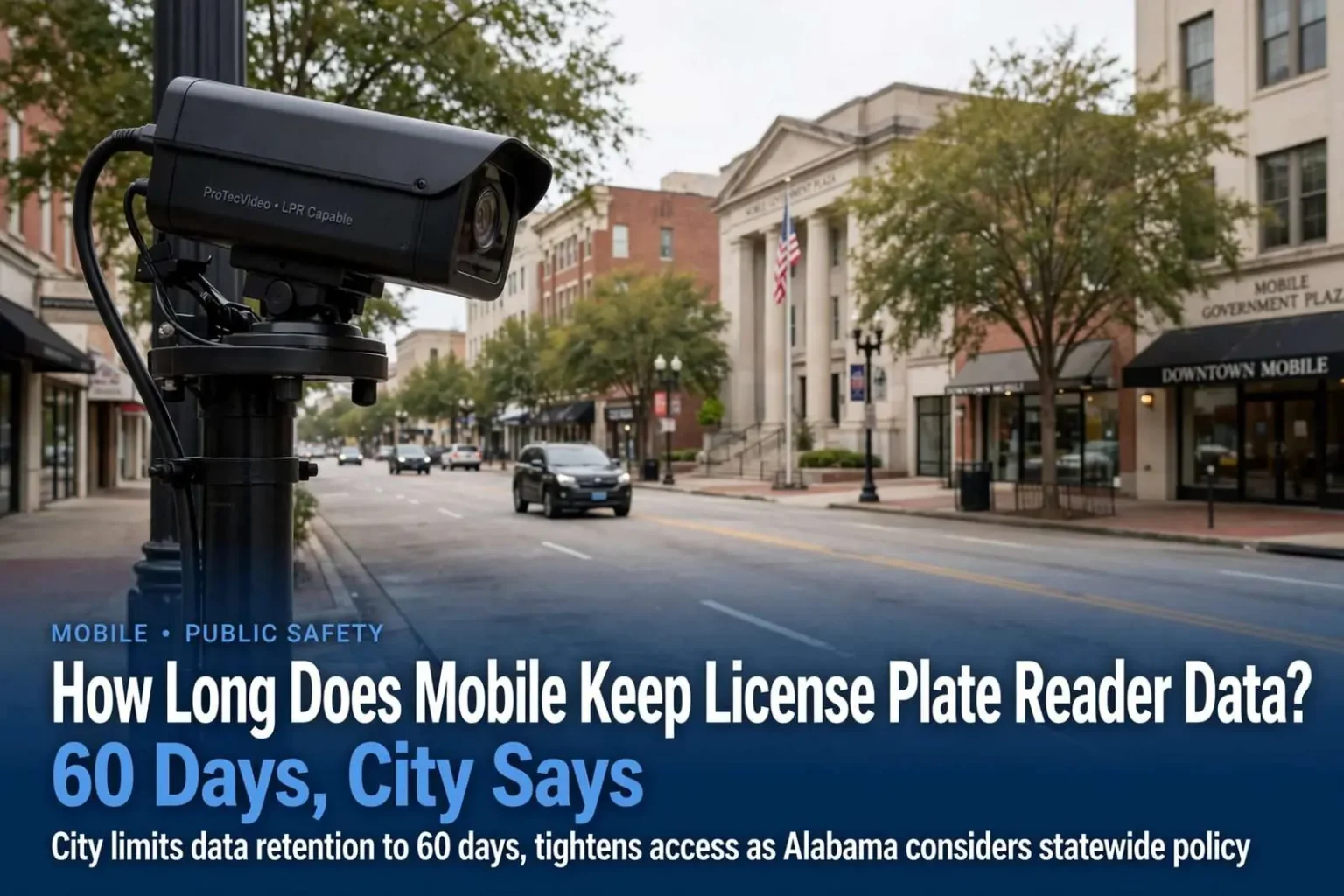
As license plate reader technology faces growing scrutiny across Alabama, the City of Mobile is detailing how it uses the tools — and how long it holds onto what they collect. The question surfaced during Tuesday’s pre-council meeting as the city considered renewing a $695,000 contract with ProTecVideo to maintain its citywide camera network.
The discussion highlights a tension playing out in cities across Alabama between public-safety officials who say license plate readers help solve crimes and locate missing people, and privacy advocates who want tighter limits on how long the resulting data is stored. Mobile’s response, at least so far, has been to lean toward shorter retention and stricter access controls.
Council Member Raises Concerns
Councilman Ben Reynolds raised concerns about data collection and protection. “We all should have concerns that while we do have the Fourth Amendment protections from the government, you’ve got to make sure that those are strictly adhered to, and you have a layered protection process,” Reynolds said. His remarks echoed concerns raised in other Alabama cities about how long license plate data is kept and who is allowed to see it.
Not Flock — But LPR Capable
Much of the recent controversy around Alabama has centered on Flock, a license plate reader brand Mobile does not use. Mobile Public Safety Executive Director Curtis Graves said the ProTecVideo contract is not specifically for plate readers, but many cameras throughout the city do have LPR capabilities. He defended the technology as a critical public safety tool.
“It could be a stolen car. It could be a missing child. You name it. It could be any of those things. And having cameras in places where you can’t have bodies is very important,” Graves said. He declined to say how many cameras have LPR capability or where they are located. That reticence is itself part of a broader national pattern in which law enforcement agencies have resisted disclosing exact camera locations for fear of tipping off suspects to which intersections are monitored.
60 Days, Unless It’s Part of an Investigation
While Alabama law allows LPR data to be stored for up to five years, Graves said Mobile keeps the data for just 60 days unless it is connected to a pending investigation. Access, he said, is tightly restricted. “We are very disciplined on how and who we give access to that ability to. So, to have an officer off the street just access data to that point would not be possible with us,” he said. Graves added that queries of the system are themselves logged and audited, and that supervisors review access patterns.
Mobile’s 60-day retention policy is notably shorter than the five years allowed under current state law, and shorter than the retention windows used by some peer cities in the Southeast. Privacy advocates have argued that the longer data is retained, the higher the risk that it can be misused — for immigration enforcement, civil process, or simply bulk surveillance of neighborhoods that have not been implicated in any specific investigation.
Statewide Scrutiny
The privacy debate is not hypothetical. Two police departments outside Birmingham have confirmed that two former officers are no longer employed following separate internal investigations into their use of Flock license plate reader systems — fueling concerns about potential misuse of the technology.
State Sen. Arthur Orr, R-Decatur, said those cases are getting lawmakers’ attention. “The public is kind of tuning in to what is transpiring as they go down the roadways. Their movements are being tracked and potentially recorded for who knows how long,” Orr said. Orr has been among the legislators pushing for a re-examination of the five-year retention window that Alabama currently allows.
What It Means for Mobile
For Mobile, the 60-day retention policy and restricted access model position the city on the more conservative end of the spectrum as state officials weigh whether Alabama’s five-year allowance should be tightened. Graves suggested the city’s posture has worked well in practice, allowing investigators to act on serious crimes while not stockpiling location data on residents who have done nothing wrong.
Council members are expected to take up the ProTecVideo contract renewal in the coming weeks. Even if the contract is approved, the broader debate over how long license plate reader data should be retained is likely to continue at the state level, and Mobile’s own policy could be revisited if the legislature mandates a uniform statewide standard.
For residents, the takeaway is that Mobile’s cameras — like those in most peer cities — are likely watching more intersections than they used to, but the city’s data is being rolled off the servers much faster than state law would allow. How long that policy holds may depend as much on what happens in Montgomery as on what happens inside Mobile City Hall.
What Other Alabama Cities Are Doing
Other Alabama cities have responded to the privacy debate in different ways. Huntsville has shortened its retention window for Flock data, while several smaller departments have continued to follow the five-year default allowed by state law. State lawmakers have indicated that they want a more uniform standard, but it is not yet clear whether the next legislative session will produce a specific cap or simply require more detailed reporting from each agency.
What the Council Is Expected to Do Next
Mobile’s council is expected to take up the ProTecVideo contract renewal in the coming weeks. Council members have signaled that they are likely to ask for written confirmation of the city’s retention and access policies before voting on the renewal, and Graves has indicated the city can produce that documentation. The contract itself is a routine renewal of an existing camera maintenance arrangement, but the public discussion has turned it into a referendum on how Mobile balances public safety and privacy.
How Residents Can Stay Informed
Residents who want to track the council’s discussion of the ProTecVideo contract can watch meetings live on the city’s website or attend in person at Mobile Government Plaza. Meeting agendas, supporting documents and archived video are posted online. State-level updates on license plate reader policy will be tracked through the Alabama Legislature’s website, where prefiled bills and committee schedules are updated daily during the session.
What ‘LPR Capable’ Really Means
Grave’s clarification that the ProTecVideo contract is not specifically a plate-reader contract but that many of the cameras are LPR capable is a common distinction. Many modern city camera installations come with plate-reading as a default or optional feature, and the cameras themselves often serve dual purposes — general surveillance, traffic monitoring and license plate capture. Cities that have not previously disclosed LPR capability have come under criticism for failing to be transparent about what their cameras actually do, and Mobile’s disclosure is part of a broader effort to get ahead of those concerns.
How Federal Funding Could Affect the Conversation
Federal dollars that cities receive for camera networks sometimes come with strings attached about data retention and access, and those conditions can shape local policy even when state law is permissive. Mobile’s existing camera network is largely funded through local sources, but future federal grants for public-safety technology could come with conditions that push the city toward a shorter retention window or stricter access controls. That, in turn, could shape the council’s thinking on the ProTecVideo renewal and on future technology purchases.
What Council Members Are Likely to Ask
Council members are likely to ask Graves and other public-safety officials specific questions about how the data is stored, who has access to it, how long it is retained, and what oversight mechanisms are in place to prevent abuse. They may also ask for a written policy that can be shared with residents, in plain language, about how the camera network is used and what rights residents have if they believe they have been improperly captured by the system. Public-safety officials have generally welcomed those questions as a chance to demonstrate that the city’s practices are more conservative than state law requires.
How the Conversation Could Spread
Mobile’s decision to publish its 60-day retention policy could become a model for other Alabama cities looking to balance public safety with privacy concerns. Several cities have been quietly updating their policies as the state-level debate has intensified, and Mobile’s posture — short retention, restricted access, audited queries — has been cited by privacy advocates as a reasonable middle ground. As the state legislature considers whether to tighten the five-year default, Mobile’s example may end up being part of the discussion in committee hearings and floor debates.
How the Privacy Debate Could Move to the Statehouse
Several Alabama legislators have indicated they want to revisit the state’s five-year retention allowance in the next session. Some have floated a default of one year, with extensions only when data is tied to an active investigation. Others have proposed outright bans on certain uses of license plate reader data, such as immigration enforcement or bulk tracking of vehicles at political gatherings. Mobile’s 60-day policy is unlikely to become the statewide default, but it has given privacy advocates a concrete example to point to when arguing for tighter limits.