How Two Teachers Beat Rising Prices at Jazz Fest 2026: They Volunteered
Facing higher ticket prices, a pair of longtime fans volunteered at the 2026 New Orleans Jazz and Heritage Festival and found a way to be part of the music, food and history.
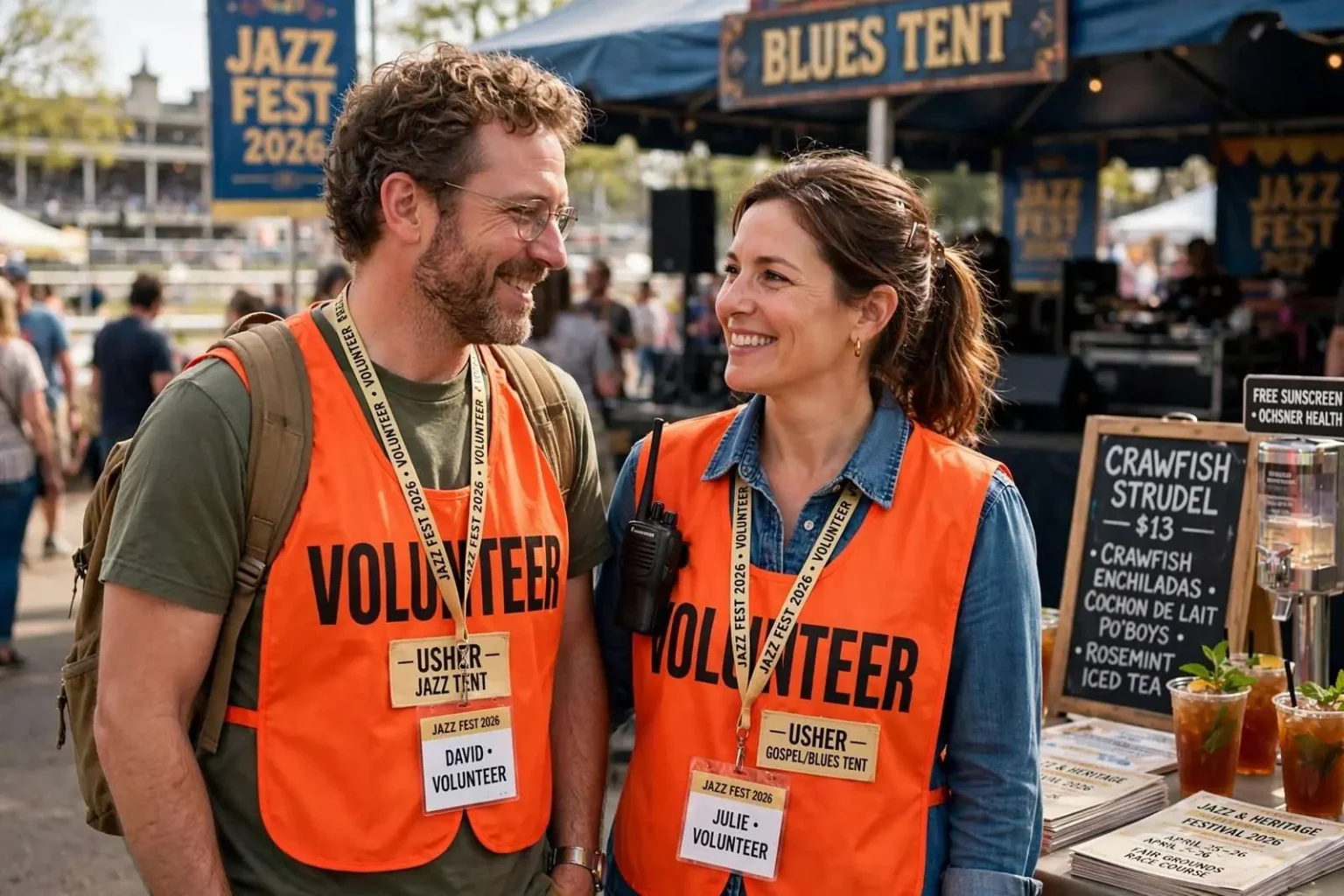
Crawfish bread, cochon de lait po’boys, boudin balls, catfish almondine, soft-shell crab po’boys, crawfish enchiladas, crawfish strudel and tall cups of rosemint herbal iced tea. For many Gulf Coast music lovers, that menu alone is reason enough to make the drive to New Orleans each spring. Add eight days of music from 11 a.m. to 7 p.m., seven stages, seven tents and roughly 5,000 musicians making up about 600 acts, and it is easy to see why the New Orleans Jazz and Heritage Festival has become an annual pilgrimage.
But the price of a Jazz Fest ticket has climbed steadily, and for one couple of longtime fans, both public school teachers raising four children, the 2026 festival nearly became the first they would miss. Instead, they found a workaround that more budget-conscious fans may want to consider: volunteering.
From 350 Fans to Nearly Half a Million
Jazz Fest’s growth is one of the great success stories in American live music. The first festival, held on April 22, 1970, in Beauregard Square, the historic gathering place now known as Congo Square, drew about 350 people, fewer than the musicians and staff on hand. Tickets cost $3. The headliners were Mahalia Jackson, Duke Ellington and Fats Domino, with a lineup that also included Al Hirt, Pete Fountain, The Meters and the Preservation Hall Jazz Band.
In 1972, the festival moved to the Fair Grounds Race Course, which has been its home ever since. The 2026 edition was expected to draw close to 500,000 people. Single-day tickets ranged from $109 to $170, with four-day weekend passes at $460. Headliners included Stevie Nicks, Rod Stewart, David Byrne and the Eagles, joined by acts such as Jason Isbell, Tyler Childers, Nas, Widespread Panic, Lainey Wilson and Alabama Shakes, among many more.
Choosing what to see and what to eat is part of the fun. Doing it all is impossible, and trying is what brings people back year after year.
A Love Story Built Around the Fair Grounds
For this couple, Jazz Fest is woven into their relationship. The husband first attended in 1998, when tickets were $20, and saw Jimmy Buffett live for the first time. He was hooked on both. His wife, Julie, grew up in New Orleans, where her father worked for Shell, the festival’s longtime presenting sponsor, which gave her a very different experience of the event, complete with hospitality lounge access and air-conditioned restrooms. Her father has since retired, and these days she experiences the festival like everyone else.
The two met in April 2017 and attended their first Jazz Fest together the following month. When Dave Matthews Band and Wilco were scheduled at the same time, he asked which she preferred. She chose Wilco, and he knew then they would be attending many festivals together.
They have not missed a year since. When the festival was canceled in 2020 and 2021 because of the COVID-19 pandemic, they joined in the broadcasts of past performances aired on New Orleans radio, and some bands played live over Zoom. The couple also hosted a backyard show at their home, giving New Orleans musician Mike Doussan a rare live audience during a difficult stretch for working musicians.
Volunteering as a Way In
With prices well above pre-pandemic levels, the couple considered skipping Jazz Fest in 2026 and attending only French Quarter Fest, the large free festival held in the French Quarter the weekend before Jazz Fest begins. But giving up Jazz Fest would have broken their hearts. So they applied to volunteer.
Jazz Fest relies on a volunteer force of nearly 1,000 people covering some 3,500 four-hour shifts. Julie had volunteered before and knew the arrangement: work a half-day shift, then enjoy the festival for the rest of the day. Applications are handled on a first-come, first-served basis, with returning volunteers given priority. The couple applied the day applications opened in late January, and because of Julie’s prior service, they landed on the priority list.
For the first weekend, they were assigned to work 2 to 6:30 p.m. as ushers for the major tent venues: the Economy Hall, Gospel, Blues and Jazz tents. That schedule allowed them to arrive when gates opened, enjoy the relatively quiet morning before the crowds, and then work in the tents with music playing all afternoon.
Saturday, April 25: Storms, Strudel and Zydeco
The first Saturday, April 25, started with a jolt. At 6:30 a.m., the couple’s phones blared an emergency alert for a tornado warning, followed by about two hours of torrential rain. Veteran festivalgoers know what heavy rain usually means at the Fair Grounds: mud. Longtime fans may remember the days when some attendees went mud sliding across the soggy infield, though that tradition has largely faded.
By the time gates opened, the storms had moved on and the sun was out. Thanks to a recent drought and changes made by organizers, the grounds were surprisingly dry. At the Congo Square stage, HaSizzle was already filling the morning with New Orleans bounce music.
Food came next. Crawfish bread is a traditional first stop, but word of the crawfish strudel led them to split one for $13. It was overstuffed with creamy crawfish filling inside a thin fried shell, good enough that they bought another on day two. On the way to the Blues Tent, they stopped at free sunscreen dispensers provided by Ochsner Health, which many festivalgoers used throughout the day.
In the Blues Tent, the trio Tin Men played originals and classic covers, including Allen Toussaint’s “Got Me a New Love Thing.” The group features Matt Perrine on sousaphone, Washboard Chaz and Alex McMurray on vocals and guitar, and fans do not have to wait for Jazz Fest to see them: the band has held a regular Monday slot from 5 to 8 p.m. at Fritzel’s.
Across the grounds at the Gentilly Stage, Dwayne Dopsie and the Zydeco Hellraisers delivered a high-energy set. Dopsie is the son of zydeco great Rockin’ Dopsie, whose band was taken over by Dwayne’s brother, Rockin’ Dopsie Jr., after their father’s death in 1993. Dwayne leads his own group and has been called the “Jimi Hendrix of the Accordion,” a nickname that makes sense the moment he starts playing.
Then more food: crawfish enchiladas and a Natchitoches meat pie, one of Louisiana’s official state foods. They caught the final song from Little Freddie King in the Blues Tent. Originally from McComb, Mississippi, King moved to New Orleans at 14 and has played Jazz Fest for 42 years.
Grandstand Interviews and a Shift in the Jazz Tent
After checking in with their shift supervisor, Billy, the couple was assigned to the Jazz Tent, with a half-hour to spare before duty. They spent it in the air-conditioned grandstand, listening to an interview with HaSizzle. He described growing up in the Calliope neighborhood, surrounded by music and block parties during the height of Master P’s popularity. The Neville Brothers and The Dixie Cups also came from the area. He recalled being surprised on his first trip to New York that people did not return his friendly “good morning” greetings, a custom he had grown up with in New Orleans. His hope, he said, is that his music inspires people to “release their wiggle”: get up, dance, enjoy yourself and don’t hurt anybody. The grandstand interviews are a favorite part of the festival for many regulars.
Their shift involved ushering the aisles and assisting with ADA seating. Julie, who makes friends easily, quickly bonded with the tent’s security guard and their shift supervisor. She also helped seat former New Orleans Saints player Steve Gleason, the beloved No. 37 who has lived for years with ALS, for John Boutte’s performance, and she drew a few smiles from him. Boutte, raised in New Orleans’ 7th Ward, is often recognized as best male vocalist in OffBeat magazine’s annual reader and critic honors and wrote the theme song for the HBO series Treme.
Saxophonist Dave Koz followed, taking the stage with a band in brightly colored suits and keeping the crowd moving until the final horn note.
When their shift ended at 6:30, they turned in their vests and avoided the enormous crowd at Stevie Nicks’ main stage set by walking along the racetrack to the Gentilly Stage for Tyler Childers. Rain returned during “House Fire,” but after a morning that many had expected to be a washout, no one seemed to mind. Childers closed with an acoustic “Lady May.” The night ended at Melba’s, the popular po’boy shop known for its childhood literacy efforts, where buying a book can earn customers a free treat. After 15,000 steps, a shrimp po’boy and a debris po’boy felt well earned.
Sunday: Tributes and Headliners
Day two opened with 16-year-old River Eckert in the Blues Tent, followed by another crawfish strudel, a Jamaican combo plate of chicken on a stick, sauteed spinach and fried plantains, and a frozen rum punch. In the grandstand, Anne Lloyd demonstrated how to make boudin balls.
One of the weekend’s most moving moments came during a tribute to Marcia Ball, the Texas-Louisiana piano player recently diagnosed with ALS. She sat beside the stage as her band played her songs, then was led to the piano to join them for “Where Do You Go?” Jon Batiste closed the Blues Tent with the first performance of The Swamp, a work many expect could eventually become a theatrical musical. On the main stage, 81-year-old Rod Stewart sang “Have I Told You Lately That I Love You?” A stop for crawfish bread meant the couple arrived just as David Byrne finished “Burning Down the House.”
Tips for Volunteering at Jazz Fest
For Gulf Coast residents who love the festival but balk at the cost, volunteering is worth a look. A few things to keep in mind:
- Apply early. Applications open in the winter and are processed first-come, first-served.
- Experience helps. Returning volunteers receive priority, so a first year can open doors for future festivals.
- Expect a half-day commitment. Shifts are about four hours, leaving the rest of the day to enjoy the music.
- Plan for weather. Spring storms, heat and sun are all part of the experience, so bring rain gear and sunscreen.
- Check official details. Dates, policies and application windows change year to year, so confirm with festival organizers.
As the couple discovered, volunteering did more than make the festival affordable. It made them part of it.
Related coverage from South AL News
- A Full Week in New Orleans: Gretna, River Road and the Sights Locals Skip
- Fifty-Two Years Between Encores: From the Mobile Civic Center in 1972 to Jazz Fest With the Stones
- Parrot Heads Flock to Gulf Shores and Orange Beach as 34th Meeting of the Minds Gets Underway
- The Haven to host 2026 Tails of Hope Gala at Daphne Civic Center Oct. 1