HUKA Entertainment Poised to Bring New Life to Mobile’s Saenger Theatre
HUKA Entertainment outlined its vision for booking and revitalizing Mobile's historic Saenger Theatre through a new partnership with venue management firm.
A New Era for a Historic Stage
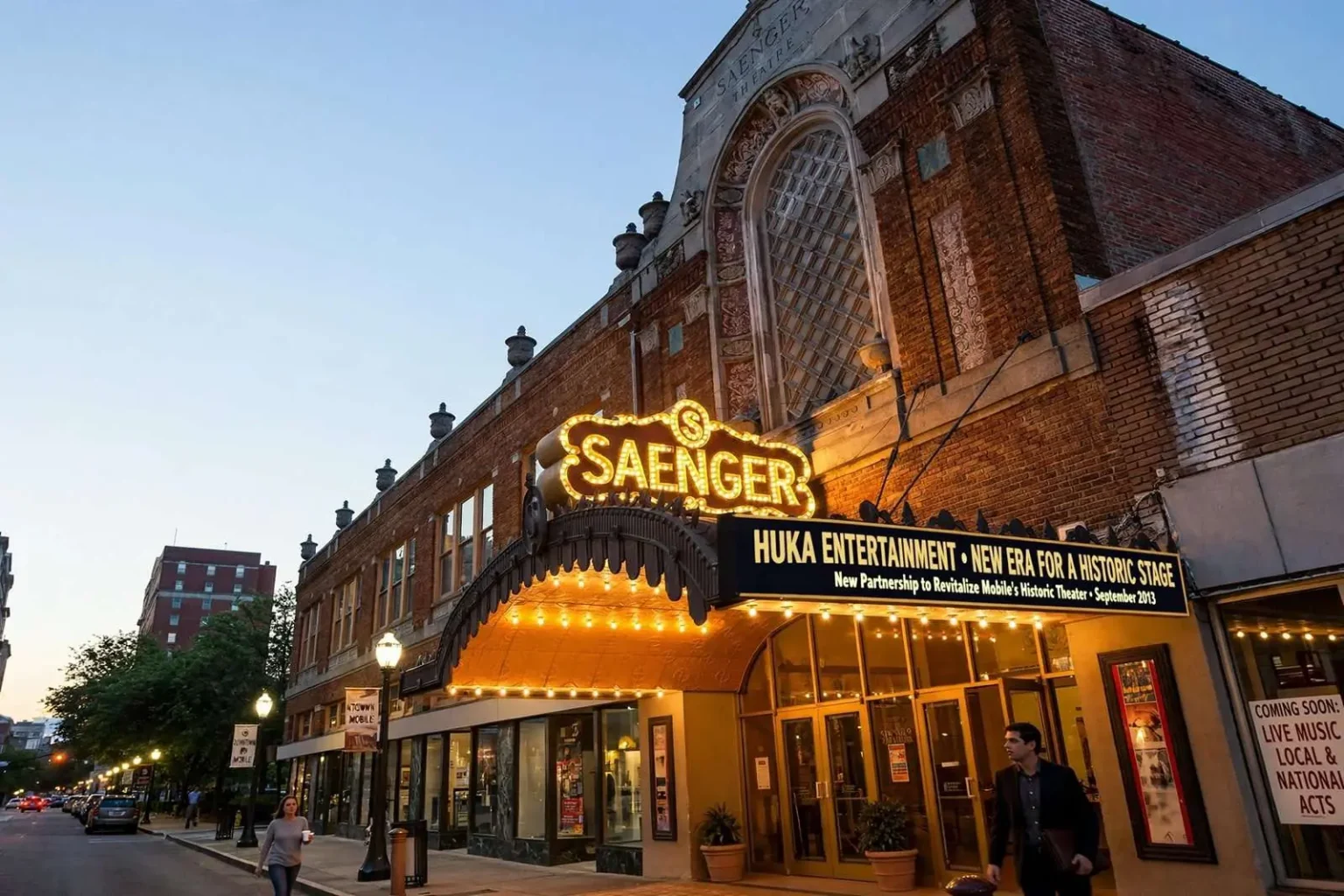
As the Mobile City Council prepared to vote on a proposal to have SMG manage the historic Saenger Theatre with HUKA Entertainment handling show bookings, HUKA representative Ryan Chavez outlined the company’s vision for the beloved downtown venue in a September 2013 interview. The arrangement, if approved, would pair one of the world’s largest facility management firms with a Mobile-rooted production company that knows the local market from the inside.
For the Saenger — the ornate 1920s movie palace on Joachim Street that long ago became Mobile’s signature indoor concert stage — the question before the council was practical: how to keep a historic venue busy, well-run and financially healthy in a market where touring acts have plenty of options. The proposed answer splits the job in two, with SMG running the building and HUKA filling its calendar.
A Natural Partnership
HUKA Entertainment, a full-service production company with deep roots in Mobile, had been producing club and theater shows in the Southeast for more than a decade, including a significant history in the Mobile market. The company had also earned a national reputation through its work on major music festivals, including the Hangout Music Festival in Gulf Shores and the BUKU Music + Art Project in New Orleans, and was preparing to launch its first international event in 2014.
That résumé is what made the company a credible booking partner for a theater of the Saenger’s size and history. HUKA’s rise from local club shows to two of the Gulf South’s most prominent festivals — the Hangout on the beach in Gulf Shores each May, BUKU at the New Orleans riverfront — tracked the growth of the region’s live-music economy, and gave the firm relationships with agents and touring acts across the country.
The partnership with SMG, a worldwide leader in facility management overseeing more than 230 venues, came together after the two organizations recognized complementary strengths during the initial request-for-proposals process. SMG would handle day-to-day facility operations while HUKA would take responsibility for booking and marketing performances at the theater.
The division of labor answered a question that has shaped venue debates in Mobile for years: what the city actually needs from a manager. Buildings like the Saenger require professional maintenance, staffing, scheduling and financial reporting — SMG’s core business across its hundreds of arenas, theaters and convention centers — while the harder problem of attracting quality touring acts is fundamentally a booking and marketing challenge, which is where HUKA comes in.
Addressing Community Concerns
Some Mobile residents had expressed concern about SMG’s track record with the Mobile Civic Center, questioning whether the Saenger might face similar challenges. Chavez drew a clear distinction between the two situations, noting that HUKA, not SMG, would bear responsibility for keeping the Saenger’s calendar full. He pointed out that many of the Civic Center’s booking challenges stemmed from the venue itself rather than from management issues.
The distinction matters in the live-entertainment business. A civic arena competes for touring productions in a market defined by its size and its physical plant, while a historic theater like the Saenger wins shows through atmosphere, acoustics and the intimacy that 1,500-seat-class rooms offer. Under the proposed structure, the company whose reputation rides on attracting acts — HUKA — is the same company responsible for the calendar, aligning incentives in a way the Civic Center arrangement never did.
Chavez’s argument to skeptics was essentially that the two venues are different businesses. The Saenger’s problem was never the building’s appeal to artists; it was ensuring someone whose livelihood depends on bookings is contractually accountable for filling the theater night after night.
Diverse Programming and Local Talent
Chavez described a programming philosophy centered on variety, promising something for a wide range of musical tastes. He pointed to HUKA’s track record at the Saenger, which already included performances by artists such as Dr. John, Gov’t Mule, Ani DiFranco, Robert Randolph, Brandi Carlile, and Ryan Adams, and indicated a similar mix would continue under the new arrangement.
That list reads as a deliberate cross-section: New Orleans legend Dr. John, jam-scene staple Gov’t Mule, folk and indie songwriters like Ani DiFranco and Ryan Adams, sacred-steel guitarist Robert Randolph, and Americana favorite Brandi Carlile. The through-line is quality across genres rather than a niche — the programming identity HUKA said it would bring to the venue’s calendar as its booking role expanded.
Chavez also emphasized opportunities for local and regional artists, pointing to the company’s history of building bills that pair national touring acts with Gulf Coast talent. For Mobile musicians, a busier Saenger calendar with an engaged local promoter means more opening slots, more festival connections and more reasons to stay rooted in the city’s scene rather than decamping for New Orleans or Nashville.
What the Deal Would Mean Downtown
The stakes extend beyond the theater’s marquee. The Saenger anchors the Joachim Street entertainment corridor, and every well-attended show sends hundreds of ticket-buyers into downtown restaurants and bars before and after curtain. City officials weighing the contract were effectively weighing a bet on downtown nightlife — that a reliably full theater calendar is one of the cheapest economic development tools a city can buy.
The timing also mattered. Mobile’s downtown revival had been gathering steam through the early 2010s, with new restaurants and residential conversion building on the investments of the previous decade. A theater that sits dark for weeks at a time works against that momentum; one booked 100 nights a year becomes the neighborhood’s engine.
HUKA’s own trajectory gave the proposal added weight. The company’s festival work — most visibly the Hangout Music Festival, which draws tens of thousands to the Gulf Shores beachfront each spring — demonstrated an ability to book national-tier talent and deliver large-scale events on the Gulf Coast, exactly the credibility needed to convince touring acts and their agents that a Mobile theater date belongs on the routing.
The Council’s Decision
For council members, the vote came down to structure as much as substance. The proposal kept day-to-day operations with an experienced professional manager while giving a company with local roots and national reach a contract-level stake in the theater’s success. The model has worked in cities across the country where historic theaters operate under management contracts rather than city staff.
Chavez’s pitch to the city was ultimately about accountability paired with local knowledge: SMG to run the building, HUKA to fill it, and a Mobile company with a decade of Gulf Coast shows behind it answering for the calendar. As the council prepared to vote, the Saenger’s supporters framed the choice simply — a beloved theater, a proven promoter, and a structure built to keep the lights on and the marquee full.
The Saenger’s Place in Mobile History
Part of the Saenger’s mystique is architectural. Built in the 1920s as part of the Saenger theater chain that dotted the South, the building housed a grand movie palace complete with the atmospheric flourishes that made those houses famous, and its restoration preserved the ornate interior that today’s audiences walk into. Generations of Mobilians have seen their first concerts, films and stage shows under its ceiling, and the theater’s survival through the decline of downtown in the late 20th century became one of the preservation community’s proudest stories.
Because of that history, decisions about the theater’s operation attract attention that an ordinary city building would never draw. Residents who grew up attending shows there see the venue as belonging to the city in a deeper sense than the deed records, and any management change is judged against memories as much as against spreadsheets. The council debates over the contract reflected that weight, with supporters and skeptics alike framing the theater as a civic trust to be protected.
The RFP process that produced the SMG-HUKA proposal gave those advocates a formal say, and the complementary-strengths pairing that emerged was shaped by the city’s stated priorities: professional operations, a fuller calendar, and a partner who understands what Mobile audiences will actually buy tickets to see.
Chavez, for his part, pointed to the company’s festival economics as evidence it could deliver. Festivals like the Hangout and BUKU live or die on lineup credibility and audience experience, the same two variables that decide whether a theater’s calendar fills. A company that convinces national acts to play a beach in Gulf Shores each May has demonstrated the pitch-making ability that theater booking requires, applied to a far harder logistics problem than a single downtown stage.
The council’s approval process, meanwhile, gave venue staff and promoters a rare public forum to discuss the business of live music — routing, agents, guarantees and the economics that decide which cities national tours visit. Mobile’s position between New Orleans and the Florida panhandle has always made it a stop that must be won show by show, and the proposal’s backers argued that a dedicated booking partner would win more of those fights than a city-run calendar ever had.