Driver Hurt in Pre-Dawn Truck Rollover on I-10 in Eastern Baldwin County
A 61-year-old man was taken to a hospital after his truck overturned on eastbound Interstate 10 near Rosinton early Wednesday, and state troopers are investigating.
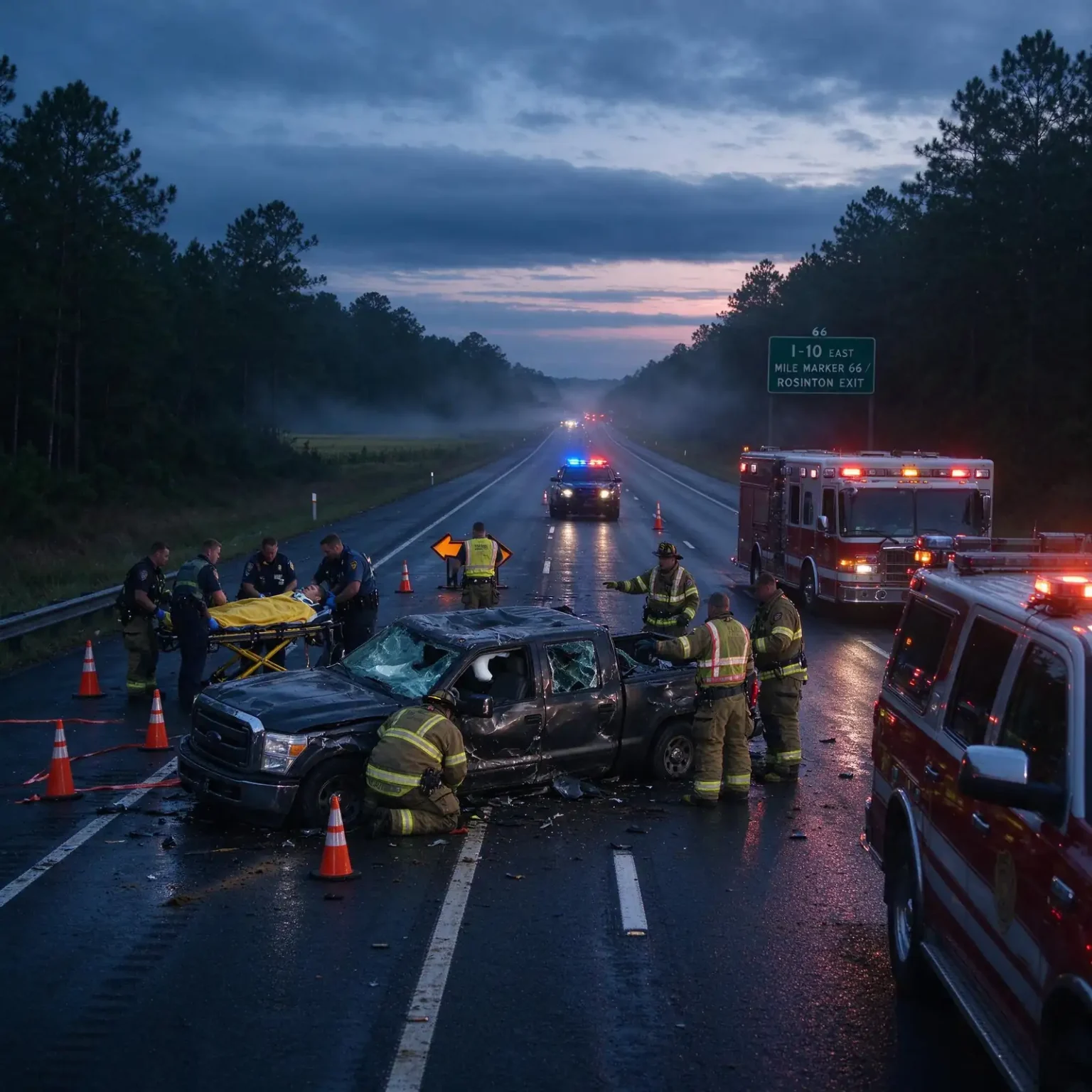
BALDWIN COUNTY, Ala. — A 61-year-old man was hurt early Wednesday, Nov. 25, when the truck he was driving overturned on Interstate 10 in eastern Baldwin County, bringing volunteer firefighters, paramedics and state troopers to the eastbound lanes in the dark hours before dawn. The I-10 rollover crash happened near mile marker 66, close to the Rosinton exit, at about 4 a.m. The man was taken to a hospital with injuries described as not life-threatening, and the Alabama Law Enforcement Agency is investigating.
What Responders Found
Law enforcement officials said the driver lost control of the eastbound truck, which then rolled over. When emergency crews reached the scene, they found the man injured and lying on the ground outside the vehicle. Authorities have not said how he came to be outside the truck, what caused him to lose control, or whether anyone else was in the vehicle; no other injuries were reported.
Several volunteer fire departments from the surrounding area answered the call along with emergency medical services and ALEA troopers. Paramedics cared for the man at the roadside before an ambulance took him to an area hospital. Officials did not identify the hospital or release the man’s name.
Weather Kept the Medical Helicopter on the Ground
A medical helicopter was also requested, a common step when rescuers first learn of a rollover with a possibly seriously injured person. The flight was called off because the cloud ceiling was too low for the aircraft to fly safely.
The ceiling is the height of the lowest layer of clouds that covers much of the sky. Air ambulance crews follow federal weather minimums for cloud height and visibility, and low clouds or fog can ground an aircraft even when conditions on the road seem manageable. When that happens, ground ambulances take over the transport, as they did Wednesday. In this case, the driver’s injuries were ultimately judged not to be life-threatening.
Traffic Impact on the Interstate
At least one eastbound lane was blocked while crews worked so that firefighters, medics and troopers had room to operate safely beside moving traffic. A wrecker later hauled the damaged truck away, and all lanes were reopened afterward. Officials did not say exactly how long the lane closure lasted, but the early hour meant traffic was far lighter than it would have been during a weekday commute or the heavy holiday travel expected later in the week.
The stretch of I-10 that crosses Baldwin County carries a steady stream of traffic between Mobile and the Florida Panhandle, including commuters, tourists headed to the Gulf Coast, and long-haul trucks moving freight along the national interstate network. Alabama’s portion of the highway ends at the Perdido River, which forms the state line with Florida, so mile marker 66 sits near the eastern edge of the state. Even a single lane closure along that corridor can slow traffic quickly when volume is heavy.
Who Investigates Crashes Like This
ALEA’s Highway Patrol Division handles crash investigations on Alabama’s interstates and on many roads outside city limits. Troopers typically document the scene, measure where the vehicle came to rest, examine roadway markings, review vehicle damage and speak with anyone who saw what happened. Their findings go into an official crash report, and in some cases investigators also consider whether traffic laws were broken.
No cause had been announced as of Thursday, and the agency has not said whether any citations are expected. Investigations of single-vehicle crashes often look at a range of possible factors, including speed, road and weather conditions, mechanical problems, distraction and fatigue. Until troopers complete their work, any of those possibilities remains just that.
About Rosinton and the Volunteer Departments That Responded
Rosinton is a small unincorporated community in east-central Baldwin County, in a largely rural area of farmland and woods between the larger towns of the county’s interior. Like much of rural Baldwin County, the area depends heavily on volunteer fire departments, whose members train in fire suppression, vehicle extrication and emergency medical first response and who often are the first to reach crashes on nearby highways, including the interstate.
When a serious crash is reported, it is common for more than one volunteer department to respond so that enough people and equipment are on hand to stabilize the vehicle, care for the injured, protect the scene from passing traffic and clean up debris or fluids. Those crews work alongside county EMS providers and state troopers, as they did Wednesday morning.
Why Rollovers Are Taken So Seriously
Rollover crashes make up a relatively small share of all collisions, but the National Highway Traffic Safety Administration notes that they have a higher fatality rate than other types of crashes. Vehicles with a higher center of gravity, such as pickups, SUVs and vans, are generally more likely to tip over once a driver loses control, especially if the vehicle leaves the pavement and its tires dig into soft ground or strike a curb or embankment.
Safety agencies stress that seat belts are the single most effective way to survive a rollover, because they keep occupants inside the vehicle and in position for airbags to work. People thrown from a vehicle during a crash are far more likely to be killed than those who stay inside. Officials have not said whether the driver in Wednesday’s crash was wearing a seat belt.
Safety Reminders for Early Morning and Holiday Drivers
Wednesday’s crash came at the start of one of the busiest travel stretches of the year, as families head to Thanksgiving gatherings and Gulf Coast destinations. Traffic safety agencies offer several reminders that apply to anyone using I-10 or other Baldwin County highways in the coming days:
- Watch for fatigue. Federal safety researchers have found that drowsy-driving crashes are most common late at night and in the early morning hours. Drivers who feel tired should pull over at a safe location, rest or switch drivers.
- Slow down in wet or foggy conditions. Reduced visibility and slick pavement leave less room for error, and sudden steering corrections at highway speed can cause a vehicle to roll.
- Buckle up every trip. Every person in the vehicle should be belted or properly secured in a child seat, no matter how short the drive.
- Move over for responders. Alabama’s Move Over law requires drivers approaching stopped emergency vehicles, tow trucks and similar vehicles with flashing lights to move out of the adjacent lane when it is safe or, if they cannot, to slow to at least 15 miles per hour below the posted speed limit.
- Check conditions before leaving. The Alabama Department of Transportation’s ALGO Traffic service posts information on crashes, lane closures and construction along state highways and interstates.
Secondary Crashes and Scene Safety
Lane closures like the one on Wednesday are about more than giving crews elbow room. Federal highway officials warn that secondary crashes, which happen when approaching drivers fail to notice or react to an existing crash scene, are a real danger to both motorists and responders. Firefighters, troopers and tow operators working beside interstate traffic are especially vulnerable, which is why responders often park their vehicles to block a lane and why drivers are urged to slow down, avoid gawking and follow directions from anyone managing traffic at the scene.
If You Come Upon a Crash
Motorists who are first to arrive at a wreck can help without putting themselves in danger. Safety officials advise calling 911 right away and giving the dispatcher the clearest location possible, such as the highway, direction of travel and the nearest mile marker or exit, which is exactly the kind of detail that helped direct crews to Wednesday’s scene. Drivers who stop should pull well off the roadway, turn on their hazard lights and stay away from moving traffic. Unless there is an immediate threat such as fire, it is generally best not to move an injured person, because doing so can worsen a neck or back injury. Staying on the line with the dispatcher until help arrives allows trained call-takers to give instructions.
What Comes Next
ALEA’s investigation will determine what led to the crash. People involved in a crash worked by state troopers can generally request a copy of the crash report from ALEA once it has been completed. Anyone who saw the truck before or during the wreck and has not already spoken with investigators can contact ALEA’s Highway Patrol Division.
For now, the key facts are these: a 61-year-old driver survived a pre-dawn rollover on I-10 near Rosinton, local volunteers and medics got him to a hospital after the weather grounded a medical helicopter, and the interstate was cleared and reopened later that morning.