Infirmary Health named one of Forbes’ Best Places to Work for second straight year
Forbes has named Infirmary Health one of the Best Places to Work and the top healthcare employer in Alabama for the second year in a row.
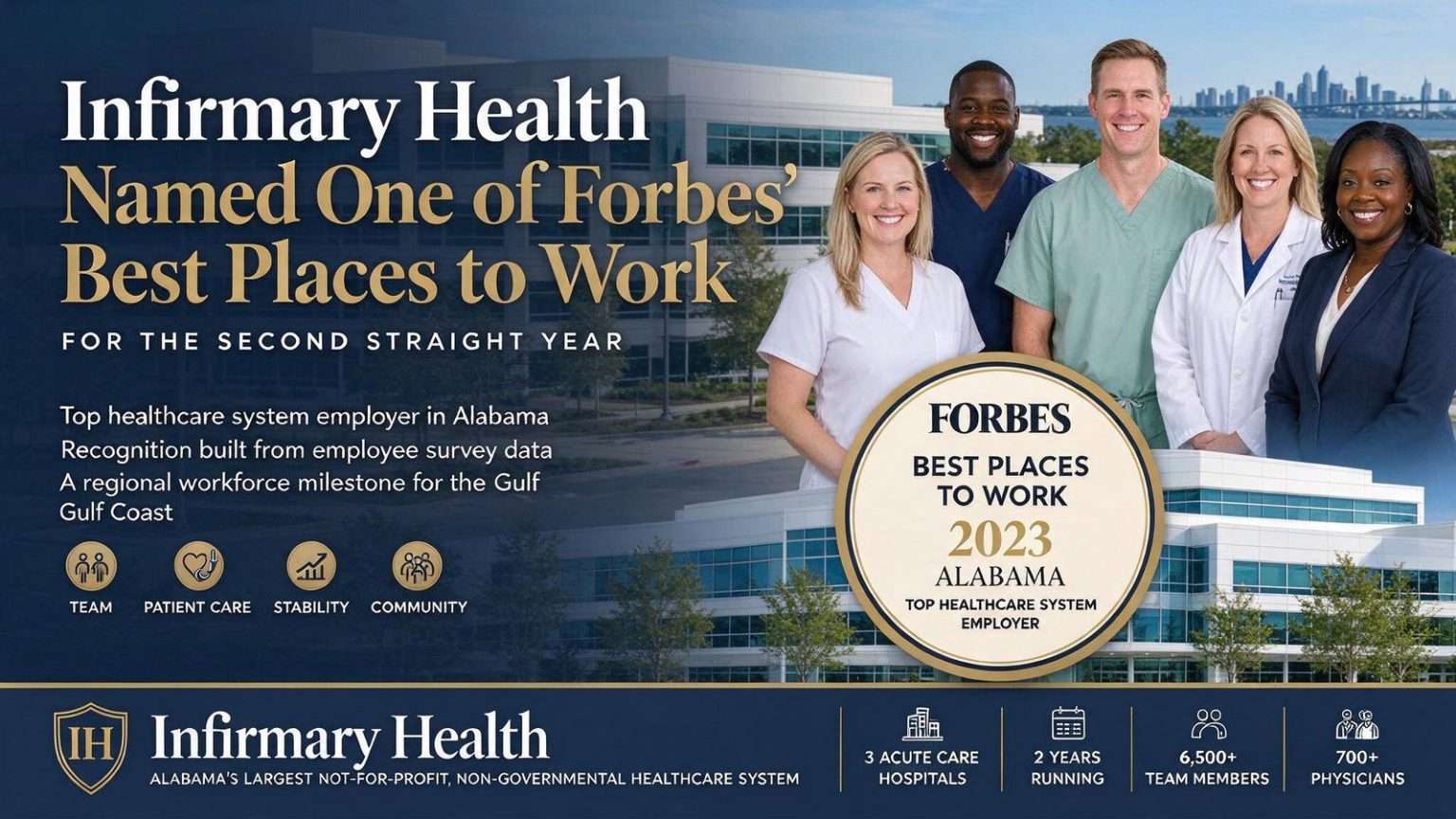
Forbes has recognized Infirmary Health as one of the Best Places to Work and the top healthcare system employer in Alabama for the second consecutive year. The honor, compiled through a national assessment of employers across every industry, lands in a healthcare labor market that has been among the most competitive in the country since the pandemic reshaped hospital staffing. For the Gulf Coast’s largest health system, holding the top state ranking two years running is a marker of stability in a sector where turnover has been the norm.
The honor follows Infirmary Health’s recognition in 2022, making this the second year in a row the system has earned a spot on the national list. Repeat recognition matters because the Forbes list is not a one-time application award; it draws on large-scale survey data about how employees themselves rate their workplaces. A second consecutive appearance suggests that the workforce experience measured in the first year held up as the organization continued to grow and absorb the pressures facing hospitals everywhere.
Infirmary Health is the largest not-for-profit, non-governmental healthcare system in Alabama. That status shapes how the organization operates: as an independent nonprofit, its earnings are reinvested into facilities, equipment and community health programs rather than distributed to shareholders or a government treasury. Nonprofit systems like Infirmary Health also carry an obligation to serve their communities’ broader health needs, from charity care to education and outreach programs that operate beyond hospital walls.
The system operates three acute care hospitals across Mobile and Baldwin counties, one post-acute care hospital, two rehabilitation hospitals, more than 60 physician practice locations and other affiliates. The footprint spans the central Gulf Coast, from the Mobile Infirmary campus in midtown Mobile to facilities serving Baldwin County’s fast-growing communities across the bay. That reach makes the system’s employment practices a matter of regional consequence, since its hiring and retention affect healthcare access for hundreds of thousands of residents on both sides of Mobile Bay.
The system employs more than 6,500 staff members and has more than 700 physicians on its medical staff. As one of the largest employers in southwest Alabama, Infirmary Health’s workforce dwarfs many of the region’s other major industries, and its payroll, training programs and benefits ripple through the local economy. Every position from nursing and pharmacy to food service and administration represents a household tied to the system’s performance.
What Leadership Says
“At Infirmary Health, our mission is LIFE — Leadership. Integrity. Family. Excellent Service. — and our greatest asset is our team members,” Infirmary Health President and CEO Mark Nix said. “The recognition from Forbes as the best healthcare system employer in Alabama affirms our dedication to our staff and physicians who work to provide high-quality healthcare to our communities.”
Nix added that the organization could not meet the needs of the region without the support and dedication of each team member. The framing reflects how health system leaders have come to talk about workforce after the strains of recent years: retention is not merely a human resources metric but the foundation of the organization’s ability to function. A hospital system cannot expand services, recruit physicians or invest in new technology without the staff to operate them.
How the Forbes Rankings Work
The Forbes Best Places to Work lists are built from surveys of employees across companies, institutions and organizations of every size. Participants respond to questions about working conditions, compensation, trust in leadership, and whether they would recommend their employer to others, with responses weighted and compared across industries and regions. Because the rankings draw on the experiences of the workforce itself rather than employer-submitted materials, they function as a broad measure of workplace reputation.
Healthcare employers face a distinctive challenge in these assessments. Hospital work is physically demanding, emotionally taxing and scheduled around the clock, and the pressures that built up during the pandemic drove many nurses, technicians and support staff out of the field entirely. Systems that score well tend to be those that invested in scheduling flexibility, professional development, safety and a culture where staff feel heard — qualities that surveys measure directly.
For Alabama’s healthcare labor market, the distinction matters because workforce shortages have forced hospitals across the state to rely heavily on travel staff and overtime, both of which strain budgets and workplace culture. Systems that retain their own workforce spend less on contract labor and build deeper institutional experience. In that context, a second consecutive year at the top of the state’s healthcare rankings signals that the system’s approach is holding through a difficult national cycle.
Why It Matters for the Gulf Coast
Infirmary Health’s scale means the recognition reaches beyond its own campuses. A stable, well-regarded workforce at the region’s largest health system affects how quickly patients can get appointments, how long emergency rooms wait times run, and whether specialized services remain available locally rather than requiring travel to New Orleans, Birmingham or Pensacola. Baldwin County’s rapid population growth has increased demand across the bay, making the system’s ability to recruit and retain staff a direct factor in how the region grows.
The system’s more than 60 physician practice locations also anchor primary and specialty care in communities that might otherwise struggle to attract doctors. Physician recruitment depends on the health of the institutions behind the practices — hospital support, staffing depth and organizational reputation all factor into a doctor’s decision to build a practice on the Gulf Coast. Recognition as a top employer strengthens that pitch.
A Mission Built Around the Workforce
The LIFE mission Nix cites — Leadership, Integrity, Family, Excellent Service — functions as the organization’s stated framework for decisions ranging from patient care standards to staffing priorities. Health systems across the country have adopted mission statements in recent decades, but the ones that carry weight with employees are those tied to daily practice: leadership development programs, integrity standards in billing and care, family-oriented benefits, and service expectations that apply from the bedside to the billing office. Rankings built on employee surveys test whether the mission is felt on the floor.
For the more than 6,500 people who work within the system, workplace recognition also carries a practical dimension. Employers known for quality workplaces tend to see stronger applicant pools, which eases the strain of filling shifts and opens career pathways for students in nursing programs at the University of South Alabama, Spring Hill College and the region’s community colleges. Pipeline partnerships between hospitals and local schools have become essential as Alabama competes with neighboring states for clinical talent.
The two-year streak also positions Infirmary Health within a broader narrative about Alabama’s healthcare economy. The state’s hospital sector has faced persistent financial pressure, with rural facilities closing and systems consolidating, and workforce costs have been the fastest-growing expense line for years. A large nonprofit system earning national employer recognition while operating across two counties offers a counterexample to the shortage narrative — one rooted in how staff themselves describe their experience.
Looking Ahead
The challenge for any recognized employer is sustaining the culture that earned the honor. Healthcare demand on the Gulf Coast continues to grow with the region’s population, and every expansion of services depends on adding skilled people, not just buildings. Leadership has framed the award as an affirmation of current staff rather than a destination, a distinction that matters in a field where burnout remains a national concern.
The post-acute and rehabilitation hospitals in the system serve a population that has grown alongside the Gulf Coast’s retirement communities. Patients recovering from strokes, joint replacements and serious injuries often spend weeks in rehabilitation before returning home, and the availability of those beds locally keeps families close during long recoveries. Post-acute care has become one of the fastest-evolving parts of American healthcare, and systems that integrate it with acute hospitals can manage the full arc of a patient’s recovery.
For residents of Mobile and Baldwin counties, the most tangible meaning of the award is continuity: the hospitals, rehabilitation facilities and practices they rely on are staffed by people who, according to the survey data behind the ranking, rate their workplace among the best in the state. In healthcare, that stability translates directly into the quality and availability of care — the difference between a region that keeps its nurses and doctors and one that watches them leave.
The recognition places Infirmary Health alongside employers across Alabama and the nation on one of the most-watched workplace lists in the country, with the added distinction of standing first among the state’s healthcare systems for a second straight year. For an organization whose mission spells out Family as a core value, the honor affirms that the message is being heard by the people who deliver it.