Infirmary Health revises visitor policy for greater flexibility starting Monday
Infirmary Health revised its visitor policies beginning July 5 to give patients and visitors more flexibility, while masks and temperature checks remain.
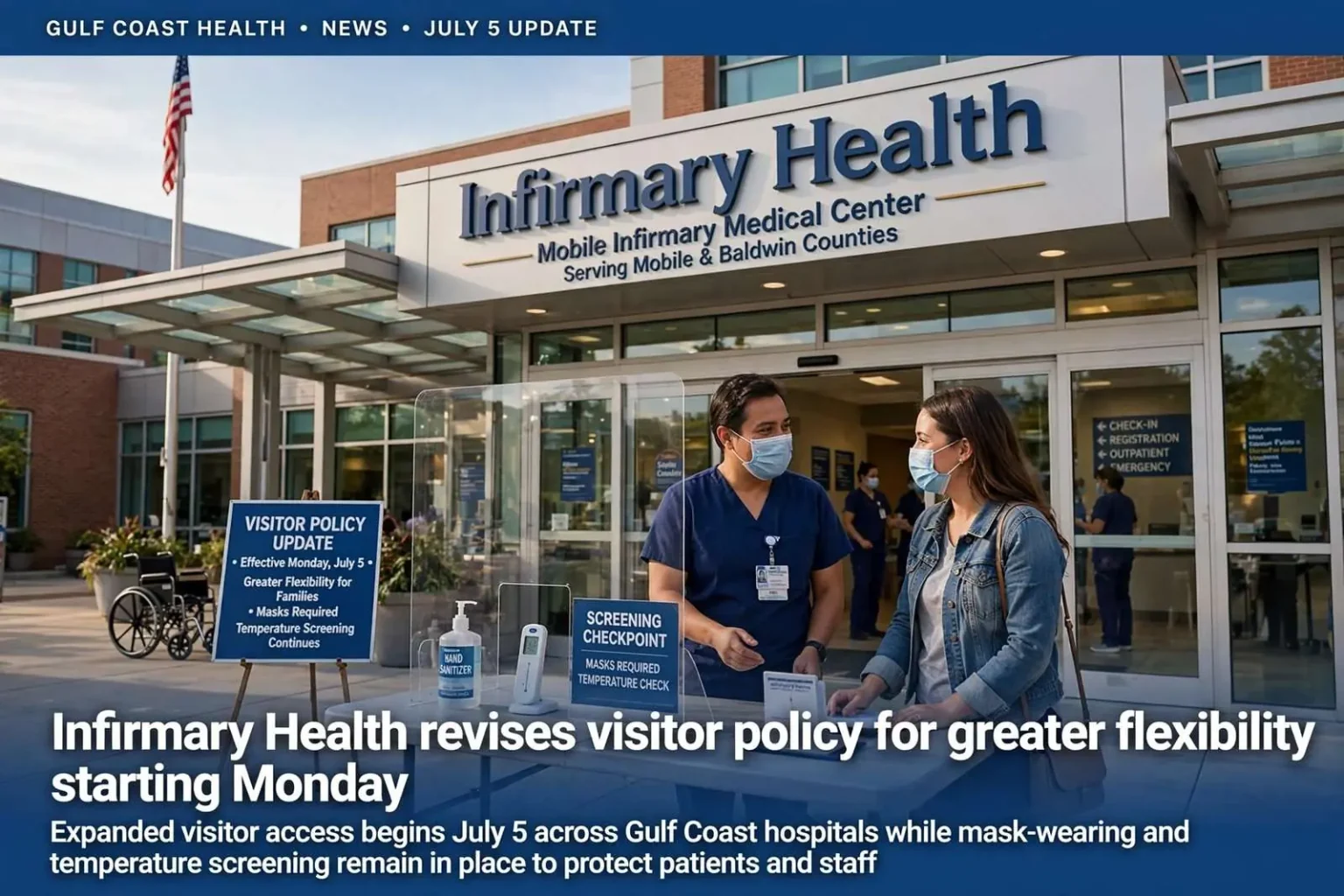
Infirmary Health will roll out revised visitor policies across its hospitals and facilities beginning Monday, July 5, a change the health system says is designed to give patients and visitors greater flexibility while maintaining key safety measures on its campuses. Under the updated approach, mask-wearing remains mandatory inside Infirmary Health facilities, and visitor temperatures will continue to be screened upon entry. The adjustments arrive as hospitals across the Gulf Coast reassess pandemic-era restrictions that, in many cases, have been in place for well over a year.
The health system said the changes are meant to improve the experience for patients and their families while continuing to protect everyone on its campuses — patients, visitors, physicians, nurses, and support staff alike. Detailed visitor hours and policy information are available through Infirmary Health, and the system has encouraged families to check the latest guidance before traveling to a facility, since rules can vary by location and by unit.
A Health System Rooted in the Gulf Coast
Infirmary Health is one of the largest health systems in the region, operating hospitals and clinics across Mobile and Baldwin counties. Its flagship, Mobile Infirmary Medical Center, has served the Port City for well over a century, and the system’s footprint extends across the bay to facilities in Fairhope and Bay Minette, along with an extensive network of outpatient clinics, imaging centers, and specialty practices. For thousands of families in southwest Alabama, a stay at an Infirmary Health hospital — whether for the birth of a child, a surgery, or emergency care — is a familiar and often defining experience.
That scale is part of why visitor policies matter so much here. A single health system’s rules shape how families in Mobile, Baldwin, and surrounding counties experience some of the most important moments of their lives, from welcoming newborns to sitting with aging parents in their final days. When pandemic restrictions sharply limited visitation beginning in 2020, many families were forced to communicate by phone and video from parking lots and living rooms, and hospitals across the country have faced pressure to restore access as conditions allowed.
What Stays the Same
Even as flexibility increases, two pillars of the existing policy remain firmly in place. Mask-wearing will still be required inside all Infirmary Health facilities, consistent with guidance that health care settings have continued to follow even as broader community rules relaxed. Health care environments concentrate both vulnerable patients and continuous close contact, and hospitals nationwide have generally maintained masking requirements longer than retail, dining, and entertainment venues.
Temperature screening upon entry also remains part of the routine. Visitors arriving at a facility should expect the same check-in process they have experienced in recent months, including screening stations and any questions about symptoms or exposure. These measures add only a moment to an arrival, but health officials credit them with helping to keep symptomatic individuals out of patient care areas during a period when a single introduced infection can ripple through a hospital floor.
Why Visitor Policies Matter for Recovery
Hospitals have learned a great deal about the role visitors play in patient recovery since the pandemic curtailed access in 2020. Family members often serve as extra sets of eyes for care teams, noticing changes in a loved one’s condition and relaying medical history that charts alone cannot capture. For elderly patients, familiar faces can reduce confusion and disorientation during hospital stays. For new mothers, partners and support persons are essential parts of the birth experience. For children, a parent’s presence is simply non-negotiable in most circumstances.
At the same time, health systems must balance those benefits against infection control. Patients in intensive care, oncology units, and other high-risk areas face heightened danger from respiratory viruses, and a single infected visitor can expose dozens of people in the course of a day. That tension is what makes incremental policy changes like the one Infirmary Health announced notable: they represent a considered judgment that conditions allow for more access without giving up the core protections.
The timing, in early July, comes as the region moves through the summer season, when hospital emergency departments traditionally see high volumes from travel, heat-related illness, and trauma. Balancing increased visitation against steady patient volume is an operational challenge that hospital staff manage daily, and administrators have generally favored gradual changes that can be adjusted if conditions on the ground shift.
Guidance for Patients and Families
Families preparing for a hospital stay or a visit in the coming days should take a few practical steps. First, check the latest visitor hours and policy details through Infirmary Health’s official channels before heading to a facility, because unit-specific rules — particularly in emergency departments, intensive care units, and obstetrics — may differ from the general policy. Second, plan for the entry process: bring a mask if you have one, allow a few extra minutes for temperature screening and check-in, and be prepared to follow directional signage and any spacing guidance in lobbies and waiting areas.
Visitors who feel ill should postpone their trips, even if masking is required, out of consideration for patients whose immune systems or medical conditions make them especially vulnerable. Care teams can often arrange phone or video updates for family members who cannot be present, a practice that became routine during the height of visitation limits and remains available in most hospitals today. Hospitals have also found that clear, consistent communication about rules reduces friction at the front desk, which is why systems publish their policies prominently and update them in a single place rather than leaving staff to interpret guidance unit by unit.
Patients with scheduled procedures can also help by confirming with their care teams whether a support person may accompany them and at what points during the visit. Surgical areas, pre-operative holding, and recovery units frequently have their own guidelines that are tighter than general visitor rules, and knowing those details in advance prevents confusion on the day of the procedure.
The Regional Context
Infirmary Health’s move fits within a broader pattern along the Gulf Coast, where health systems in Mobile, Baldwin, and the Florida Panhandle have eased visitation rules in stages rather than all at once. Neighboring systems have followed similar templates: restore access first for outpatient and surgical settings, expand hours in inpatient units, and maintain masking and screening as constants. Coordinating those changes regionally matters because families along the coast frequently cross county and state lines for care, and consistent rules reduce the confusion that comes when a relative drives from Baldwin County to Mobile or vice versa expecting a different policy.
The health system’s hospitals also serve as major employers in the two counties, with thousands of workers whose daily experience is shaped by the same policies that govern visitors. Easing restrictions affects staff workflows as well — screening stations, unit clerks who enforce limits, and nurses who mediate between families and rules all feel the effects of any change. Administrators typically consult with clinical leadership and infection prevention specialists before announcing revisions, and the phased approach Infirmary Health has taken reflects that internal review.
Looking Ahead
Whether Monday’s revision represents the final stage of the health system’s return to normal operations or another step in a longer sequence will depend on conditions in the weeks ahead. Health systems across the country have learned to build flexibility into their planning, with policies that can be tightened quickly if circumstances change in their communities. Infirmary Health’s statement emphasized the balance it is trying to strike — improving the experience for patients and their families while continuing to protect everyone on its campuses — and that balance will continue to guide decisions as summer progresses.
For now, the message to families in Mobile and Baldwin counties is straightforward: more access is coming beginning Monday, July 5, but the basics of hospital etiquette during this period remain unchanged. Wear a mask inside. Expect a temperature check at the door. Follow unit rules, check official channels for the latest hours, and stay home if you are sick. Those simple steps are what allow hospitals to keep opening their doors wider — safely — to the families who rely on them in the most difficult and most joyful moments of life on the Gulf Coast.
Patients and visitors with specific questions about a facility, a unit, or an upcoming appointment are encouraged to contact the hospital directly through its main information lines rather than relying on secondhand accounts, since policies and hours can be updated between announcements. The health system has said detailed visitor hours and policy information are available through Infirmary Health, and keeping that guidance close at hand remains the best way to make a hospital visit go smoothly as the new rules take effect.