Infirmary Health to resume elective surgical procedures beginning Friday, May 1
Infirmary Health will resume elective surgical procedures on May 1, following guidance from Alabama health officials during the COVID-19 pandemic.
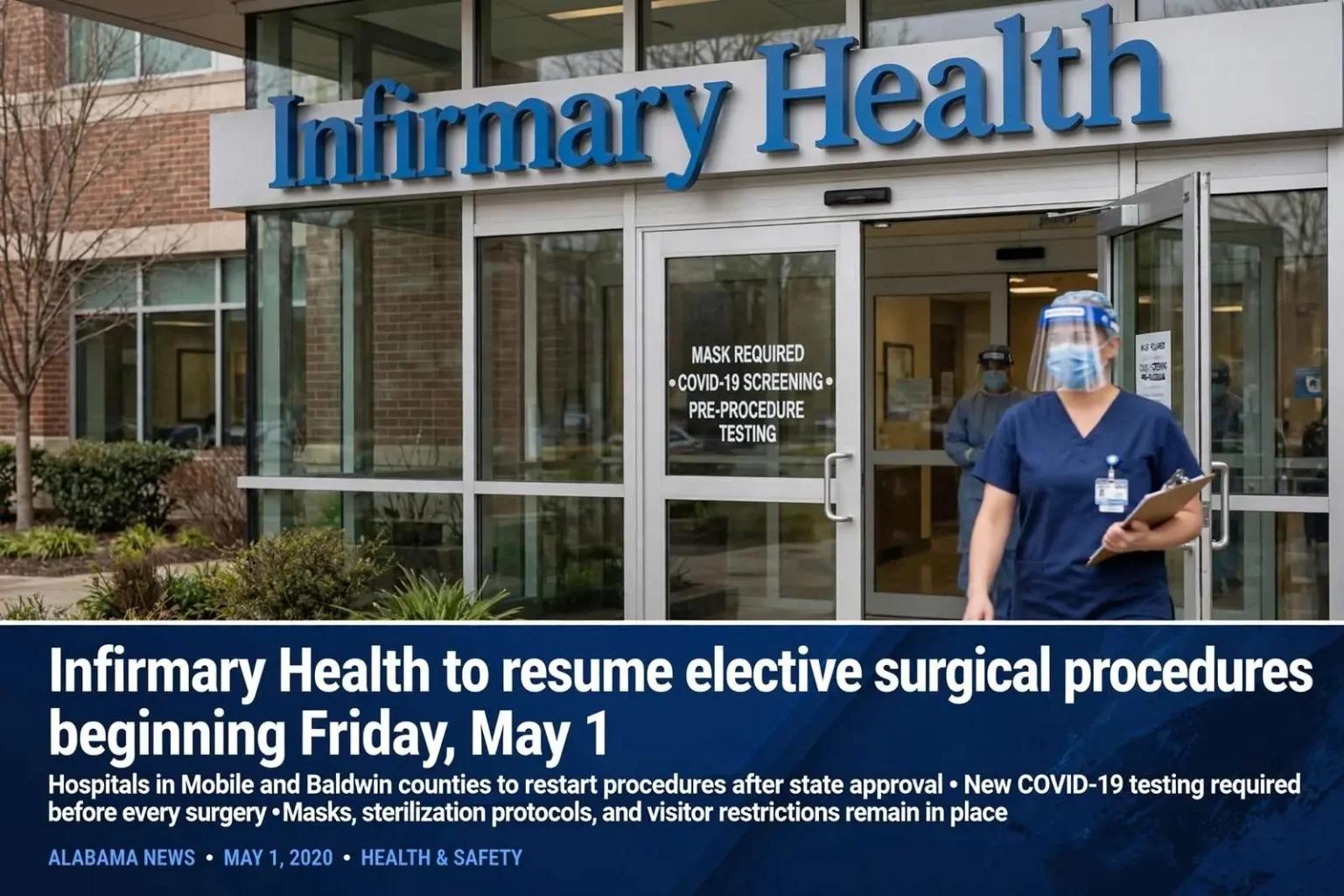
Infirmary Health has announced it will resume elective surgical procedures beginning Friday, May 1, following direction from Alabama State Health Officer Dr. Scott Harris and Gov. Kay Ivey. The resumption applies to procedures scheduled at Infirmary Health facilities across Mobile and Baldwin counties.
The announcement marks a significant step in the region’s cautious reopening from the coronavirus shutdowns of the spring. When the pandemic first reached Alabama in March, public health officials ordered hospitals to postpone elective procedures as a two-part strategy: to conserve protective equipment, hospital beds, and staff capacity for a potential surge of COVID-19 patients, and to minimize the risk of exposure for patients coming into facilities for non-urgent care. The suspension of those procedures — everything from joint replacements to non-urgent cancer surgeries to scheduled diagnostic procedures — also carried a heavy cost of its own, idling surgical suites that normally anchor hospital operations and delaying care for thousands of patients across the state.
The decision to allow resumption came after health officials assessed the state’s hospital capacity, testing availability, and protective equipment supply, concluding that facilities could begin working through surgical backlogs without compromising pandemic readiness. For Alabama’s hospitals, the resumption also carries financial significance, since elective procedures represent a major share of hospital revenue, and weeks of suspension strained budgets across the industry.
Testing Before Every Procedure
All patients scheduled for surgery will be required to be tested for COVID-19 before their procedure date. Those who test positive or show symptoms will not be permitted to have surgery. Patients scheduled for a procedure will be contacted by an Infirmary Health representative with instructions on when and where to receive their test. Patients with questions about scheduling are directed to contact their physician’s office.
The pre-procedure testing requirement reflects the reality that infected patients can carry the virus without showing symptoms. Testing every surgical patient ahead of time allows the health system to route positive cases into isolation and appropriate care rather than into an operating room, protecting surgical teams, other patients, and the patient’s own recovery. Patients should expect the testing step to add a logistical wrinkle to their surgical preparation — typically a test performed in the days before the procedure, with results processed before admission — and officials urge patients to follow the instructions they receive precisely so their surgery is not delayed.
New Protections in the Surgical Pipeline
To protect patients and staff, surgical teams have put new policies in place for pre-admissions, operating rooms and recovery areas, including increased sterilization between cases. All Infirmary Health employees, including admissions and ancillary departments, are required to wear masks and other appropriate personal protective equipment at all times.
The changes touch every stage of a surgical patient’s experience. Pre-admission processes have been reworked to minimize crowding and face-to-face contact, with some paperwork and screenings handled in advance or by phone. Operating rooms have adopted stricter sterilization routines between cases, and recovery areas — where patients spend their most vulnerable post-operative hours — have been reorganized to maintain separation and reduce traffic. The universal mask requirement extends beyond clinical staff to admissions desks, support departments, and every employee a patient might encounter, reflecting the understanding that the virus spreads most readily through the interactions that happen before and after the procedure itself.
Health systems across the country adopted similar protocols as elective work resumed, and the measures have become the practical framework for surgical care during the pandemic. Patients may notice fewer visitors, more screening questions at entrances, and staff in masks and face shields — all of which are expected parts of the new environment rather than signs of a problem.
Don’t Delay Needed Care
Officials said patients should not delay an elective procedure out of concern about COVID-19 unless instructed by their physician, noting that postponing care could negatively affect a patient’s health.
The message addresses one of the quieter consequences of the pandemic: patients who avoided hospitals altogether, allowing serious conditions to progress untreated. Physicians and hospital leaders have warned throughout the shutdown period that emergencies do not pause — heart attacks, strokes, appendicitis, and worsening chronic conditions continued through the spring — and that delayed diagnoses often mean worse outcomes. The term “elective” can mislead patients into thinking a procedure is optional; in hospital usage, it simply means scheduled in advance rather than performed emergently, and many elective procedures address conditions that deteriorate when left waiting.
Health officials emphasize that patients with symptoms such as chest pain, difficulty breathing, sudden weakness, or severe abdominal pain should seek emergency care immediately and not stay home out of fear of the virus.
Infirmary Health’s Role in the Region
The resumption of surgeries at Infirmary Health carries weight across the Gulf Coast because of the system’s size. The organization, rooted in Mobile’s Infirmary and grown over more than a century into one of the region’s largest not-for-profit health systems, operates hospitals, outpatient centers, and specialty facilities across Mobile and Baldwin counties, and its surgical volumes serve patients drawn from throughout south Alabama and the Mississippi and Florida border counties. Restarting those operations gradually restores a major component of the region’s healthcare capacity — and its healthcare employment, since surgical schedules support jobs from anesthesia and nursing to sterilization, supply, and administrative roles.
The resumption also eases pressure on the wider medical community. Patients whose procedures were postponed through the spring — cancer screenings, orthopedic repairs, cardiac workups — had been accumulating on waiting lists, and the gradual restart allows physicians to prioritize the most medically urgent cases first while working through the backlog safely.
Visitors Still Restricted
Infirmary Health’s restricted visitor policy remains in place, and more information is available through the health system.
The continuing visitor restrictions are among the most visible remnants of the pandemic response inside hospitals. Facilities throughout the state limited or eliminated visitors to reduce the number of people entering and moving through buildings, a measure shown to cut exposure risk substantially even as clinical operations resumed. For surgical patients, that typically means arranging for drop-off and pick-up rather than having family accompany them through the process, and family members should confirm current policy details with the hospital before arriving.
Patients preparing for a procedure in the coming weeks are encouraged to review the instructions they receive from the health system closely: the pre-procedure COVID-19 test, the timing of the test, mask requirements, entrance screening, and visitor limits all shape the experience of surgery in a way that would have been unfamiliar a year ago.
A Cautious Path Forward
The May 1 resumption positions Mobile and Baldwin counties alongside communities across Alabama as the state works through its phased response to the pandemic. Health officials have been clear that the reopening steps remain contingent on conditions: a resurgence of cases could force retrenchment, while sustained stability allows further normalization. For now, surgical schedules at Infirmary Health facilities move forward under the new protocols, physicians’ offices resume scheduling, and patients who spent the spring waiting can begin planning for the care that was postponed.
Residents with questions about a scheduled or postponed procedure should contact their physician’s office or the health system directly, and anyone experiencing a medical emergency is urged to seek care immediately rather than waiting.
What Elective Means — and Doesn’t
The vocabulary of the resumption deserves a plain-language explanation, because the word “elective” has confused patients throughout the pandemic. Hospitals categorize procedures as elective when they are planned ahead of time rather than performed as emergencies. The category spans an enormous range: knee and hip replacements, gallbladder removals, hernia repairs, biopsies, cardiac ablations, cataract surgeries, and many cancer-related operations all fall under the elective umbrella, and delaying them can allow conditions to worsen materially. When physicians weigh whether a procedure can wait, they do so on medical grounds — not on whether the patient considers it important.
During the shutdown weeks, triage systems were put in place to identify the postponed procedures that could least afford further delay. Patients with aggressive conditions, rapidly worsening symptoms, or time-sensitive diagnoses moved to the front of the restart queue, while procedures with lower medical urgency were scheduled later in the reopening sequence. Patients who had surgery canceled in the spring should expect their physician’s office to reach out with new scheduling rather than needing to start the process from scratch.
The Economics and the Logistics
Behind the clinical decisions sits a financial reality that hospital leaders have discussed candidly. Elective surgery is the financial engine of most American hospitals, and the suspension ordered in March cut off that revenue stream while facilities continued bearing the costs of readiness — staffing, supplies, and empty capacity held in reserve for a surge that varied in severity across the state. The strain was felt industry-wide, and the White House and state officials weighed it alongside the medical rationale when the resumption guidelines were drafted.
The logistics of the restart are deliberately gradual. Operating room schedules ramp up as staffing, testing capacity, and supply chains allow, and facilities stagger procedures to maintain the sterilization intervals and physical separation the new protocols require. That means patients should not expect an immediate return to full pre-pandemic scheduling; calendars will fill progressively as the system proves it can sustain the safety measures.
For the Mobile area, the May 1 date marked the practical beginning of the region’s healthcare recovery — a careful, protocol-heavy return toward normal operations, with testing, masks, and restricted visiting forming the bridge between the shutdown of spring and the resumption of the surgical care that thousands of local patients have been waiting for.