
Inmate Walks Away From Mobile Work Release Site Near Moffett Road
The Mobile County Sheriff's Office is searching for an inmate who walked away from a work release site near Moffett Road and Interstate 65.
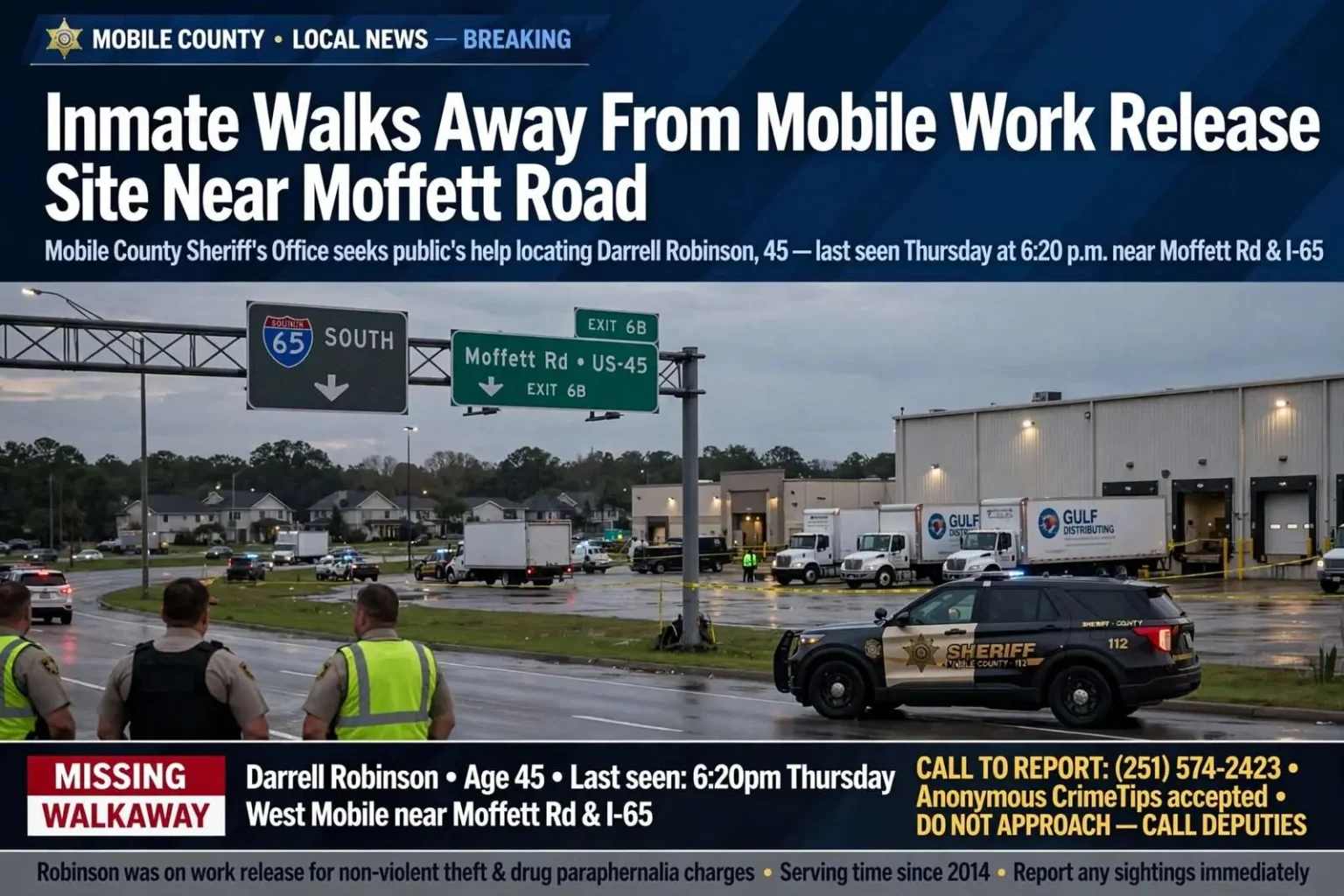
The Mobile County Sheriff’s Office is asking for the public’s help locating an inmate who walked away from a work release assignment in west Mobile, and deputies are urging anyone who spots him to call rather than approach.
Deputies said Darrell Robinson, 45, left on foot around 6:20 p.m. Thursday while working with other inmates at a site for Gulf Distributing near the intersection of Moffett Road and Interstate 65. The location is a busy commercial corridor in west Mobile, where Moffett Road — also known as U.S. Highway 45 — carries heavy traffic between the I-65 interchange and the communities farther north.
Who deputies are looking for
Robinson was serving time on theft of property and drug paraphernalia charges stemming from a 2014 arrest, according to the sheriff’s office. His records show a criminal history in Mobile County dating back to 1988, made up mostly of non-violent theft and drug offenses.
Work release programs place eligible inmates in supervised jobs with local employers while they serve their sentences, allowing them to earn wages, pay restitution and rebuild work habits ahead of their release. Participants are required to report back to the facility or supervision point at set times, and leaving a work site without authorization is treated as an escape or walkaway under Alabama law — a serious offense in its own right that can add years to a sentence.
Gulf Distributing, the beverage distributor whose work site Robinson left, is one of the area employers that participates in the county’s work release arrangements. Businesses that take part provide job sites for crews of supervised inmates, who are transported to and from the site and monitored while they work.
How walkaways are handled
When an inmate fails to return from a work assignment, the supervising agency typically moves quickly: confirming the individual’s last known location, notifying deputies in the surrounding area, and releasing identifying information so the public knows who to watch for. Deputies also check addresses connected to the person’s history, since most walkaways are found near family contacts or familiar neighborhoods within a short distance of the site they left.
In this case, the sheriff’s office is asking anyone with information about Robinson’s whereabouts to call the Mobile County Sheriff’s Office at (251) 574-2423 or submit a tip through the department’s anonymous CrimeTips page. Anonymous tips allow residents to share information without identifying themselves, and tips that lead to an arrest can qualify for rewards through the regional crime stoppers program.
Deputies caution residents not to attempt to detain or confront the individual themselves. Anyone seen matching the description should be reported immediately with a location, direction of travel and vehicle description if one is involved, so that deputies can respond with the proper resources.
Work release in Mobile County
The Mobile County Metro Jail’s work release program is part of a broader approach Alabama counties use to manage jail populations while keeping low-risk inmates connected to employment. Inmates selected for the program are screened for eligibility, typically limited to non-violent offenders, and are subject to drug testing, accountability checks and strict schedules.
The program is designed to reduce recidivism. Studies of work release across the country have found that inmates who hold jobs and maintain family ties while incarcerated are less likely to return to crime after release, and counties point to participants who complete their sentences, pay their fines and restitution, and walk out with documented work history and savings from their wages.
Walkaways remain the program’s known risk, and each incident prompts a review of how the individual qualified, how supervision was conducted and what changes might prevent a repeat. Counties across Alabama balance those incidents against the program’s successes, and eligibility rules have tightened over the years in response.
The search area in west Mobile
The site Robinson left sits near the Moffett Road and Interstate 65 interchange, one of the busiest junctions in west Mobile. From there, a person on foot can reach residential neighborhoods to the north and south, retail strips along Airport Boulevard and the commercial cluster around the highway interchange within an hour’s walk.
Deputies concentrate searches in areas like this by coordinating with businesses that have surveillance cameras, contacting known associates and family members, and keeping patrol officers alert to sightings in the surrounding beats. Interchange areas present particular challenges for locating someone on foot, because of the volume of pedestrian and vehicle traffic, the number of places to rest or find shelter, and the easy access to rides along major corridors.
Residents in the neighborhoods around Moffett Road are asked to check their yards, sheds and outbuildings if they notice anything unusual, and to review doorbell or security camera footage from Thursday evening onward. Even a brief clip showing a person crossing a yard can help deputies establish a direction of travel.
What happens when he is found
Once located, Robinson will be taken back into custody and will face the walkaway or escape charge in addition to the remainder of his original sentence. Alabama courts treat unauthorized absence from a work release assignment as a felony, and a conviction adds substantial time that must be served before any future release eligibility.
The original charges — theft of property and drug paraphernalia possession — will continue to be served as well, since a walkaway does not pause the underlying sentence. Prosecutors in Mobile County handle these cases routinely, and the added charge is typically resolved alongside the existing term.
How residents can help
The sheriff’s office has released Robinson’s name and age and is asking the public to be alert but not to take action beyond reporting. The department’s tips line, (251) 574-2423, is staffed for calls about his whereabouts, and the CrimeTips page on the sheriff’s website allows anonymous submissions at any hour.
Dispatchers ask callers to provide as much detail as possible: where the person was seen, what he was wearing, whether he was alone, and whether he entered a vehicle. That information allows deputies to prioritize the response and alert neighboring jurisdictions, including Mobile police, whose officers patrol the area around the work site.
Anyone with direct knowledge of where Robinson is staying or who may be helping him is asked to come forward. Helping a walkaway avoid capture — providing transportation, shelter or a phone — can expose the helper to criminal charges, and deputies emphasize that the quickest and safest outcome for everyone is a prompt report from someone who recognizes him.
As the search continues, updates from the sheriff’s office are expected to be shared through the department’s public channels if his location is confirmed or if he is taken back into custody.
A closer look at the circumstances
Robinson’s departure happened while he was working alongside other inmates, which means supervisors and fellow participants may be able to provide investigators with a minute-by-minute account of when he was last seen and in what direction he moved. Those accounts matter, because the early hours of a walkaway response are when the search radius is smallest and the chance of a quick recovery is highest.
His 45 years of age and his history of non-violent offenses shaped his original eligibility for work release, and they also shape how deputies describe the risk he presents to the public. Walkaway notices from the sheriff’s office routinely note the nature of the underlying offenses, giving residents context without overstating the danger — most walkaways in Mobile County are individuals who left a job site to avoid finishing a sentence, not people believed to be planning new crimes.
Still, deputies treat every unauthorized absence as serious. Until Robinson is back in custody, he is considered absent without authority, and any sighting should be reported to the sheriff’s office rather than assumed to be harmless.
Employers and the work release partnership
Local employers who host work release crews, including distributors like Gulf Distributing, fill a role that few businesses consider: they provide structured, supervised job sites that give inmates a path toward lawful employment after their sentences end. In return, the county provides labor at participating sites while retaining custody and control of the workers.
Site supervisors coordinate with jail staff on schedules and headcounts, and any absence from the crew triggers an immediate report to the supervising agency. The presence of other inmates and supervisors at the site is often what allows investigators to establish a timeline within minutes of a walkaway, as appears to have happened in this case.
Community programs like this operate largely out of public view until an incident draws attention. Deputies say the partnerships remain valuable despite occasional walkaways, because the majority of participants complete the program, return to custody as scheduled each day and leave the system better positioned to stay employed.
The record behind the search
Records show Robinson’s history in the Mobile County court system stretches back to 1988, the kind of long-running file that is common among inmates who cycle through county jails on theft and drug charges. Non-violent offenders with long histories often serve portions of their sentences in county facilities and work release programs rather than state prison, which is why walkaway notices from county jails frequently involve people with decades-old first arrests.
Each cycle through the system also builds a record of addresses, associates and known haunts, and that information forms the backbone of the search now underway. Deputies say most walkaways are located within days, often because a family member, employer or neighbor recognizes the name and calls it in.
The Mobile County Sheriff’s Office continues to ask anyone who knows where Robinson might be to call (251) 574-2423 or use the anonymous CrimeTips page. The department has not said whether the search has narrowed to a specific area, and further updates are expected once he is located.


