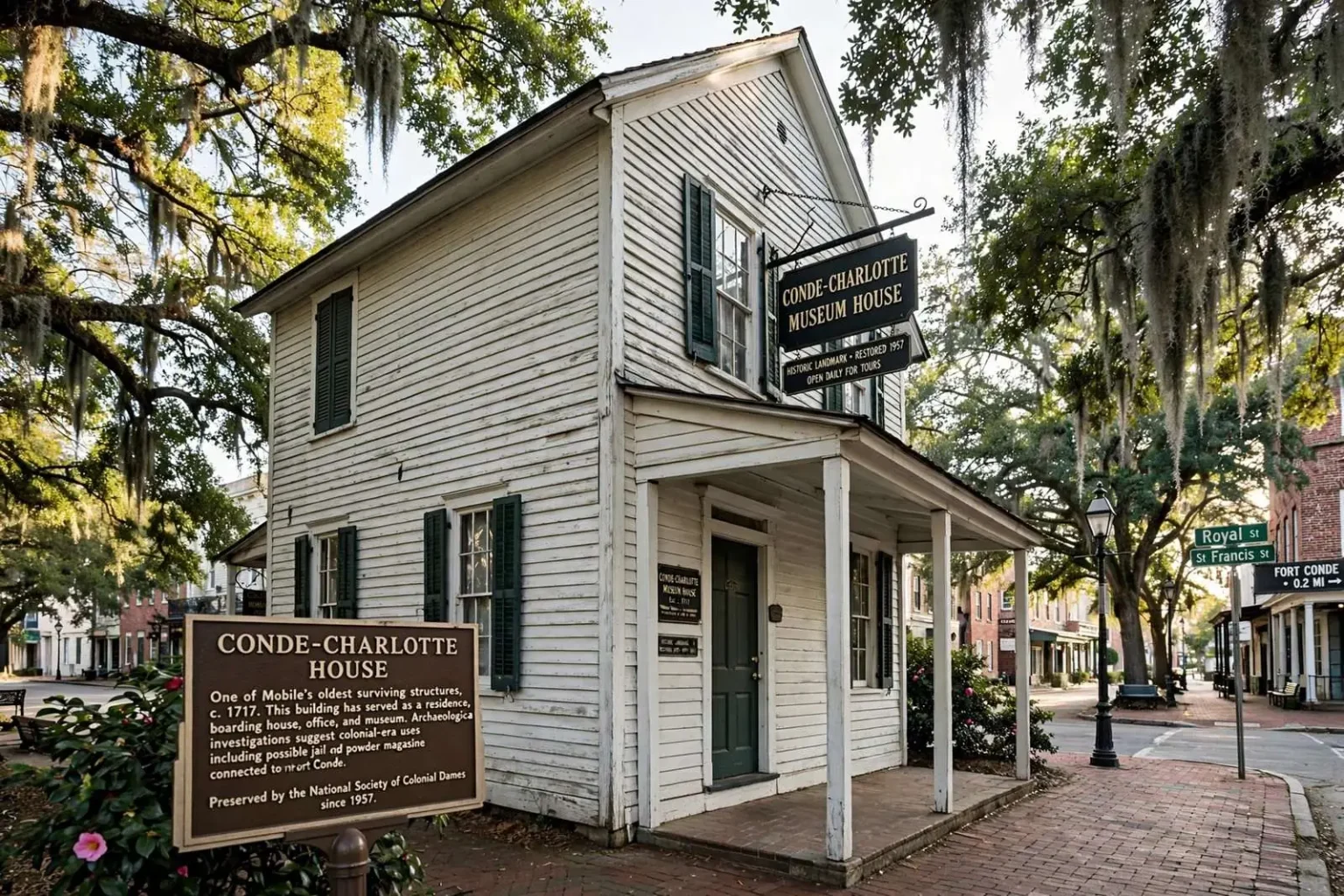
Tucked near Fort Conde in downtown Mobile, the Conde-Charlotte Museum House stands as one of the city’s most layered historic properties, with a past that stretches from the colonial era through the 20th century and a use history that even now is not fully settled. The property sits at the corner where the city’s oldest stories and its modern tourist district meet, a modest-scaled building whose plain exterior conceals a documented history more complicated than nearly any other structure in the area.
The National Society of Colonial Dames in the State of Alabama purchased the building in 1957 and undertook a restoration before opening it to the public as a history museum. Since then, the house has drawn visitors interested in Mobile’s early architecture and its role in the city’s downtown historic district, which sits within walking distance of Fort Conde itself. Generations of school groups, tourists and architecture enthusiasts have passed through its rooms, and the museum remains one of the few places in the city where the colonial period can be encountered up close.
Mobile’s colonial origins reach back to the early eighteenth century, when the French established the settlement that would become the oldest city in Alabama. Control of the city subsequently passed among the French, British and Spanish before becoming part of the United States, a succession that left Mobile with an architectural and institutional inheritance unlike any other city in the state. The Conde-Charlotte House, named for two of those periods, sits squarely inside that inheritance.
A building with multiple lives
Over the decades, the structure has served as a private residence, an office space, and at times a boarding house, reflecting the shifting needs of downtown Mobile as the city grew and changed hands among European and American powers. Buildings in old port cities routinely outlive their original purposes, and the Conde-Charlotte House is a textbook case: the same walls that sheltered a prominent family later housed boarders, offices and finally a museum, each era leaving traces that restoration architects have had to interpret.
Its location so close to Fort Conde has long fueled speculation about even earlier uses. Archaeological research conducted at the site has suggested that portions of the building may once have functioned as a city jail or as a magazine, a storage structure for gunpowder and ordnance, connected to the fort. Both possibilities fit the geography: the ground near a fortification was where a colonial government put the functions it needed close at hand but at arm’s length, and the jail and the powder magazine were among the least glamorous and most essential of them.
Because written records from Mobile’s colonial and early American periods are incomplete, historians and preservationists have relied partly on physical evidence uncovered during restoration and later archaeological work to piece together the building’s earliest roles. Documents from the French and British eras survive only in fragments, and property boundaries, construction dates and ownership chains must be reconstructed from scraps: tax lists, maps, deeds and the buildings themselves. The result is a property whose story is told in the qualified language of evidence rather than the certainty of a plaque.
Reading the evidence below ground
Archaeology has become one of the most valuable tools for reading Mobile’s early history, precisely because the written record is so thin. Excavations near the fort site and around colonial-era properties have recovered foundations, ceramics, glass and other material culture that document what documents do not. Each artifact recovered from a site like the Conde-Charlotte property narrows the range of plausible answers to questions about when the structure was built and what it was used for in its first decades.
The possibility that part of the building served as a jail gives the house a darker edge than the average historic home tour. Colonial jails were small, improvised and often attached to or near government buildings, holding debtors and minor offenders in conditions modern visitors would find startling. The powder magazine possibility, meanwhile, speaks to the military realities of a colonial port: gunpowder was stored apart from dwellings because an accidental ignition could level a block, and its placement was regulated with the era’s equivalent of zoning.
Restoration itself is an act of interpretation, and the Colonial Dames’ mid-century restoration reflected the historical understanding of its time. Later scholarship and archaeology have refined that picture, and house museums like Conde-Charlotte periodically revise their narratives as research advances. The building’s willingness to admit what is unknown is part of what makes it useful to historians: it preserves the evidence rather than flattening it into a tidy story.
The Colonial Dames stewardship
The National Society of Colonial Dames in the State of Alabama has maintained the property ever since the 1957 purchase, funding preservation work and staffing the museum through its members. Patriotic societies like the Colonial Dames took on house museums across the country in the mid-twentieth century, stepping in when commercial owners had no incentive to preserve colonial-era structures. In Mobile, that stewardship kept a building standing through decades when much of the old downtown was being cleared for parking lots and new construction.
Operating a house museum is an ongoing financial and practical commitment, requiring climate control, periodic conservation and the volunteer labor that keeps regular tours running. The society’s members lead visitors through rooms furnished to represent different periods of the house’s use, an approach that presents the building not as a single moment in time but as the layered object it actually is. School groups form a core part of the visitation, making the museum a fixture of local history education.
Why it still matters
Mobile’s downtown holds a concentration of historic sites tied to its French, British, Spanish, and American periods, and the Conde-Charlotte House is frequently cited by local historians as a tangible link to that layered past. Within a few blocks, visitors can find the fort reconstruction, the city’s history museum, churches and commercial buildings spanning two centuries, a density of historic material that few Gulf Coast cities can match. The house anchors the oldest corner of that collection.
The museum remains part of a broader effort in the city to preserve historic structures near Fort Conde, an area that continues to anchor much of downtown Mobile’s identity as a historic destination. Preservation advocates in Mobile have long argued that the city’s colonial inheritance is an economic asset as well as a cultural one, drawing heritage tourists who might otherwise pass through on the way to the beaches. Buildings like the Conde-Charlotte House are the argument in physical form, and keeping them standing, researched and open to the public is how the city holds onto the oldest part of its story.
The fort that gives the neighborhood its name was the third fortification built on or near the site of Mobile’s colonial defenses, and the reconstruction that stands today was completed in the twentieth century after the original remains were removed during urban renewal. The reconstruction rebuilt the fort’s footprint to its French-era dimensions, and the surrounding museum space interprets the city’s military past. The proximity of the Conde-Charlotte House to that site is what makes the jail and magazine theories plausible, since structures serving a fort tended to cluster just outside its walls.
Downtown Mobile’s survival as a historic district was not inevitable. Like many American cities, Mobile spent the mid-twentieth century demolishing older commercial blocks in the name of modernization, and pockets of the oldest city survived partly through the intervention of preservationists and civic organizations. The Colonial Dames’ purchase of the Conde-Charlotte House in that era placed it among the buildings that were deliberately saved, a decision whose full value became apparent only as heritage tourism grew into an economic force.
House museums occupy a distinctive place in how communities teach their own history. Unlike a gallery or a textbook, a historic structure lets visitors stand where events happened, see the scale of colonial rooms and the construction methods of another era, and absorb the past through their feet as much as their eyes. Docents at the Conde-Charlotte House can point to the actual fabric of the building while explaining what is known, what is debated and what may never be settled about the property.
The boarding house chapter of the building’s history also says something about downtown Mobile’s economic rhythms. Boarding houses served the transient population of a port city, from merchants and clerks to sailors waiting between ships, and their presence in a neighborhood indicated a district that lived by commerce rather than residence alone. The building’s shifts between family home, workplace and lodging track the cycles of prosperity and change that swept through the lower downtown blocks over more than a century.
Period furnishing adds another interpretive layer to the museum’s work. Rooms staged to different eras help visitors understand that the house was not frozen at a single moment, and the decorative arts displayed in them reflect the material culture of the communities that used the building. Museum professionals describe this approach as furnishing the building’s biography, an approach that honors the structure’s complexity rather than choosing one era as the authentic one and erasing the rest.
The house’s very name encodes its layered past, recalling both the French colonial Conde period and the American era of the Charlotte connection. Names of historic properties are themselves historical documents, changed by owners and generations to reflect who claimed the building’s story at a given time. Visitors who ask why the house carries a double name get a first lesson in the complexity that defines the property.
Mobile’s preservation community continues to balance growth and heritage in the downtown core, where development pressure and historic fabric coexist block by block. The district around Fort Conde remains the symbolic heart of that balance, drawing cruise passengers, convention visitors and locals to a walkable concentration of history. Each preserved building extends the experience that makes the district worth visiting, and the Conde-Charlotte House, oldest among them in story if not in every surviving brick, remains its most instructive stop.