
Interview: ‘Haunted Mobile’ Author Elizabeth Parker on the City’s Ghost Stories
Mobile writer Elizabeth Parker has spent years collecting the port city's ghost stories, and in a recent interview she explained how that obsession became .
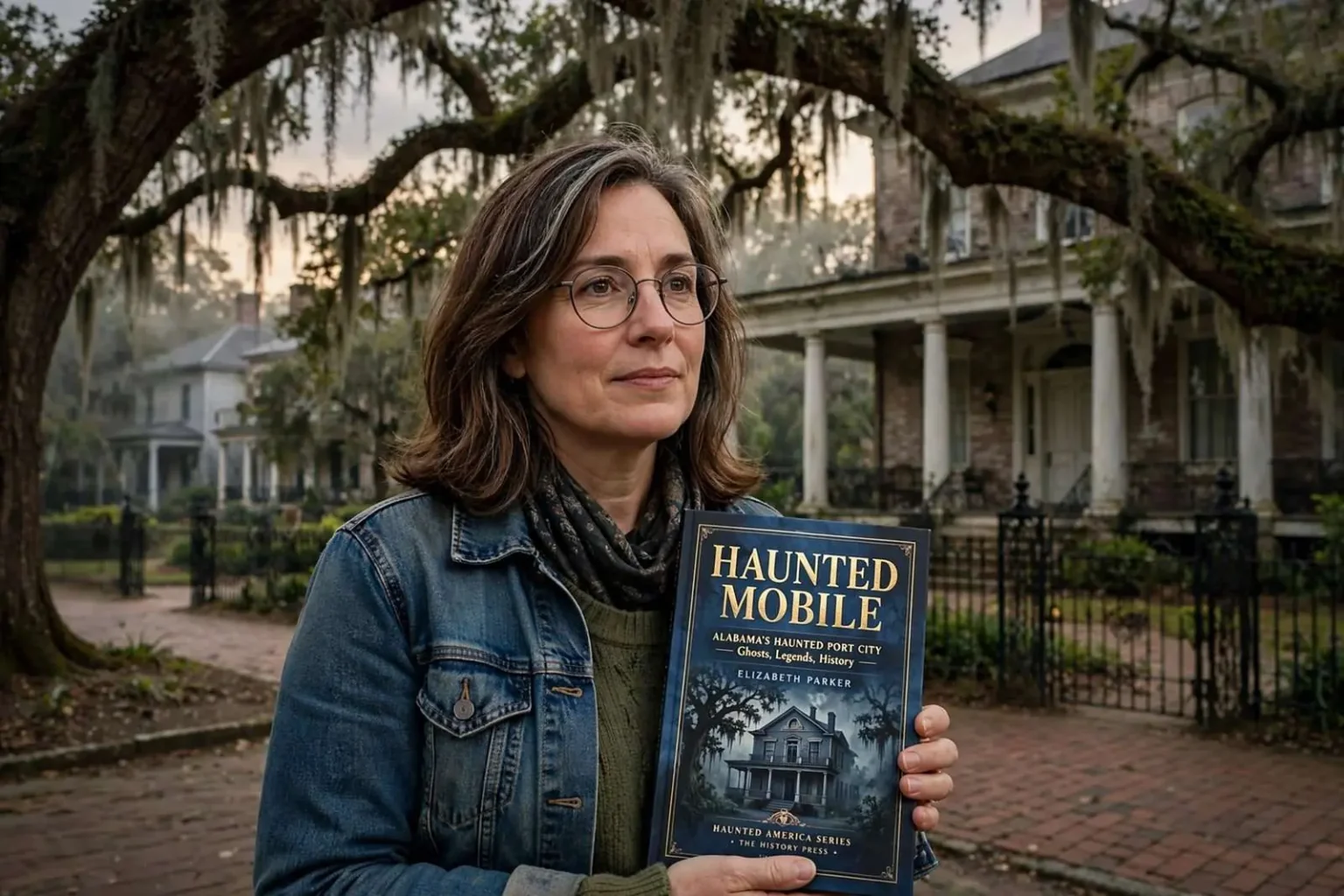
Mobile writer Elizabeth Parker has spent years collecting the port city’s ghost stories, and in a recent interview she explained how that obsession became a book — and how a self-published passion project eventually found a national publisher.
From Self-Publishing to the Haunted America Series
Parker’s Haunted Mobile combines her two earlier self-published titles, Mobile Ghosts: Alabama’s Haunted Port City and Mobile Ghosts II: The Waterline. Frustrated that Mobile’s haunted history was underrepresented beyond a few mentions in Kathryn Tucker Windham’s beloved books, she wrote them herself. Windham, whose 13 Ghosts series made her Alabama’s most celebrated collector of Southern ghostlore, had documented only a handful of Mobile stories, and Parker felt the city’s wealth of haunted places deserved fuller treatment.
The History Press approached her in 2009 to add the work to its national Haunted America line, a series that documents local ghost stories across the country, bringing her previously self-published material to a wider audience under a professional imprint. The collaboration preserved her voice while giving the stories the distribution of a national catalog, placing Mobile alongside cities like Savannah, Charleston and New Orleans in the series’ catalog of haunted Southern ports.
“Ghosts stick around because they do not perceive their stories as finished,” Parker said. “I feel like it is my job, as well as my passion, to tell these stories.”
Spooky Encounters and a Fake Tale
Parker’s research has taken her into some of Mobile’s most storied buildings, and her own encounters form part of the book’s appeal. She described being physically shoved out a door by an unseen presence in the second parlor at Oakleigh, the antebellum house museum in the city’s historic Oakleigh Garden District. She also recounted being followed home by something with what she called “a funky, rank stench” — an experience she tracks among the recurring sensory details that witnesses across the city report when they claim encounters with Mobile’s restless dead.
Not every story makes the cut. Parker noted that one well-known Mobile ghost tale is entirely contrived, created in part to deter vandalism, and therefore excluded from her books. Her standard, she explained, is to document stories with genuine provenance — accounts passed down through families, documented in historical records or reported by credible witnesses — rather than to repeat legends whose origins are known fabrications. In a city with 300 years of history, distinguishing the real folklore from the invented can be as much work as the collecting itself.
Mobile’s Haunted Landscape
Mobile’s ghost stories draw depth from the city’s singular place in Alabama’s history. Founded by the French in 1702 and ruled in turn by the French, British, Spanish and Americans, the Port City carries three centuries of colonial architecture, antebellum mansions, Civil War memories and yellow fever epidemics — the raw material from which generations of hauntings have been reported. Oakleigh, where Parker described her encounter, anchors a historic district of period homes where tour guides and caretakers have long traded accounts of unexplained footsteps, cold spots and apparitions.
The city’s haunted reputation fits alongside its better-known cultural identity as Alabama’s Mardi Gras birthplace and a city of live oaks, ironwork balconies and church spires. For Parker, the supernatural layer is inseparable from the historical one — each ghost story is also a story about the people, events and neighborhoods of Mobile’s past.
What’s Next for the Collector
Looking ahead, Parker is working on a book of all-new stories and hopes to document the ghosts of “Katrina country,” including Bayou La Batre, before those accounts fade. The coastal communities south of Mobile absorbed the full force of Hurricane Katrina in 2005, and the storm reshaped both the landscape and the folklore of the region’s fishing villages, adding a modern layer to the old stories of the water.
Haunted Mobile is available at Bienville Books, Page and Palette, the Museum of Mobile and Mobile Carnival Museum gift shops, local bookstores, Sam’s Club and the library — a distribution network that mirrors the local book-buying community the book was written for.
Parker’s route from self-publishing to a national series is itself a Mobile story of persistence. The two volumes she combined into Haunted Mobile began as labors of love, sold through the same local shops that carry the new edition, before The History Press’s 2009 invitation formalized what local readers already knew. The Haunted America series has become the country’s most extensive line of regional ghost books, and each title pairs folklore with local history, which is exactly the combination Parker’s background prepared her to deliver.
Her complaint about the thin coverage of Mobile in Kathryn Tucker Windham’s books reflects the particular place Windham holds in Alabama culture. Windham, who spent much of her career in nearby Thomasville and Selma, compiled the 13 Ghosts series beginning in 1969, and her stories of Jefferson, the ghostly dog whose portrait hangs in her Selma home, became among the most famous in Southern folklore. But Windham’s collections ranged across the state, and Mobile’s stories received only passing attention — a gap Parker set out to fill with the depth of a writer who lives in the city she covers.
The Craft of Ghost Collecting
Collecting ghost stories, as Parker practices it, is closer to oral history than to fiction writing. The work involves interviewing witnesses, tracking down the historical record behind each haunted site, and weighing which accounts have been passed down honestly from which have been invented. Her decision to exclude the fabricated story — the one created to deter vandalism — illustrates the line she draws: a ghost story whose origin is a deliberate invention is not folklore but a hoax, however entertaining, and her books distinguish between the two.
The sensory details she documents — the shove in Oakleigh’s second parlor, the following presence with its rank stench — are the kinds of specifics that give the accounts their texture and their credibility as folklore. Witnesses across cultures tend to report similar patterns: smells, touches, sounds and the feeling of being watched, rather than dramatic apparitions. Parker’s field notes preserve those patterns as they were told to her, letting readers weigh the stories for themselves.
Preserving Stories Before They Fade
Parker’s current project — all-new stories, plus the ghosts of Katrina country — extends her collecting to the fishing communities south of the city. Bayou La Batre, the small seafood-processing village on the Mississippi Sound that was devastated by Katrina’s storm surge, has a centuries-old maritime culture whose stories of the water are the region’s most distinctive folklore. The storm scattered families, destroyed landmarks and ended ways of life, and with them the storytellers who carried the old accounts. Documenting those ghosts, in Parker’s framing, is a race against memory — the same urgency that drives her belief that ghosts stick around because their stories are unfinished.
For readers in Mobile, the book’s availability close to home is part of its point. The shops that carry it — Bienville Books downtown, Page and Palette across the bay in Fairhope, the museum shops — are themselves part of the city’s cultural fabric, and the library copies ensure the stories reach readers of every age. In a city that celebrates its history with parades and preservation alike, Parker’s work adds a nightly dimension: the Port City’s past, walking its parlors and porches after dark.
Oakleigh itself deserves a closer look, both as a historic site and as the setting of Parker’s most vivid personal encounter. Built in the 1850s and named for the live oaks that shade its grounds, the house is now operated as a museum and stands at the heart of the Oakleigh Garden Historic District, one of Mobile’s most visited historic neighborhoods. Houses of that age accumulate the layered histories — family tragedies, wartime privations, enslaved laborers’ lives, epidemics — from which haunting stories traditionally grow, and Oakleigh’s second parlor, where Parker described being shoved by an unseen hand, is exactly the kind of intimate interior space where witnesses most often report physical contact with the unseen.
The encounter with the foul-smelling presence that followed her home belongs to a well-traveled folklore tradition along the Gulf Coast. Accounts of rank odors accompanying ghostly figures appear throughout Southern collecting, and Kathryn Tucker Windham herself recorded smells among the signature signs of hauntings in her Alabama stories. Parker’s experience put her on the witness side of the tradition she documents, a credibility marker among folklorists who argue that the best collectors are ones who know what it feels like when the story finds them.
Why Mobile’s Stories Run Deep
The depth of Mobile’s haunted inventory comes from its unusual history within Alabama. As the oldest city in the state, founded by French colonists at the dawn of the 18th century, Mobile predates every other Alabama community by decades and carries colonial-era graveyards, French and Spanish land grants, and a port economy that brought sailors, merchants and epidemics through its streets for 300 years. Yellow fever outbreaks, Civil War occupation and the shipping trade each left their mark on the city’s memory, and each supplies its own cast of lingering characters in the local ghostlore.
The city’s architecture preserves that history in walkable form. From the Church Street Graveyard and its colonial-era stones to the antebellum mansions of Government Street and the Victorian neighborhoods spreading east toward the river, Mobile offers the dense concentration of historic buildings that ghost traditions require. It is the same built environment that makes the city a destination for heritage tourism, and the haunted layer has become part of how the city markets its past to visitors alongside Mardi Gras and the museums.
The Local Book Community
Where the book is sold tells a story of its own. Bienville Books, the independent bookstore in downtown Mobile, anchors the city’s literary retail scene, while Page and Palette serves the Eastern Shore from Fairhope, a town with its own celebrated literary tradition. The Museum of Mobile and the Mobile Carnival Museum gift shops place the volume alongside the city’s historical and cultural institutions, and the Sam’s Club and library listings put it within reach of readers who might never browse a specialty shop. That distribution reflects the book’s dual identity as both a regional history title and a popular Halloween-season favorite.
Parker’s ongoing work — the new collection and the bayou-country stories — continues the pattern that produced Haunted Mobile: a Mobile writer, writing about Mobile places, published first for the community that lives with the stories every day. For a port city whose past has never quite left, that seems a fitting arrangement. As Parker puts it, the ghosts are still here because their stories are unfinished — and as long as she is collecting, those stories will keep being told.


