Jack Friend Research Library Opens Doors to Mobile’s History Museum Archives
The Jack Friend Research Library at the History Museum of Mobile gives researchers access to primary sources on Mobile and south Alabama history, from Civil War records to Mardi Gras archives.
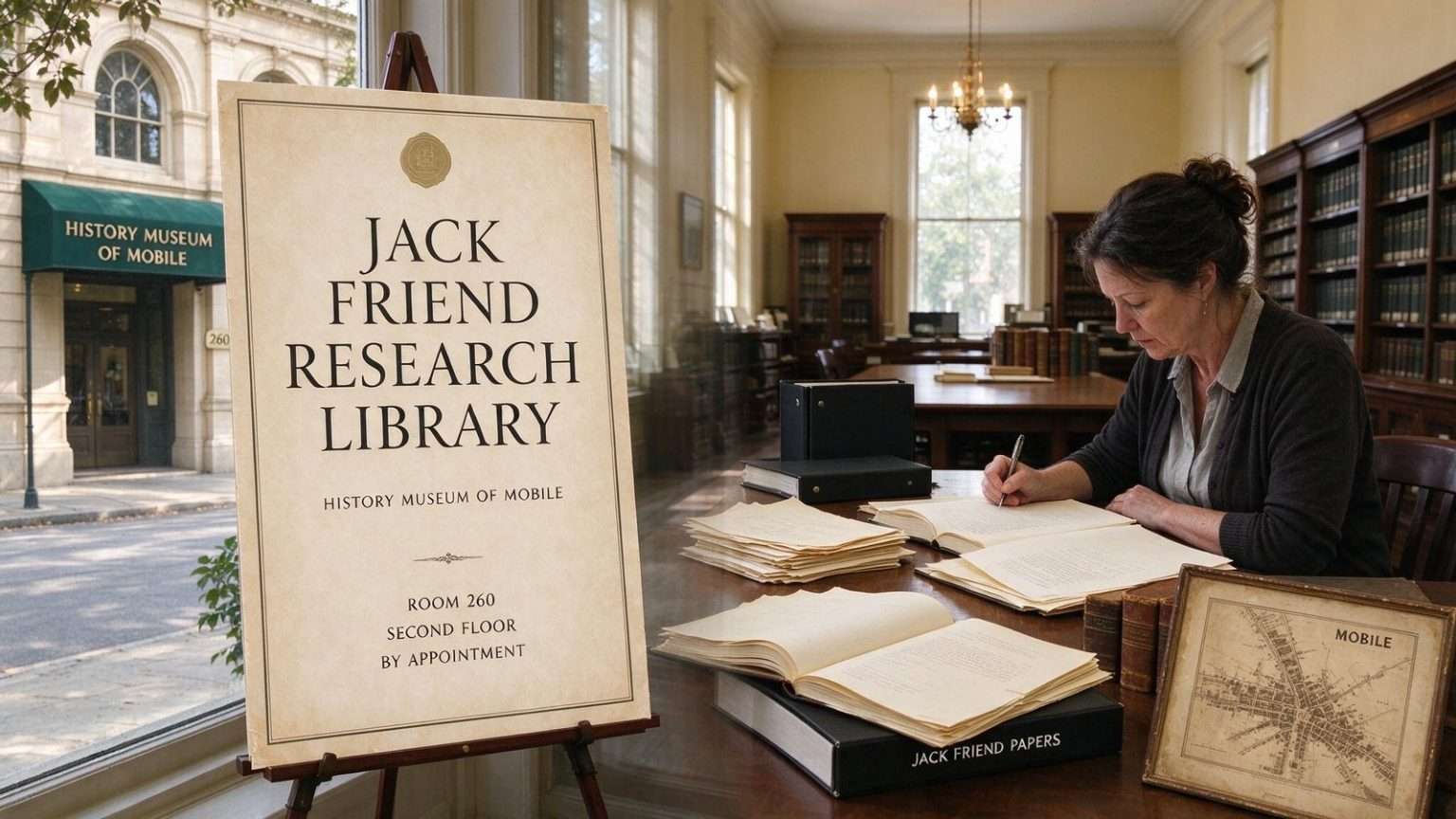
Tucked away on the second floor of the History Museum of Mobile, in Room 260, the Jack Friend Research Library gives residents, students and historians a chance to dig deeply into the social, political and economic history of Mobile and south Alabama. The library is open to researchers interested in exploring primary source documents and reference material spanning more than two centuries of the region’s history.
The setting fits the mission. The museum occupies the old City Hall and Southern Market building on Royal Street downtown, a mid-19th-century National Historic Landmark that has served the city as a market hall, an administrative seat and, for decades now, as the repository of its collective memory. A researcher climbing to Room 260 is working, in other words, inside one of the very structures the city’s history was made in — a short walk from the forts, wharves, churches and graveyards where the documents in the collections were written.
The library carries the name of Jack Friend, a noted Mobile historian whose book “West Wind, Flood Tide” is widely considered the authoritative account of the Battle of Mobile Bay. Friend’s own research materials for the book form part of the library’s holdings, and the naming reflects the significant role his scholarship played in documenting one of the pivotal Civil War engagements fought along the Gulf Coast.
The battle Friend documented remains the single most studied event in Mobile’s military history. On the morning of Aug. 5, 1864, Adm. David Farragut’s Union fleet forced its way past the torpedoes and batteries guarding the entrance to Mobile Bay, sank the Confederate ironclad CSS Tennessee in a running fight, and closed the last major Gulf port east of the Mississippi to blockade runners. The engagement gave American naval history its most famous order — “Damn the torpedoes” — and its outcome, combined with the later capture of Forts Morgan and Gaines, sealed the bay that Mobile’s economy depended on.
Planning a visit
Because the library operates on an appointment basis, researchers are asked to contact the library ahead of time before visiting. That advance notice allows staff to confirm that the library will be open, that the specific collection a researcher wants to access is available, and that adequate staff will be on hand to assist.
Appointments are scheduled through research historian Charles Torrey, who also maintains a broad selection of subject files compiled over the years covering topics of local interest.
The appointment system is the norm for archives of this kind, and the reasons are practical. Rare manuscripts cannot simply sit on open shelves; they are retrieved by staff, handled under supervision and returned to controlled storage. An advance request also lets the staff pull the right boxes before the researcher arrives — in an archive, the files do not come to you on demand — and pairs the researcher with someone who knows where the unexpected material is hiding. For visiting scholars driving down from universities elsewhere, that preparation is often the difference between a productive week and an empty one.
The subject files Torrey maintains serve a different audience: the genealogist tracing a family through Mobile’s church registers, the property researcher mapping a downtown block, the writer chasing a neighborhood’s history. Compiled over years of answering such questions, the files work as an index to the region’s memory.
Strengths of the collection
The Jack Friend Research Library is particularly well-suited to researchers interested in biographies of prominent Mobilians, the history of Mardi Gras in Mobile, the city’s business history, crime and punishment records, and the immigrant experience in the region.
Each of those strengths points at something Mobile uniquely holds. Mardi Gras history is the most obvious: Mobile celebrated Carnival before New Orleans existed as a city, tracing its revelry back to 1703 and the Cowbellion de Rakin Society of the 1830s, and the mystic societies’ records — the invitations, the regalia inventories, the membership rolls — form an archive of American festival culture found nowhere else. Business history is nearly as deep. As the port through which cotton, timber, coal and bananas moved, Mobile accumulated the ledgers, steamship records and mercantile correspondence of an antebellum and Gilded Age commercial capital.
Beyond those broad subject areas, the library houses several notable named collections that offer a deeper look into specific chapters of Mobile’s past. Among them is the Creole Fire Company Records collection, which documents the activities of Mobile’s Creole volunteer firemen. Chartered in 1819, the Creole Fire Company was a supplement to the Creole Social Club and became a well-respected organization that did far more than fight fires — it made small loans to members, hosted parades that drew large crowds, and challenged discriminatory laws affecting Creoles. The collection includes manuscripts, photographs and artifacts.
The company belongs to a chapter of Mobile history that often surprises visitors: the city’s long tradition of free Creole civic life, rooted in the community of free people of color and mixed heritage that grew up in colonial and antebellum Mobile under French, Spanish and finally American rule. Volunteer fire companies were among the era’s most prestigious institutions, and a Creole company chartered in 1819 — before Alabama even achieved statehood — doubled as a mutual aid society: a place where members could borrow in hard times, march in public on their own terms and organize politically. The surviving minutes, receipts and photographs give researchers a rare window into how that community organized itself, a story that survives in few other American archives.
A related collection, the Creole Social Club Records, spans the 1850s through the 1880s and includes the club’s monthly minutes, committee minutes, correspondence, receipts and governing documents.
Read together, the two collections trace an institution across seven decades — from the early republic through the Civil War and into Reconstruction — a period during which Creole Mobilians navigated first antebellum race law and then the new legal order that followed emancipation. Documents that record loans, feasts, elections and legal challenges are, in aggregate, a map of how a community preserved itself under pressure.
The library also holds the Caldwell Delaney Collection, a body of correspondence, articles, manuscripts, photographs and newspaper clippings gathered over roughly fifty years by historian Caldwell Delaney, who served as the first director of the History Museum of Mobile.
Delaney’s collection is the professional backbone of the archive. A museum’s founding director decides, in practice, what gets saved, and fifty years of deliberate collecting by the institution’s first leader means the shelves hold the accumulated correspondence and clippings of a man who knew everyone and wrote everything down. For researchers, that makes the collection both a source and a guide: Delaney’s files frequently point to the people and documents that a Mobile historian needs next.
Authors and soldiers
The Mary McNeil Fenollosa Collection, meanwhile, spans the 1890s through the 1940s and contains the correspondence, books, pamphlets and diaries of the Mobile author, who published acclaimed works ranging from stories of the American South to post-Imperial Japan under the pen name Sidney McCall.
Fenollosa’s life arcs through Mobile’s literary history and out into the wider world. She married the orientalist scholar Ernest Fenollosa and lived in Japan, and the novels she published under her pen name brought both the Gulf South and Meiji-era Japan to American readers. Her diaries and correspondence — held here rather than in the larger archives where her husband’s papers went — document a Mobile woman’s authorial career at the turn of the 20th century, a perspective that literary historians of the period increasingly seek out.
Civil War researchers will find substantial material in the Thomas M. McMillan Collection, which includes books, manuscripts and photographs connected to well-known figures such as Generals Robert E. Lee and P. G. T. Beauregard, Admiral David Farragut and Secretary of the Navy Gideon Welles.
The collection also documents everyday life in Mobile and south Alabama during the Civil War, including personal and business correspondence, material on slavery in the urban South, receipts and bills belonging to Confederate officers stationed near Mobile, and records related to the city’s wartime defenses and the Battle of Mobile Bay.
That everyday material is, for many scholars, the more valuable half. The generals and the cabinet secretaries appear in every major Civil War archive; what survives far more rarely is the paper trail of an occupied or besieged Southern city — the grocer’s receipts of officers stationed in the forts, the letters of families waiting out the blockade, the records of urban slavery in a port city where enslaved workers were hired out by the trade rather than held on plantations. Mobile’s war was a home-front war for most of its length — the city filled with refugees, prices climbed, defenses were built by enslaved labor — and the collection’s receipts, bills and correspondence capture that texture directly.
Also of note are the William T. Mumford Diaries, two journals kept by a Confederate artillery officer who traveled through Alabama, Mississippi and Louisiana during the war. Together, the diaries span from September 1862 to May 1865 and offer a firsthand account of troop life, including movements, illness, camp gossip, weather and pay.
The Mumford journals run the full arc of the western war: the campaigns in Alabama and Mississippi, the long garrison stretches around Mobile’s defenses, and the collapse that ended in May 1865 — a month after Appomattox, when the last Confederate forces in the Gulf theater finally surrendered. Diaries that record camp gossip, weather and sickness are the raw material of social military history; they tell historians what soldiers actually did between battles, which was most of what soldiers did.
The Yuille Family Collection rounds out the library’s major holdings, documenting a family that immigrated to Mobile from Scotland in the early 1820s and went on to play an important role in the city’s banking history, through correspondence, photographs, clippings, ledgers and personal journals.
The Yuille papers anchor the library’s business-history strength in a single family’s experience. Scots merchants and bankers were out of proportion presence in the antebellum cotton economy, and a family that arrived in the early 1820s — as Mobile was exploding from a frontier town into a cotton port of international consequence — and stayed to help build its banking institutions provides a continuous record across the city’s formative century. Ledgers and journals of that kind also document how credit actually worked in the cotton economy, a subject on which the surviving evidence is thinner than the economics deserve.
Growing online resources
The library also maintains online guides and resources for researchers who cannot visit in person, with new records added periodically. Among the material planned for that section are World War I and World War II casualty lists for Mobile and Baldwin Counties, giving families and historians another way to trace the region’s wartime history from home.
The digitization push extends the library’s reach well beyond the appointment desk. Casualty lists from the two world wars are among the most frequently requested materials the museum holds — every family reunion, memorial program and local-history book project eventually runs into them — and putting them online turns a research trip into a search from a kitchen table. For the descendants of the thousands of Mobilians and Baldwin Countians who served in both wars, the online guides mean the same resources that scholars have flown in to use are gradually becoming available to anyone with an internet connection, and the appointment-only Room 260 remains the deeper archive behind them.