Jefferson County Sheriff Candidate Reach: Flock Camera Data Should Require a Search Warrant
Jefferson County Sheriff candidate Jacob "JJ" Reach says law enforcement should need a search warrant to access Flock license plate reader data, comparing it to obtaining cellphone location records.
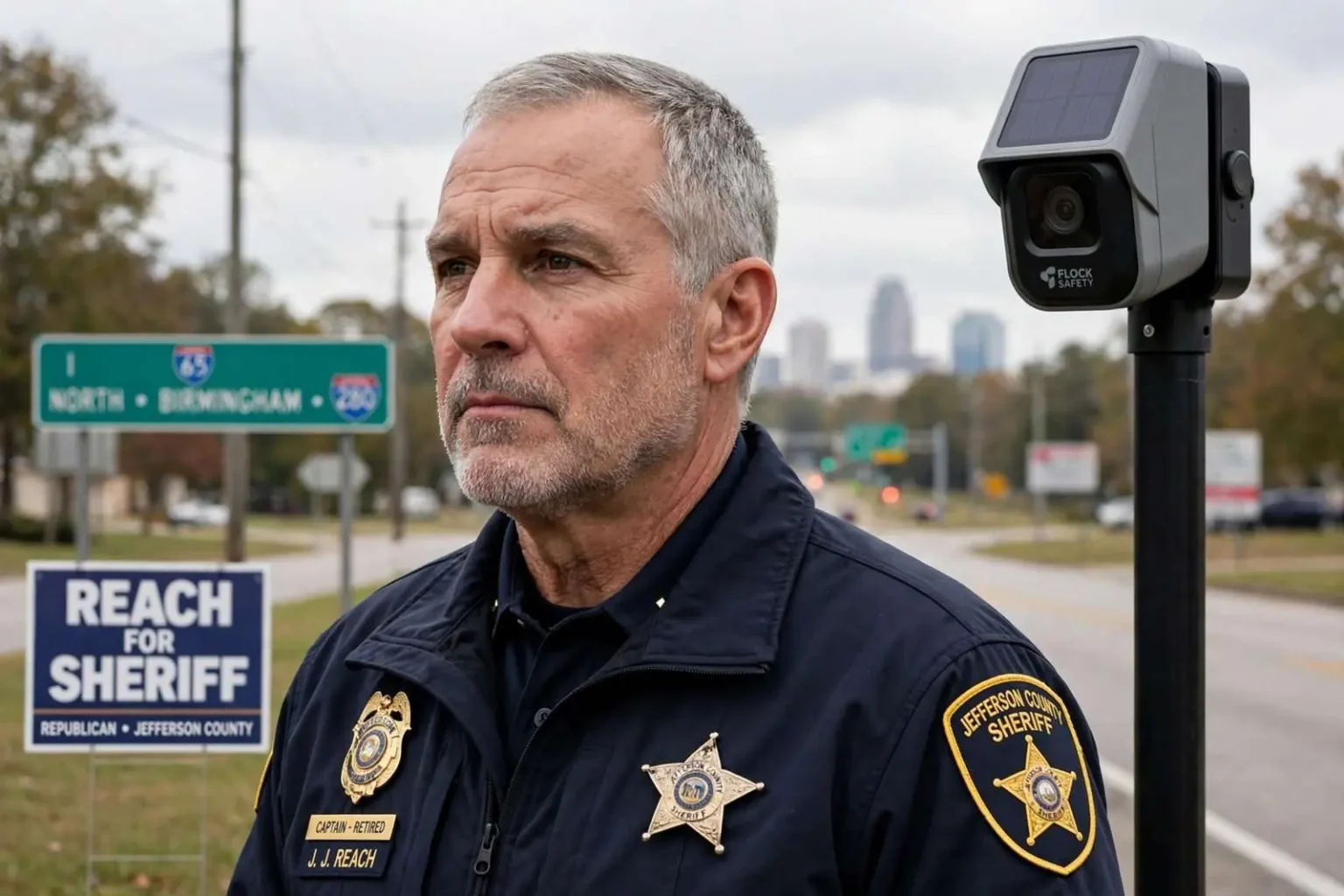
The Republican nominee for Jefferson County Sheriff, Jacob “JJ” Reach, says law enforcement agencies should be required to obtain a search warrant before accessing footage and data collected by Flock Safety license plate reader cameras. Reach, a retired captain with the Jefferson County Sheriff’s Office who spent 30 years in law enforcement serving the county, raised the concern during a Wednesday radio interview with Allison Sinclair and Amie Beth Shaver. His comments come as the automated camera systems, which photograph and log license plates as vehicles pass, face growing scrutiny nationwide following reports of misuse by police and sheriff’s departments in other states.
The debate touches a technology that has spread rapidly across Alabama and the Birmingham metro area. Jefferson County, home to Birmingham and more than 650,000 residents, has seen municipalities and law enforcement agencies deploy the pole-mounted readers on major corridors such as U.S. 280, Interstate 65 and Interstate 20/59, as well as at neighborhood entrances where homeowners associations pay for added coverage. Supporters credit the systems with recovering stolen vehicles and cracking cases, while critics — now including a candidate running to lead the county’s largest law enforcement agency — worry that a network built for public safety can quietly become a mass tracking tool.
Reach said he built a career solving serious crimes long before the technology existed and cautioned against letting public-safety arguments override individual liberty. “I had the opportunity to work complex felony investigations for a long time, including homicides, cold homicides. We had success in doing that, and we accomplished all that prior to having license plate readers,” Reach said. “We have to not allow the safety term to override taking someone’s liberty.”
Comparing Flock Data to Cellphone Records
Reach drew a comparison between the geo-tracking capability of license plate reader networks and the process officers already follow to obtain cellphone location records. “I’ve got to be able to articulate the reasoning for me to obtain that information, so I can get a search warrant,” he said. “It can tell us the geo tracking location, anything you can imagine off that cell phone — so it’s the same with the LPR readers. In my opinion we should have to obtain a search warrant that way we’re not violating someone’s rights.”
The analogy goes to the heart of how courts have treated location data. Cellular records require investigators to persuade a judge that probable cause exists before a provider will turn them over, and federal case law has increasingly treated historical location information as protected material. A license plate reader network functions in a similar way — logging where a specific vehicle was at a specific time, again and again — which is why critics argue the aggregated data deserves the same warrant protection rather than a casual database query.
He also pointed to the oversight already required for other law enforcement databases as a model for how Flock access should work. “I have access to NCIC and the CJIS, the Criminal Justice Information System — I have to have a reason to run your driver’s license,” Reach said. “I can’t just go out and start searching you. I have to have a reason to run your tag. I have to have a reason to run a criminal history. All of this data is recorded. It should be the same with Flock.”
The NCIC and CJIS comparison carries weight with law enforcement audiences because those federal systems are governed by strict audit rules. Every query is logged, tied to a specific officer and a documented reason, and misuse can cost an agency its access to the systems entirely. Reach’s argument is that a camera network capable of reconstructing a driver’s movements should be held to no lesser standard than the databases officers already use.
Limiting Access to Investigators
Reach said he would prefer to restrict routine access to the camera network to investigators, reserving broader searches for cases where a warrant has been obtained. “Me personally, I believe only investigators should have access to the LPR readers, and that way, if a search warrant is needed, you obtain a search warrant to gather the information,” he said. “Now, sometimes it is convenient to be able to run a tag and it pops up, or some stolen car comes through and it pops up. But convenience should not outweigh the liberty of those who have not done wrong.”
The distinction he draws is between an active alert — a hot-list hit when a stolen car or a vehicle tied to an AMBER Alert passes a camera — and a retroactive search through the historical database, where an officer’s curiosity, rather than any judicial finding, drives the query. Under the model Reach describes, patrol deputies would still get real-time alerts, but digging into where a vehicle has been would require an investigator to articulate reasons to a judge first.
Flock Safety cameras, often mounted on poles at intersections and neighborhood entrances, use optical character recognition to log license plates, vehicle types and travel patterns, building a searchable database that officers can query. Departments across Alabama and the country have adopted the systems to help locate stolen vehicles, missing persons and suspects, but civil liberties advocates and a growing number of lawmakers have raised Fourth Amendment concerns about how long the data is retained, who can access it and whether searches are properly documented.
The company’s systems typically retain footage for a set window — commonly around 30 days — before it is automatically deleted, and Flock has marketed the product to cities as a privacy-conscious alternative to continuous video surveillance. But the databases can be networked across jurisdictions, allowing an officer in one city to search camera hits recorded in another, and news investigations in other states have documented agencies running searches without case numbers, sharing data with out-of-state departments, or querying the systems in connection with personal matters. Those episodes have turned Flock into a national flashpoint and put local policies under a microscope, including in communities across the Birmingham metro area.
A Statewide Debate Ahead of the Legislative Session
The use of Flock cameras is expected to be a major topic when the Alabama Legislature reconvenes for its next session. State Rep. Ernie Yarbrough, R-Trinity, has said he hopes lawmakers will take up new restrictions on the technology, adding Reach’s voice to a widening chorus of Republican officials and candidates across the state questioning how the cameras are used.
Legislative interest reflects a broader national trend, as statehouses from Texas to Virginia have debated bills to require warrants for license plate reader searches, cap data retention, or bar the sharing of camera data with federal agencies. In Alabama, where lawmakers have previously taken up privacy measures on questions such as drone surveillance and biometric data, any Flock bill would have to sort through competing interests — law enforcement groups that value the technology, municipal governments that have budgeted for it, and residents who object to being logged every time they drive through an intersection.
What It Means for the Sheriff’s Race
Reach will face incumbent Jefferson County Sheriff Mark Pettway in the November general election, with the future of Flock camera policy in the county likely to remain part of that campaign. The sheriff’s office is the county’s principal law enforcement agency, responsible for patrolling unincorporated areas, operating the county jail and serving warrants and civil papers across one of the most populous counties in Alabama, so its data-handling policies set the tone for the region.
The position also gives Reach a ready-made contrast on a civil-liberties question that cuts across party lines. Polling around the country has shown that voters who strongly support police powers are often the same voters most uneasy about government tracking, which is why candidates in both parties have found license plate readers a fruitful issue. Reach’s argument that warrants and audit trails should govern Flock searches frames the technology as something that can coexist with constitutional protections — if, in his view, agencies put the guardrails in place themselves rather than waiting for courts or legislators to do it for them.
For residents of Jefferson County, the practical stakes are straightforward. The cameras already record their comings and goings on the roads they drive every day, from the suburbs of Hoover and Vestavia Hills to the neighborhoods of Birmingham itself. Whether a query into that record of daily life requires a judge’s signature, and who within an agency is allowed to run one, will shape how the technology fits into daily policing — and Reach has made his answer a central plank of his campaign for the office that would decide it.
The general election will settle the question of who sets that policy. Until then, the debate Reach joined on the radio is expected to continue in City Council chambers and legislative committee rooms across Alabama, as the state decides how far automated license plate readers — and the databases behind them — should be allowed to see.