Jo Bonner Moves Resignation From Congress to Aug. 2, Setting Stage for Special Election
Rep. Jo Bonner moved his congressional resignation to Aug. 2, giving Alabama time to organize a special election for the First District seat.
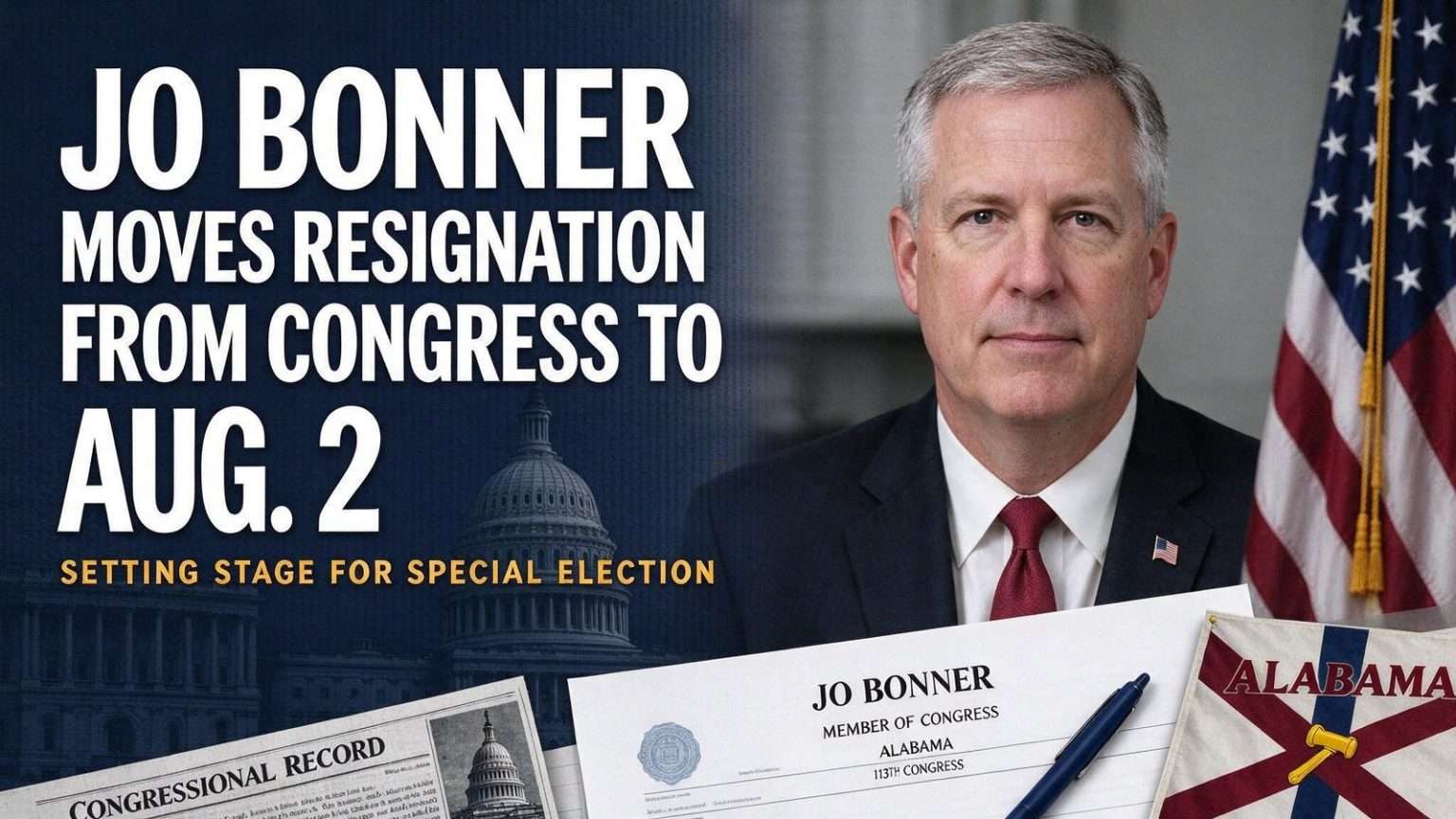
Rep. Jo Bonner, R-Mobile, accelerated his departure from Congress, telling House leadership he would step down on Aug. 2 instead of his originally planned mid-August date. The move, announced weeks after Bonner revealed his intention to leave Washington, hands Alabama’s governor additional runway to call and conduct a special election so that the First Congressional District has seated representation when Congress returns in January.
The timing of a congressional vacancy is governed by a web of federal and state law, and every day counts once a seat sits empty. Under Alabama law, the governor sets the dates for a special primary and special general election, and those contests must be spaced far enough apart for absentee voting, military ballots and runoff provisions to work as designed. By moving his effective resignation earlier in August, Bonner gave the governor’s office more room to schedule a primary in the fall and a general election in time for a successor to take the oath when the second session of the 113th Congress convenes.
“It was always my intent for this seat to be vacant as little time as possible,” Bonner said in announcing the move, adding that he wanted to ensure a successor could be elected and sworn in ahead of the second session of the 113th Congress. He also thanked Gov. Robert Bentley for his cooperation in coordinating the timeline, an acknowledgment of the coordination required between a departing member’s office and the state’s chief executive to keep constituent services running during the transition.
Bonner’s district office in Mobile will continue handling casework for residents during the vacancy period, a routine arrangement that allows constituents dealing with federal agencies — Social Security, veterans’ benefits, immigration matters — to keep receiving help while the seat is unfilled. The district itself stretches across southwest Alabama, taking in Mobile and Baldwin counties along with portions of the surrounding region, and has been considered one of the safest Republican seats in the state for years.
A Crowded Field Forms Quickly
Even before the resignation took effect, at least nine names had surfaced as prospective candidates for the safely Republican seat. The list spanned the district’s two population centers and reflected the breadth of the region’s political landscape: former gubernatorial nominee Bradley Byrne of Mobile, Orange Beach businessman and 2012 congressional candidate Dean Young, conservative columnist Quin Hillyer of Mobile, real estate agent Jessica James of Mobile, first-time independent candidate James Hall of Stapleton, state Rep. Chad Fincher of Semmes, state Rep. Randy Davis of Daphne, Fairhope builder Daniel Dyas and Wells Griffith of Mobile.
Several of the prospective candidates came to the table with established political résumés. Byrne, a former member of the State Board of Education and one-time chancellor of the two-year college system, had run statewide for governor in 2010 and carried name recognition across south Alabama. Fincher and Davis brought legislative records from Montgomery, where each had served in the Alabama House of Representatives, giving them networks of supporters in Baldwin County and along the Eastern Shore. Young, who had finished a strong second in the 2012 Republican primary against a sitting incumbent in a neighboring district, represented the more activist conservative wing of the party.
Others were newer to electoral politics. Dyas, a builder from Fairhope, and James, a Mobile real estate agent, had never held elected office, while Hillyer had built a statewide reputation through years of syndicated column writing and work with national conservative organizations. Griffith brought experience from state government circles in Montgomery, and Hall entered the race as an independent, a rarity in a district where the Republican primary has traditionally been the decisive contest.
Because the district leans so heavily Republican, the practical race is the special primary, and the large field on the Republican side raised the likelihood of a runoff. Alabama election law requires a candidate to win a majority of the vote to claim a nomination outright; without one, the top two finishers advance to a secondary contest weeks later. A sprawling field of well-known candidates virtually guarantees a compressed, expensive campaign in which fundraising and name identification matter enormously, and it leaves independents and Democrats facing an uphill path in the general election that follows.
The compressed calendar of a special election magnifies those dynamics. Unlike a regular cycle, candidates have only weeks rather than months to introduce themselves, raise money and get their voters to the polls on an unusual election date that many residents will not have marked on their calendars. Turnout in special elections is typically a fraction of what it is in November, which rewards campaigns with strong organizations, church networks, business connections and absentee-ballot operations rather than broad messaging alone.
The winner will inherit a district with an economy anchored by some of the region’s largest employers and industries. The Port of Mobile, the aerospace and shipbuilding operations that employ thousands across the two counties, the tourism economy of the Baldwin County beaches, and the timber and agricultural interests that stretch across the district’s rural reaches all have standing interests in Washington, from navigation funding to defense contracts to federal disaster policy. Defense in particular looms large, with shipyard work along the Mobile River and aviation operations in the western part of the region depending on congressional appropriations cycles.
A Decade of South Alabama in Washington
Bonner, who spent a decade representing South Alabama in Washington, first won the seat in 2002 after his predecessor moved on, and he was re-elected five times, frequently without serious general-election opposition. During his tenure he became known for his work on the Appropriations Committee, a post that gave the district a voice in federal spending decisions, and for his attention to the port, the region’s military installations and the recovery efforts that followed Hurricane Katrina’s strike on the Gulf Coast in 2005.
His decision to leave Congress mid-term came as he transitioned to a new role outside elected politics, and his resignation announcement emphasized continuity for the district rather than any dissatisfaction with the job. In closing his announcement, Bonner said he would be “forever indebted” to the people of the region for the chance to serve them in Congress, a sentiment he paired with gratitude to the staff members and supporters who had worked with him across five congressional terms.
For voters across Mobile, Baldwin and the surrounding counties, the immediate practical questions are dates and ballots: when the governor sets the special primary, when the special general follows, and which of the crowded field’s names ends up on the November-style ballot that decides the seat. The county probate offices and absentee election managers in each county will publish the qualifying lists and sample ballots once qualifying closes, and the campaigns themselves are already expected to begin organizing across a district that spans everything from downtown Mobile’s port district to the orange groves and beach towns of Baldwin County.
What is already certain is that the seat will change hands for the first time in more than ten years, and that the race to replace Bonner will be the region’s most-watched political contest since the last redistricting cycle reshaped the district’s boundaries. Between now and January, the district’s representation in Washington depends on a special-election process that Bonner, by moving his resignation up, did his part to compress as tightly as state law allows.
The mechanics of filling a vacant House seat are worth understanding, because they differ sharply from how Senate vacancies work. When a Senate seat opens, the governor may appoint a temporary successor. In the House, the Constitution requires that a replacement be chosen by special election, which is why the governor’s scheduling authority matters so much and why Bonner’s accelerated timeline carried real weight. Between the vacancy and the election, the district simply has no vote in Congress — its representative’s office closes out its casework, and legislation moves forward without a southwest Alabama voice on the floor.
That gap is exactly what Bonner said he hoped to minimize. A resignation in late summer, paired with a prompt special primary, can still put a new member in Washington by January; a slower sequence could have left the seat empty well into the new session. Congressional sessions typically begin in early January, and major spending bills, defense authorizations and port-related legislation all move in the first months of the year, making the timing more than a technicality for a district with as many federal ties as the First.
Qualifying itself is a formal step handled through the state parties. Prospective candidates must qualify with their party by the deadline the party sets under the governor’s election proclamation, pay any required qualifying fee and file the paperwork that puts their name on the special primary ballot. Independent candidates follow a separate petition-based path under state law. Once qualifying closes, the ballot is fixed, and the field of nine or more names — depending on who ultimately qualifies — becomes official rather than prospective.
County election officials across the district have their own preparations to make. Mobile and Baldwin are two of the largest counties in the state by registered voters, and a special election on an off-cycle date requires printing ballots, staffing precincts, training poll workers and processing absentee applications on a timeline measured in weeks. Military and overseas voters add another layer, since federal law requires ballots for uniformed services members and citizens abroad to be transmitted at least 45 days before a federal election.
For the candidates, the short runway changes campaign arithmetic. Television advertising in the Mobile-Pensacola market is less essential when the electorate is small and highly motivated, so door-to-door organizing, civic club appearances, church visits and direct mail tend to dominate special elections in south Alabama. Fundraising still matters for signs, mail and digital advertising, but the premium falls on turnout operations — identifying the handful of voters who will show up for a special primary in the fall and making sure every one of them casts a ballot.
As the qualifying deadline approached, the question in south Alabama political circles was not who could win the general election but who could survive a crowded Republican primary and, more likely than not, a runoff against a rival from the same party. With a former statewide nominee, two sitting state legislators, a 2012 congressional runner-up, a prominent columnist and several newcomers all weighing the same race, the First District’s special election was shaping up as the most competitive contest the seat had seen in a generation — all compressed into a calendar that Bonner, with his Aug. 2 exit date, had helped make as short as the law permits.