‘That Ronald Reagan Smile’: A Mobile Woman’s Inaugural Ball Encounter With the 40th President
As the nation mourned Ronald Reagan in June 2004, a Mobile woman recounted how persistence, Southern charm and a sympathetic Secret Service agent let her press a medal into the president's hand in 1981.
In the weeks after former President Ronald Reagan’s death in June 2004, Americans everywhere reached back for their own small pieces of him. Some remembered voting for him, some remembered his movies, and many remembered nothing more than a moment in a crowd. In Mobile, Joan Rolison had a story that involved a religious medal, a rope line, a sympathetic Secret Service agent and a good deal of Southern determination.
The encounter dates to January 1981, when Mrs. Rolison and her husband, then Assistant U.S. Attorney E.T. Rolison, traveled to Washington for Reagan’s first inauguration. The trip placed the Mobile couple inside a week of pageantry that marked the transfer of power from Jimmy Carter to the former California governor, and it set the stage for an evening that Mrs. Rolison would still be telling, word for word, more than two decades later.
A Sister’s Request
Before they left, one of her 14 siblings made a request. Her sister asked that Mrs. Rolison take a medal of the Immaculate Conception and place it in the ground at the White House — a small act of intercession, meant to protect those who serve there.
The medal was a humble thing, the kind of devotional object carried quietly in a purse or pocket, and the request reflected a family faith that large households in the Catholic South know well. Carrying it to Washington was easy enough. Finding the right moment to deliver it, it turned out, would take the better part of a week and a run-in with the United States Secret Service.
Washington that January was bitterly cold, and between the weather and the whirl of inaugural events, the medal slipped her mind entirely. Inaugural weeks are a blur even for practiced Washingtonians; for out-of-town guests, the days fill quickly with receptions, parties and the logistics of simply getting from one event to the next in a city packed with visitors.
She remembered it only as she and her husband were stepping into an elevator on their way to an inaugural ball — a California and Illinois ball that the president and Mrs. Reagan were certain to attend. The realization arrived at the worst possible moment, with the couple already dressed and late, and it forced a decision on the spot.
She asked her husband to hold the elevator and went back for it. “He said, ‘What do you think you’re going to do with it?’ and I said, ‘Give it to President Reagan,'” Mrs. Rolison recalled. “And he said, ‘You won’t get within 100 feet of him.’ I said, ‘We’ll see.'”
It is worth pausing on her husband’s skepticism. He was an assistant U.S. attorney, a man who understood better than most how tightly guarded a president is, and “you won’t get within 100 feet of him” was not an idle estimate. Mrs. Rolison’s response — “we’ll see” — was, in retrospect, the first move in a campaign.
Working the Room
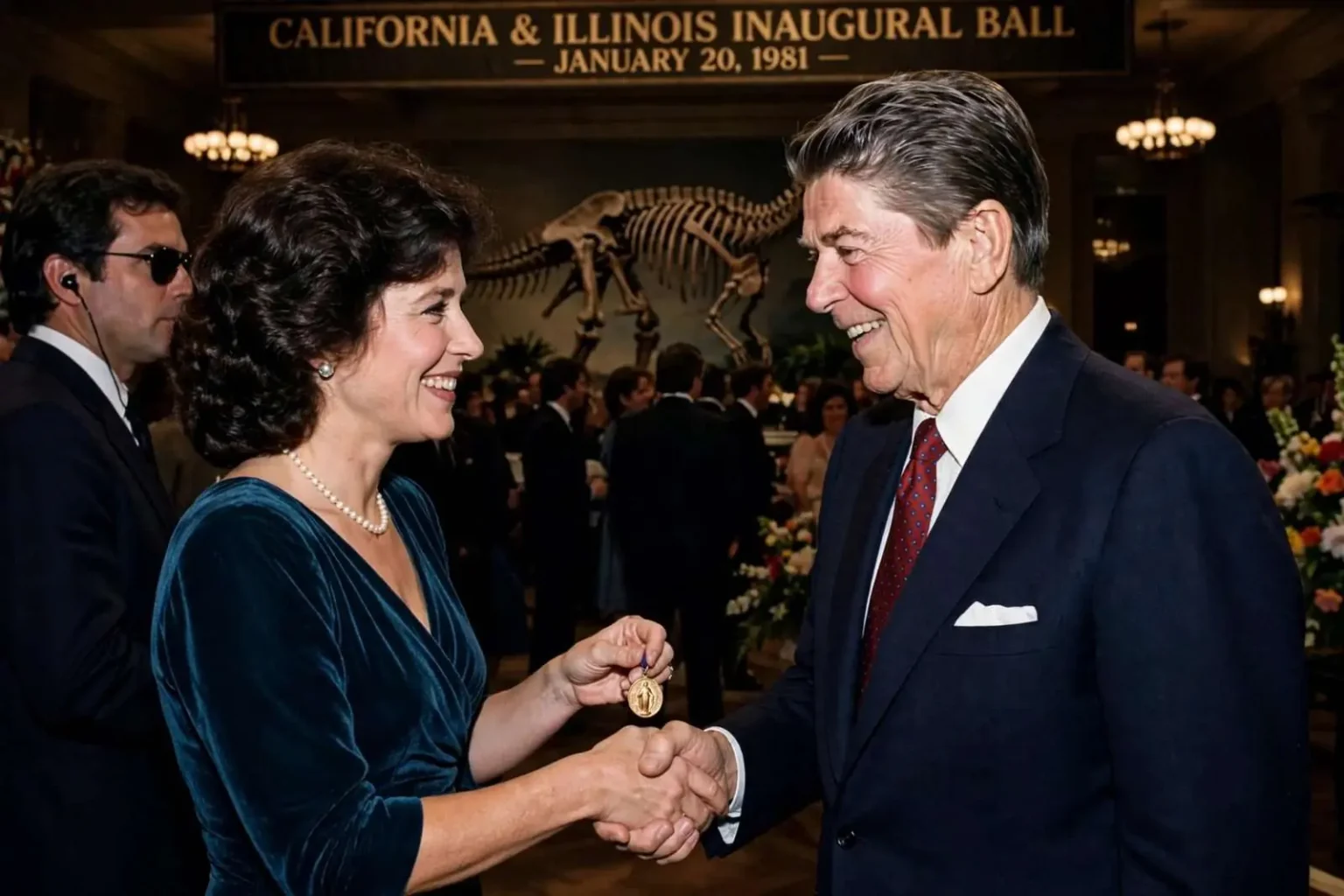
The ball was held at the Museum of Natural History, one of the capital’s grandest spaces pressed into service for an evening of celebrating the new administration. The Rolisons and another couple found themselves in a staked-off area well back from the stage where the dancing would take place — a fine vantage point, their companions insisted.
Mrs. Rolison disagreed. “I said, ‘Let’s go stand over there near those stairs,'” she said. “They said, ‘No, this is the best place to view it from.’ I said, ‘Well, I’m going over there.'”
The disagreement over where to stand is a familiar one to anyone who has ever attended a big event with a group, and it captures Mrs. Rolison’s instinct: the best view is never the one assigned to you. She threaded her way through the crowd to the steps leading up to the stage, positioning herself where the evening’s principals would have to pass.
A Secret Service agent turned down her request to stand on the steps for a better view. “I said okay,” she recalled. “But I still stood there.”
Hemmed in by agents and other guests already standing on the steps in front of her, she could see almost nothing — only glimpses of dancing between people’s feet. For a few minutes, the great campaign to deliver a medal to the president of the United States had stalled in a crowd, inches from its target, with nothing to show for it but the shoes of the dancers in front of her.
The Agent Looks Away
Then the music stopped, and the agent who had refused her turned around. “If I’m not looking and you stand on those steps, I can’t say anything, can I?” he said. “I said, ‘No, you can’t.'”
It was a small act of official mercy, the kind experienced Secret Service agents have long been known for when a request is harmless and the requester is harmless too. The agent had already judged that Mrs. Rolison posed no threat whatsoever — only the mild, persistent menace of a Mobile woman on a mission — and he arranged his own sightlines so that her next step up the stairs would technically not happen.
With the dance ended, President and Mrs. Reagan made their way back toward the stairs. As they neared, Mrs. Rolison caught the president’s eye. “He made eye contact with me and I made eye contact with him, and I stuck out my hand,” she said. “We shook hands and I pressed the medal into his hand. His eyes got huge, like, ‘What have I done?'”
Reagan continued down the stairs, took a few more steps, and then looked at what was in his palm. “He turned around and looked back at me and gave me the ‘okay’ sign and smiled that Ronald Reagan smile,” she said. “I smiled back and gave him the okay sign, too. And that’s my Ronald Reagan story.”
The whole exchange lasted a matter of seconds — long enough for a handshake, a pressed medal, a glance at an open palm and a grin across a crowded ballroom. The mission her husband had declared impossible had been accomplished, within 100 feet turned into inches, and the medal of the Immaculate Conception had left Mobile bound for the hands of the 40th president.
Why These Stories Mattered
Reagan died on June 5, 2004, at the age of 93, after a long withdrawal from public life following his 1994 announcement that he had been diagnosed with Alzheimer’s disease. The letter announcing his diagnosis, written in his own hand, was among the most affecting documents of his later years, and the decade of silence that followed made the memories of those who had met him all the more precious.
His state funeral, the first for a president since Lyndon Johnson’s in 1973, drew enormous crowds in Washington and California, and the week that followed produced a national outpouring of personal recollections — handshakes, motorcade waves, brief exchanges at rope lines. Newspapers across the country, including papers in Alabama, filled their pages with such stories, because it turned out that the man’s political legacy was matched by an equally large legacy of small encounters.
There is something fitting in the way these memories survive. Presidents are remembered by history for budgets and treaties and elections, but they are remembered by people for instants: a wave from a limousine, a joke told at a rope line, a grin exchanged across a ballroom. Mrs. Rolison’s account belongs to that genre, and it survives for the same reason those stories generally do: not because anything of consequence happened, but because of what it says about the man’s manner, and about the kind of moment ordinary people remember for a quarter century afterward.
Reagan’s public manner was, in fact, a large part of his political identity. Long before he entered politics he had been a professional performer, and the warmth that played so well on screen and on the campaign trail translated into the casual, unguarded interactions that people who met him at inaugural balls, county fairs and rope lines carried away with them. The “Ronald Reagan smile” that Mrs. Rolison described was not a figure of speech; it was a shared reference point for a generation of Americans who found themselves, briefly, the object of it.
For Mobile, the story is also a small piece of the city’s long connection to national politics. Mobilians have made the trip to inaugurations for generations, and each inauguration sends back its own supply of stories — some about the ceremonies, some about the weather, and a rare few, like this one, about getting close enough to shake a president’s hand when everyone said it couldn’t be done.
She got past the Secret Service on nerve and charm, and she got back a grin. For a Mobile woman with a medal, a mission and a sister’s request to fulfill, that was more than enough — and twenty-three years later, it was still the story she told, with the same eye contact, the same okay sign, and the same Ronald Reagan smile at the end of it.