Baldwin County’s Jody Bishop Named Alabama ‘Judge of the Year’ for Protecting the Forests
Baldwin County District Judge Jody Bishop was named Alabama's Judge of the Year by the state's forest owners and forestry commission for his work prosecuting timber and woodland crimes.
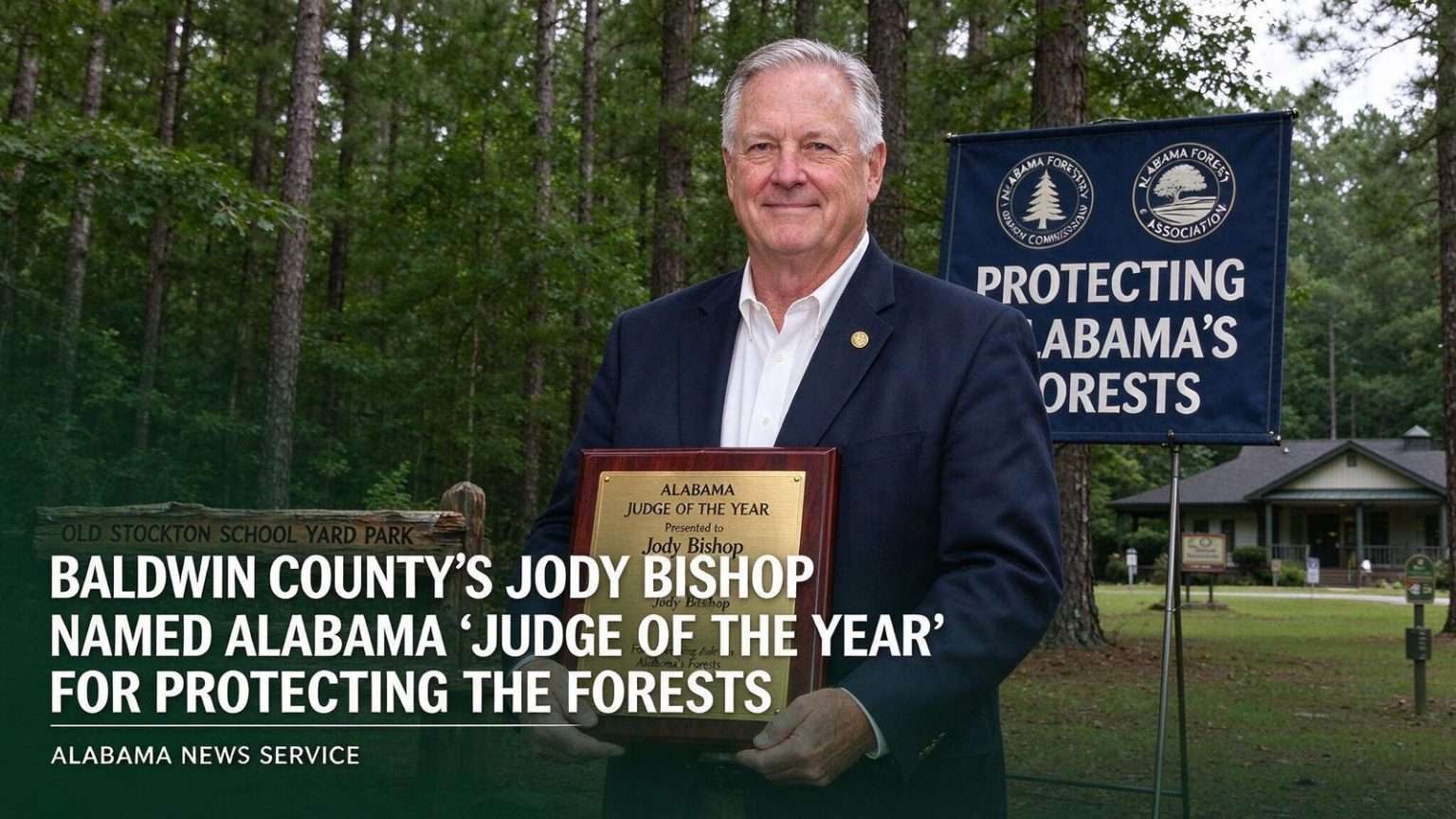
BALDWIN COUNTY, Ala. — Baldwin County District Judge Jody Bishop has been recognized as Alabama’s “Judge of the Year,” an honor bestowed by the Alabama Forest Owners’ Association and the Alabama Forestry Commission for his commitment to protecting the state’s woodlands. The award puts a rare public spotlight on a corner of the courtroom docket that most residents never see — the prosecutions of timber theft, woods arson and the destruction of forest land that costs landowners across Alabama dearly each year.
Bishop was selected over judges nominated from across Alabama. The nomination originated with Alabama Forestry Commission investigators working in Southwest Alabama, who put his name forward after working with him on cases in the region. The Forest Owners’ Association then reviewed all of the nominations and made the final selection based on votes and a written recommendation letter.
Commission officials said Bishop earned the award because of his “exemplary commitment to the apprehension and prosecution of individuals who steal, burn or otherwise destroy the forest resources of this state.” The wording is deliberate: timber crimes occupy an unusual space in the law, blending theft, arson, trespass and property damage, and bringing them to prosecution requires investigators and courts that understand both the evidence and the economics of standing timber.
In a part of Alabama where timber remains a bedrock industry, that kind of vigilance from the bench carries real economic weight. Forests cover the majority of Baldwin County and the state as a whole, and timber is consistently ranked among Alabama’s most valuable agricultural commodities, supporting landowners, loggers, truckers, mills and the rural communities in between. When a landowner’s timber is stolen or a woodland is set ablaze, the loss is measured not only in trees but in decades of growth that cannot be quickly replaced.
A judge with roots in the land
“I am honored to be selected for this award,” said Bishop, who was set to take office as a Baldwin County circuit judge in January. “Our forests have always been a key component of Baldwin County’s history and economy, and I am committed to enforcing the laws that protect them.”
The recognition arrived as Bishop prepared to move up from the district bench to the circuit court, underscoring a career built in part on treating crimes against forests and forest landowners as offenses worth taking seriously. The move from district to circuit court is a significant step in Alabama’s judicial system: district judges handle misdemeanors, preliminary hearings and civil matters up to a statutory limit, while circuit judges preside over felony trials and larger civil cases — including the felony-level theft and arson prosecutions that most seriously harm forest landowners.
Bishop’s background in a rural, forested county has given him a working familiarity with the timber economy that prosecutors and investigators say makes a difference in the courtroom. Valuing stolen or burned timber is a specialized exercise, involving cruising the standing trees, calculating board-foot volumes and applying market prices, and cases succeed or fail on whether the court grasps what that evidence means. Judges who understand the industry, forestry officials note, are better equipped to weigh restitution and set penalties that actually deter the crime.
Honored at Stockton
The award was presented during a meeting of forestry investigators at the Stockton Community Center at the Old Stockton School Yard Park in Stockton, in the rural reaches of north Baldwin County. The setting was fitting for an honor rooted in the stewardship of the region’s pine and hardwood. Stockton is a small crossroads community surrounded by some of the county’s most extensive timberland, and the old school yard park has long served as a gathering place for the area’s landowners and outdoorsmen.
Gathering the investigators who nominated him was itself part of the honor. The Alabama Forestry Commission’s law enforcement investigators are a specialized force within state government, sworn officers who work the back roads and woodlands of their districts chasing complaints of stolen loads, cut-over boundaries that do not match deeds, and woods fires that turn out to be arson. Their casework is often slow and patient — timber does not move like stolen merchandise, and identifying who harvested a tract illegally takes knowledge of local markets and logging crews.
Guardians of a working landscape
The Alabama Forestry Commission is a state agency charged with protecting forests, serving landowners and fostering responsible stewardship of the state’s timber resources. Its mission spans fire protection, forest health, seedling programs and assistance to private landowners, who own the overwhelming majority of Alabama’s forestland. Within that mission, the commission’s investigators handle the criminal end: timber theft, arson and related offenses reported by landowners who discover their property has been damaged or harvested without permission.
The Alabama Forest Owners’ Association, the other organization behind the award, is a private, nonprofit organization representing thousands of family and private forest landowners across the state. The group publishes guidance on timber management and taxation, lobbies on behalf of landowners in Montgomery, and keeps a watchful eye on how timber crimes are charged and punished. Its annual recognition of judges, prosecutors and investigators is intended to encourage officials to take woods-related crime seriously — an offense category the association has long argued is under-reported and under-punished.
Landowners’ groups point out why the issue deserves the attention. A mature stand of timber represents decades of investment: planting, thinning, waiting through growth cycles and paying property taxes year after year. A thief with a chainsaw and a truck can strip a boundary line in a weekend, and an arsonist can undo a generation of growth in an afternoon. Because many victims are older, rural landowners, the crimes often go undetected until a neighbor notices fresh stumps or smoke rising from a distant tract.
For Baldwin County, the award is also a statement about local identity. The county’s economy has diversified rapidly in recent decades with growth along the Eastern Shore and Interstate 10 corridor, but its northern and rural reaches remain pine country, measured in acres and cords rather than subdivisions. Bishop’s rise to the circuit bench with this honor in hand signals to those landowners that the courts they fund understand what a load of stolen timber — or a burned tract — truly costs them.
Bishop takes the recognition with him into circuit court in January, where the felony cases that most threaten the state’s forests will ultimately land. The forestry community, for its part, has made clear it intends to keep watching — and to keep honoring the judges who do the same.
The path the award took — from field investigators to a statewide landowners’ vote — reflects how the forestry community evaluates its allies. Investigators see first-hand which judges handle timber cases competently, because they appear before them on every case they make. The Forest Owners’ Association’s membership then weighs those nominations through the lens of their own experience: landowners who have fought theft or arson cases know exactly which courts moved their cases forward and which let them languish.
Timber crime prosecutions also depend on cooperation between state and local authority. The Forestry Commission’s investigators generally develop cases that are then presented to district attorneys and heard in district or circuit courts, making the local judiciary an essential link in the chain. A commission can investigate anywhere in the state, but it cannot convict anyone without a willing prosecutor and a court prepared to treat the offense as more than a property nuisance.
That cooperation is why the investigators’ meeting at Stockton doubled as the award ceremony. The event brought together the commission’s Southwest Alabama law enforcement personnel with the judge whose courtroom they know best, in the heart of the timber country his decisions affect. Officials used the occasion to encourage landowners to report suspected theft and arson promptly, noting that early reports give investigators their best chance of recovering stolen wood or tracing a fire to its source.
The district court docket that built Bishop’s reputation remains a busy one. Misdemeanor theft cases, criminal trespass charges and preliminary hearings for felonies all pass through the district bench in Baldwin County, meaning many timber-related cases get their first — and sometimes only — day in court there. Judges in those seats set the tone for how seriously the justice system treats woods crime long before a felony ever reaches circuit court.
For rural landowners across south Alabama, the recognition of a Baldwin County judge sends a practical message: the courts do notice. Wooden boundaries, smoke in the distance and unfamiliar logging trucks remain worth a phone call to the Forestry Commission, and the cases that result have a better chance of being taken seriously from the first hearing to sentencing. In an industry built on patience and decades of growth, that continuity of enforcement is itself a form of stewardship.