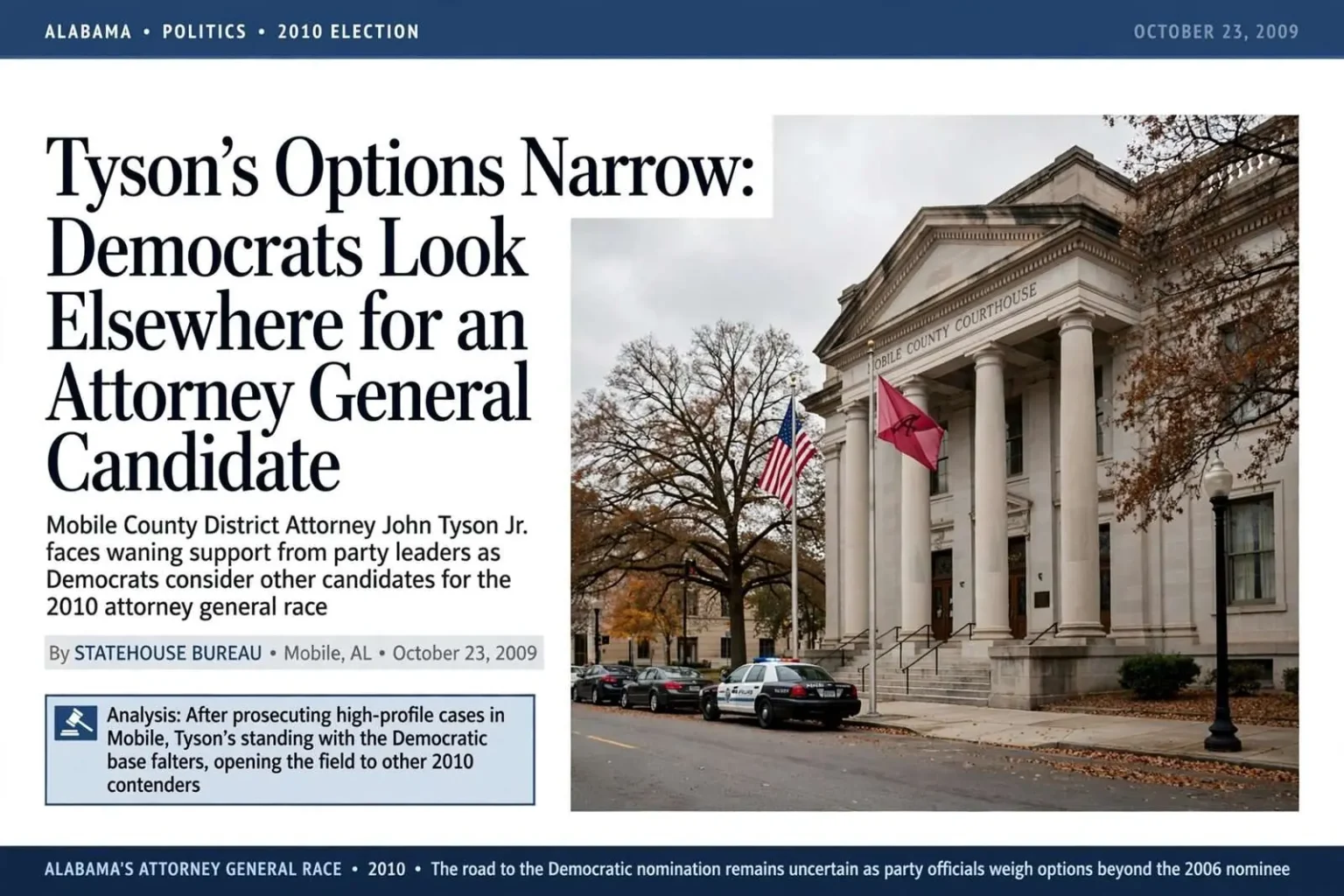
John Tyson Jr. carried the Democratic banner for attorney general in 2006 and lost to Republican Troy King. Whether he gets a second try is now, increasingly, someone else’s decision. The Mobile County district attorney’s prospects for 2010 do not appear to have improved — not on his own end, at any rate, and not among the party figures whose support would make a second campaign viable.
For Alabama Democrats, the attorney general’s race has long been one of the few statewide contests in which their party can realistically compete. The office sits at the intersection of criminal justice, consumer protection and state government oversight, and it has historically attracted candidates from both parties who see it as a proving ground for higher office. But winning it requires a candidate who can hold together a coalition that runs from urban Black Belt counties to suburban Mobile and Baldwin precincts where Democrats survive only on the strength of individual name recognition. Tyson, by virtue of his office, entered 2006 with a profile that seemed suited to that task. What followed instead was a defeat that left party leaders questioning whether he could ever assemble the coalition a statewide race demands.
The question heading into 2010 is not merely whether Tyson wants the rematch. It is whether the party’s organized constituencies — the ones who fund campaigns, staff phone banks and drive turnout in a low-profile election year — are prepared to invest in him again, or whether they will look to one of the other names already circulating in Democratic circles.
The Cost of Doing the Job
Part of Tyson’s difficulty is the work itself. His office pursued an investigation into alleged financial irregularities at Bishop State Community College, a Mobile-based institution in Alabama’s two-year college system. The inquiry landed squarely in the middle of a period when the state’s community college system was under intense scrutiny over questions of hiring, contracting and the use of public money, and it made Tyson a central figure in a story that touched lives and livelihoods across Mobile’s black community. Bishop State has long played an outsize role in the city’s educational and civic life, and any prosecution that reaches its campus is watched closely by the people the college serves.
Before that, Tyson’s office prosecuted Prichard Mayor Jessie Norwood, a case that carried its own political weight in Mobile County. Prichard, a city of roughly 28,000 north of Mobile, has struggled for decades with fiscal stress, and its city government has twice gained unwanted statewide attention through municipal bankruptcy — a distinction few Alabama cities share. A sitting mayor’s prosecution in a city with so tight-knit a political community inevitably generated hard feelings that outlasted the courtroom proceedings. Both cases were, by any prosecutorial measure, defensible. Both also cut against constituencies within his own party’s base.
The pattern is a familiar one for big-city prosecutors who harbor statewide ambitions. The district attorney’s office in Mobile County handles some of the most consequential criminal work in south Alabama, and the cases that make headlines there — public corruption, financial misconduct at public institutions, allegations against prominent local figures — are precisely the cases that leave political scars. A prosecutor cannot pick his cases based on how they will play in a future primary. But a politician’s memory of who was offended along the way is longer than the public’s memory of why the case was brought.
Then there is the pending trial of former Circuit Judge Herman Thomas, who until his resignation under pressure held perhaps the highest profile of any elected African-American official in Mobile County, and who now faces charges of trading judicial favor for sex with criminal defendants. Whatever the verdict, the prosecution will be conducted by Tyson’s office in an election cycle. That timing guarantees the case will remain a live political subject through the very months Tyson would be asking his party’s voters for a nomination. The allegations against Thomas — a former presiding judge whose career had included service as a prosecutor and a generation of prominence in Mobile’s legal and civic establishment — have already been the subject of months of coverage, and the trial’s echoes will reach every corner of the county’s Democratic electorate.
The Thomas case illustrates the broader bind. Tyson did not create the allegations, and few would argue a district attorney should decline to act on them. But every development in the proceedings will be refracted through the lens of race and political loyalty in Mobile County, where the Democratic primary electorate is drawn heavily from the same communities most affected by the case. A district attorney who does his job aggressively accumulates enemies. A district attorney who wants to run statewide as a Democrat in Alabama needs the party’s organized constituencies to turn out for him. Tyson’s recent history has done much to satisfy the first requirement and little to secure the second.
The Field Before Him
Before Tyson could face King in a general election, he would likely have to survive a tougher primary than the one he won in 2006 — when he defeated Larry Darby, an avowed atheist, white supremacist and Holocaust skeptic, by a 56-44 margin. That Darby drew 44 percent of a Democratic primary vote remains an uncomfortable fact of recent Alabama political history. Darby’s candidacy was disavowed by party leaders across the state, yet the size of his showing suggested how thin the connection had become between the party’s institutional leadership and the voters who actually cast ballots in its primaries. For anyone assessing Tyson’s strength, the number was a warning: in 2006, a substantial share of Democratic primary voters either did not know who their nominee-for-the-nomination was or declined to support him even with the party establishment lined up behind him.
The names now circulating are of an entirely different character. Montgomery attorney James Anderson is the most frequently mentioned. Conecuh County District Attorney Tommy Chapman and Giles Perkins, a former executive director of the Alabama Democratic Party, have also been discussed. Where Tyson’s profile is that of a big-city prosecutor with a list of courtroom adversaries, these are figures whose political liabilities are fewer and whose relationships with the party’s core constituencies are, in several cases, decades deep.
Anderson, 54, the son of a Baptist minister, described himself as being in the “seriously considering it” stage. With no other announced Democratic contender, he sees no reason to hurry: he will keep practicing law and decide “probably this summer sometime.” He has run statewide before, losing a 2002 bid for the Alabama Supreme Court, and he considers the experience an asset. That race, contested in a year when Republicans swept every statewide office on the ballot, gave Anderson a firsthand education in the cost of running as a Democrat at the top of the ticket — and in the mechanics of raising money and organizing a campaign across Alabama’s 67 counties. His Montgomery base puts him near the center of the state’s government and lobbying community, and his biography — a minister’s son with a law practice built on civil and criminal work — is the kind that party officials believe travels well across regional lines.
Chapman, as a sitting district attorney in Conecuh County, offers a small-town prosecutors’ profile in a party whose rural base has been shrinking but remains essential to any statewide victory. Conecuh County sits in the Black Belt, the band of largely rural, majority-Black counties across south-central Alabama that historically anchors Democratic turnout. A candidate from that region who can speak credibly about rural courts, rural crime and rural economic decline fills a gap that urban candidates cannot. Perkins, meanwhile, brings institutional knowledge from his years as the party’s executive director, a post that put him at the center of every statewide campaign the party ran — and at the center of its relationships with organized labor, the education establishment and the county committees who select and support nominees.
The Republican Side
Whoever emerges will face a Republican primary already in progress. King, whose own office is under federal scrutiny, must first withstand an unusually strong intraparty challenge from Birmingham attorney Luther Strange. Strange defeated George Wallace Jr. for the Republican lieutenant governor nomination in 2006 before losing the general election to Jim Folsom Jr. For him, as much as for King, 2010 looks close to do-or-die. Strange’s 2006 campaign demonstrated real fundraising reach and name identification beyond Birmingham, and his loss to Folsom — a popular, long-tenured figure whose family name has anchored Alabama Democratic politics for three generations — did little to diminish his standing inside a party that regarded the lieutenant governor’s race as an uphill contest from the start. A primary challenge from a well-funded candidate with an organized statewide network is the kind of test King’s allies did not anticipate when he first won the office, and it forces the incumbent to spend money and attention months before a general election.
The federal scrutiny of King’s office adds a further variable. An attorney general under investigation cannot campaign as the state’s chief law enforcement officer with the usual confidence, and any resolution of the scrutiny — favorable or not — will arrive on an unpredictable schedule that could reshape the Republican race entirely. Democrats watching from the sidelines have calculated that the Republican primary could leave the eventual nominee damaged, an opening that makes the field of prospective challengers on their side correspondingly more willing to consider the race.
What Tyson Does Next
The calculation for Tyson may come down to arithmetic rather than ambition. If the Alabama Democratic Conference, Paul Hubbert and the state employees’ union conclude that Anderson, Chapman or Perkins is the better horse for 2010, there is little point in Tyson trying to rally a party to him that he could not rally in 2006. The Alabama Democratic Conference, the state’s most influential Black political organization, and the education establishment represented by Hubbert’s Alabama Education Association together form the backbone of Democratic turnout in a general election. Candidates who win their backing inherit an operational network no amount of personal campaigning can replace; candidates who lack it have historically found Democratic primaries and general elections alike unwinnable, whatever their individual qualifications.
The more immediate question is whether he seeks re-election as district attorney at all, or steps aside to collect a generous retirement while entering private practice — a decision that, at his years of service, involves working for pennies on the dollar if he stays. The arithmetic of the state’s retirement system makes the choice real for many longtime public officials: a district attorney near the top of the service scale can forfeit a substantial portion of his pension by continuing to draw a public salary. It is a calculation that has quietly ended the careers of more than one Alabama prosecutor and legislator.
It is hard, though, to picture Tyson far from politics. Some veteran Democratic loyalists have urged him to consider another run for Congress. A call to his office Friday was not immediately returned. Anderson, for his part, was a substantial contributor to Tyson’s 2006 campaign and says the Mobile official’s decision will not govern his own. “I thought he was very qualified,” Anderson said. “I certainly think John would’ve done a better job than the guy who’s in there right now.”