
Judge Drops Charges for Man Accused of Shooting at Mobile Police Officers
A district judge found no probable cause against Valeido Davidson, while co-defendant Tymetrick James's case heads to a grand jury under strict bond terms.
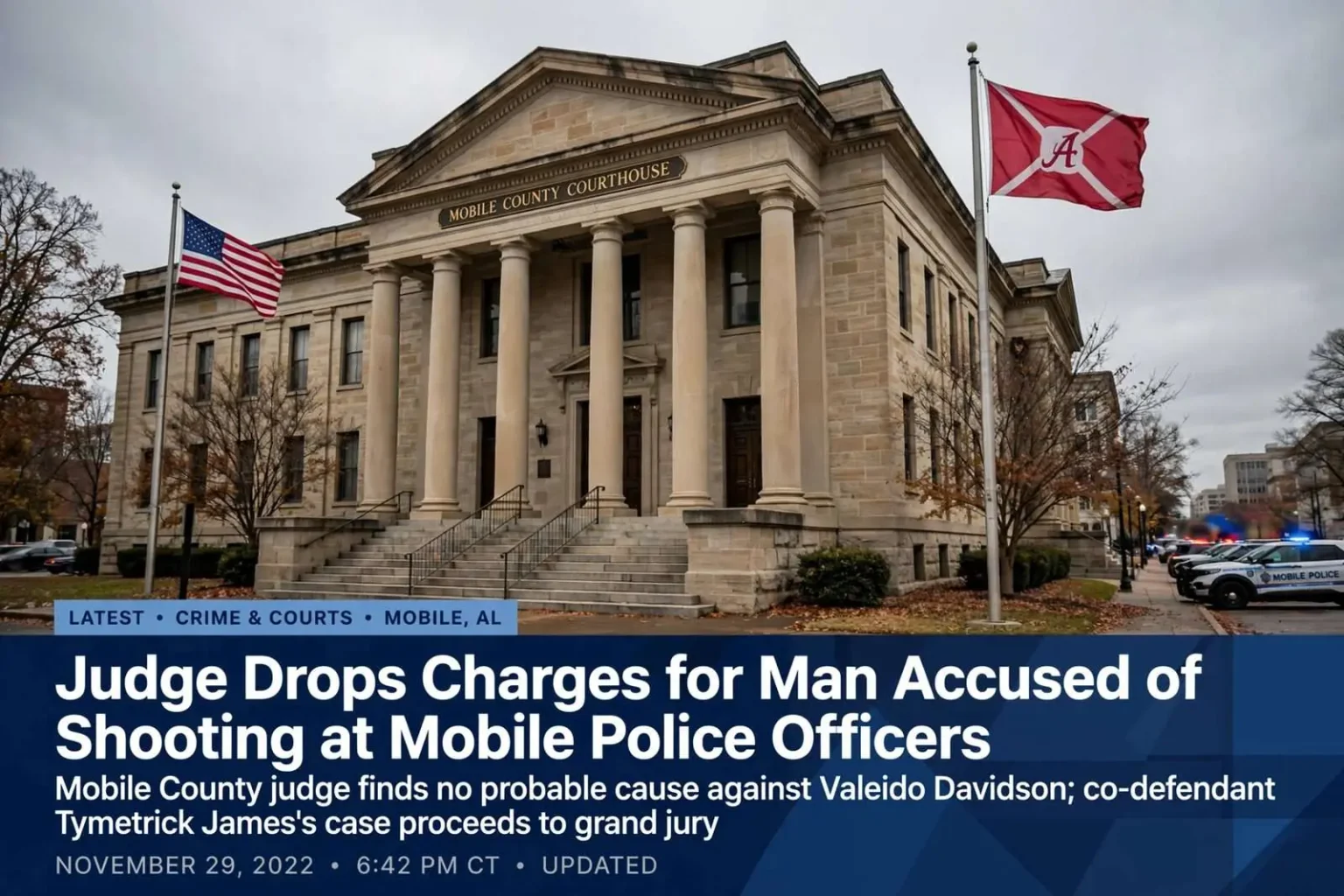
A Mobile County district judge has dismissed the case against one of two men accused of opening fire on Mobile police patrol cars this fall, finding no probable cause to hold him. Valeido Davidson faced two counts of attempted murder along with charges of discharging a gun into an occupied building and vehicle after police said he and another man, Tymetrick James, shot at police cars on September 21.
But following a hearing Tuesday, November 29, the court found no probable cause against Davidson, and he is set to be released, according to Mobile County District Court records. The dismissal ends the case against him at the district court level, where judges determine whether sufficient evidence exists to bind a defendant over for further prosecution.
Probable cause hearings — often called preliminary hearings — are a checkpoint built into the criminal process. At the hearing, prosecutors present enough evidence to show that a crime was committed and that the defendant probably committed it. If the judge finds the showing insufficient, the charges are dismissed, though prosecutors retain the option of pursuing the case later through a grand jury or refiling if new evidence emerges. The judge’s finding in Davidson’s case was that the evidence presented did not meet that threshold.
Co-defendant’s case moves forward
James, who was arrested three days after the shooting and faced the same charges, appeared in district court the same afternoon. The judge found probable cause in his case and granted bond, sending the matter to a grand jury. No grand jury date has been set.
The divergent outcomes in the two cases illustrate how the probable cause standard operates on a case-by-case basis. Evidence presented at one hearing may differ from what is presented at another — witnesses may appear for one defendant and not the other, forensic results may be available for one and pending for the other, and the strength of identification evidence can vary. The judge’s role is not to determine guilt but only whether the evidence clears the low but real threshold of probable cause.
James’s bond comes with significant restrictions, according to court documents: he may not possess a firearm or have any contact with the officers involved. He will be confined to his home with an ankle monitor under an 8 p.m. to 6 a.m. curfew, with travel permitted only to meet with his attorney or appear in court. The conditions — electronic monitoring, a firearms prohibition, a no-contact order and strict travel limits — are typical of the supervision imposed when a case involves allegations of violence against law enforcement officers.
What comes next
The grand jury process to which James’s case now heads is the next stage of Alabama’s criminal procedure. A grand jury hears evidence presented by the District Attorney’s Office in secret proceedings and decides whether there is sufficient basis to return an indictment — a formal charge that allows the case to proceed to circuit court for trial. If the grand jury indicts, the case moves into the circuit court docket; if not, the charges end there.
The dismissal leaves prosecutors with one active defendant as the case heads toward the grand jury. The allegations at the center of the case — gunfire directed at police patrol cars on September 21 — fall among the most serious a defendant can face, carrying potential sentences measured in decades if a conviction were obtained. Cases involving alleged violence against officers typically draw close scrutiny from prosecutors, who must weigh identification evidence, forensic findings and witness accounts as the matter advances.
Court records in Mobile County District Court document the procedural track of both cases, and any further action — a grand jury indictment, a refiling against Davidson or the resolution of James’s bond conditions — will appear there as it occurs. Until the grand jury acts, the case against James remains in its early stages, and Davidson is set for release after the judge found no probable cause to hold him.
The charges and the allegations
The case arose from an incident on September 21 in which Mobile police said two men fired on patrol cars. Davidson was charged with two counts of attempted murder — one for each apparent target — along with counts of discharging a gun into an occupied building and vehicle. The attempted murder counts reflect prosecutors’ position that the officers in the patrol cars were the intended targets of the gunfire; the discharge charges cover the act of firing a weapon at occupied structures or vehicles regardless of whether anyone is struck.
James was arrested three days after the shooting and faced the same charges. The quick arrest timeline — less than 72 hours between the incident and James’s detention — suggested investigators moved rapidly on the leads available in the case, which in shootings of this kind typically include witness accounts, ballistic evidence, surveillance video and tips from the community.
Incidents in which gunfire is directed at police vehicles mobilize substantial investigative resources. The Mobile Police Department, like departments across the country, treats any attack on officers as a priority investigation, both because of the danger to personnel and because of what it represents for officer safety generally. Cases built on such incidents are typically presented to district court promptly to test whether the evidence will support prosecution.
Probable cause in the Alabama system
Alabama’s criminal process routes felony arrests through district court, where a judge reviews the evidence before the case can advance. The probable cause standard at this stage is deliberately modest — far short of the proof required for a conviction — but it is not meaningless, and defense attorneys use the hearing to test whether the state’s evidence connects their client to the offense. When a judge finds no probable cause, the defendant is released from the charges in that case, as occurred for Davidson.
When probable cause is found, as in James’s hearing, the case is bound over to the grand jury, and the judge’s bond determination sets the conditions of release pending further proceedings. The restrictions imposed on James — home confinement with an ankle monitor, a nightly curfew from 8 p.m. to 6 a.m., no firearms, no contact with the officers involved and travel only for attorney meetings or court appearances — mark the conditions as among the strictest short of continued detention. Violating any of them can result in bond revocation and return to jail.
The two hearings, held the same afternoon in the same courtroom, produced a split outcome that will shape the case’s path: one defendant set for release and his charges dismissed, the other bound over for grand jury review with no date yet set. For the Mobile Police Department, whose patrol cars were the alleged targets, the proceedings mark the first judicial test of the evidence gathered since the September shooting — a test that succeeded for one defendant and failed for the other, under the same standard, on the same day.
The grand jury’s role
With James’s case bound over, attention shifts to the Mobile County grand jury. In Alabama, felonies must be indicted by a grand jury before they can proceed to trial in circuit court, making the panel a pivotal gatekeeper. The grand jury — a group of citizens drawn for jury service — hears the District Attorney’s presentation of evidence behind closed doors, without the defense present, and votes on whether to return a true bill of indictment. The standard is similar to probable cause, and the process generally moves faster than a trial docket, though no date had been set in James’s case as of the November hearing.
If the grand jury indicts, the case will be arraigned in circuit court, where James will enter a plea and the case will move toward pretrial motions and, potentially, trial. If the grand jury declines to indict, the charges end. Either way, the district court phase — where the probable cause determinations were made — is finished, and the matter now belongs to the grand jury and, potentially, the circuit court.
For Davidson, the dismissal is a final judicial word at this stage of the process. A finding of no probable cause releases him from custody on those charges. Prosecutors who believe additional evidence could change the analysis retain limited avenues to revisit a dismissed charge, but unless that occurs, the case against him is over.
How such cases typically unfold in Mobile
Cases arising from shootings involving police vehicles move through Mobile County’s courts under the same framework as other violent felonies, but they carry high stakes for all sides. For defendants, attempted murder charges carry sentences that can stretch to life in prison, making every procedural stage consequential. For prosecutors, the cases demand careful evidence presentation at probable cause hearings, where an insufficient showing can end a prosecution before it begins — as Davidson’s dismissal demonstrates. For the police department, the proceedings test the investigation’s work in a public forum.
The bond conditions imposed on James reflect the court’s effort to balance competing interests in the interim: the presumption of innocence that entitles a defendant to reasonable bail, and the community’s and officers’ interest in safety while the case is pending. Ankle monitoring with home confinement, a firearms prohibition, a no-contact order covering the officers involved and travel restricted to attorney visits and court dates form a web of supervision designed to ensure the defendant’s availability and the absence of further alleged contact with the case’s subjects.
Until the grand jury acts, the case remains in procedural suspension, with James under bond supervision and Davidson released. The District Attorney’s Office will decide what evidence to present, the grand jury will decide whether the case proceeds, and any trial would follow in circuit court. The September 21 incident — gunfire directed at Mobile police patrol cars — has thus arrived at its first judicial crossroads: one defendant’s charges dismissed for lack of probable cause, the other’s case advancing toward the next stage of Alabama’s criminal process.


