

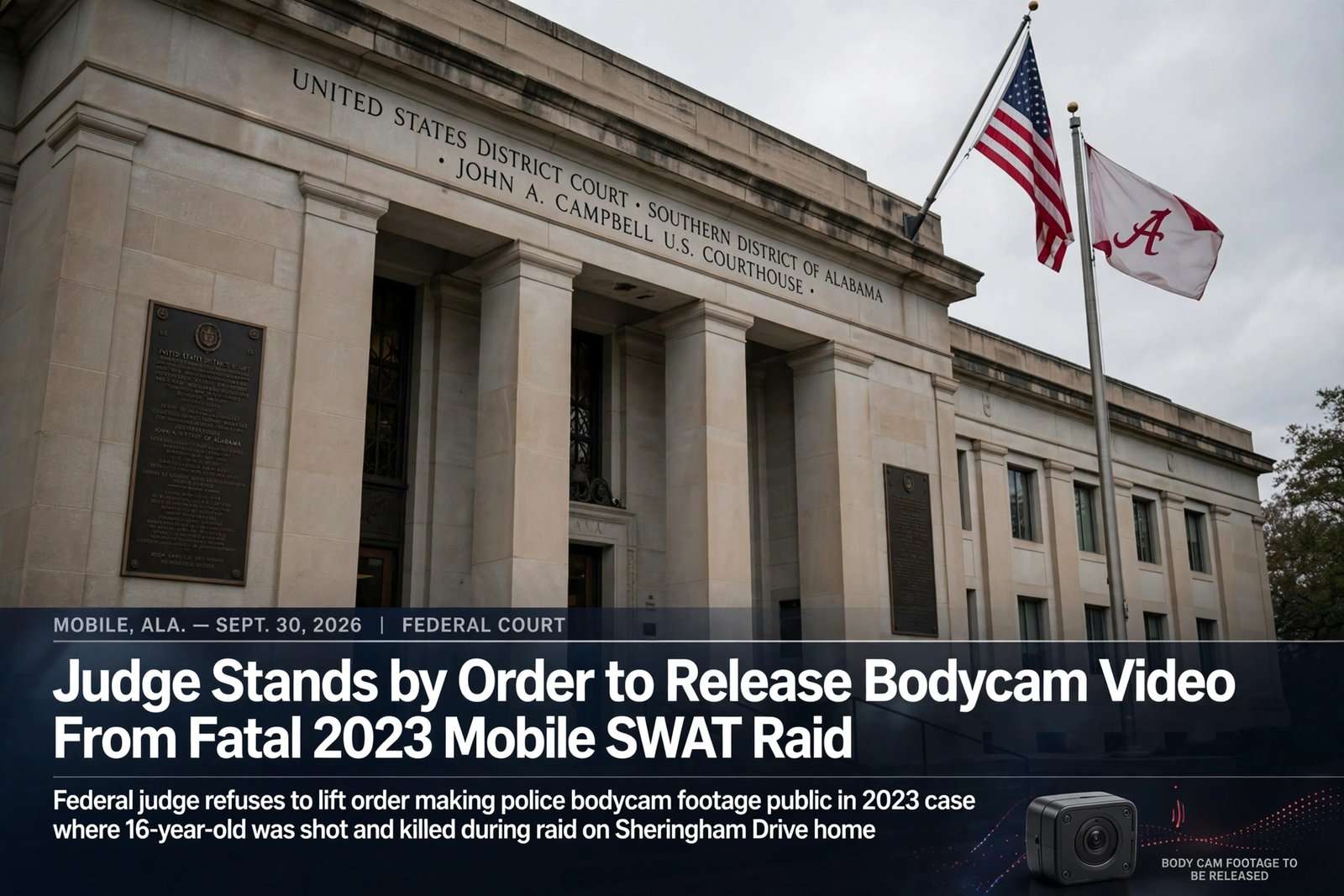
MOBILE, Ala. — A federal judge has refused to back away from his decision to make public the police body camera recordings from a 2023 SWAT raid in which a 16-year-old Mobile boy was shot and killed, clearing the way for residents to see for themselves what happened inside a house on Sheringham Drive.
U.S. District Judge Terry Moorer announced at a hearing Wednesday, Sept. 30, that he was keeping his original order in place. The ruling rejected a request from an attorney for the officer who fired the fatal shots, who argued that releasing the video before trial could poison the pool of potential jurors.
At the same hearing, Moorer handed the city of Mobile a partial win on a separate issue, pausing depositions and the exchange of documents about the police department’s broader policies until the court resolves whether the officers themselves acted unconstitutionally.
The raid on Sheringham Drive
The case stems from a predawn narcotics search warrant executed by the Mobile Police Department’s SWAT team on Nov. 13, 2023, at a home on Sheringham Drive near Cottage Hill and Azalea roads in west Mobile. The warrant targeted marijuana-related activity, and the person officers were looking for was Randall Adjessom’s older brother, Deangelo Adjessom.
Randall Adjessom, 16, who lived at the house, was shot and killed during the operation. An 8-year-old child was also inside the home at the time, according to earlier reports on the case.
Police and the family have offered sharply different accounts of those few seconds. Police said officers announced themselves and that the teenager confronted them armed with a laser-sighted pistol. Attorneys for the family dispute that, saying in the lawsuit that officers executed what amounted to a no-knock entry, that Randall raised his hands and retreated toward his bedroom once he realized the men were police, and that Officer Osviel Vigoa-Martinez fired four shots into his chest and torso about 11 seconds after officers came in.
Those allegations have not been proven, and the city of Mobile has denied wrongdoing. The officers have not been criminally charged in connection with the shooting.
Deangelo Adjessom, who was 19 at the time, was later indicted by a Mobile County grand jury on charges that included marijuana and drug paraphernalia possession and a firearm count, as well as a first-degree assault charge stemming from an unrelated shooting earlier that year. He is presumed innocent of those charges unless proven guilty.
The wrongful-death lawsuit
Randall’s family filed a federal wrongful-death lawsuit against the city and officers involved in the raid. The complaint named members of both the SWAT team and the department’s narcotics unit and argued the shooting reflected broader problems within the department.
In July 2026, Moorer narrowed the case. He dismissed a claim that other officers on the scene failed to step in and stop the shooting, reasoning that Vigoa-Martinez fired his shots over a span of, at most, about two seconds — too little time for anyone else to intervene.
The judge allowed other claims to go forward, including allegations of excessive force, false imprisonment and deliberate indifference to the teenager’s medical needs. On the medical-care question, Moorer found factual disputes over whether it was reasonable for officers to secure the house before rendering aid, and said the body camera footage alone could not settle how quickly treatment was provided or how emergency services responded.
Why the video is part of the case
In that same July ruling, Moorer said the body camera recordings he had reviewed in deciding the motion should be made public, because they formed part of the basis for his decision. Court records are generally presumed open in the federal system, and judges who seal evidence are expected to explain why secrecy outweighs the public’s interest in seeing it.
The footage had been set for release on Sept. 1. Shortly before that date, an attorney for Vigoa-Martinez asked the judge to reconsider, and Moorer agreed to hold off while he heard arguments, temporarily keeping the videos sealed.
The officer’s argument: pretrial publicity
At Wednesday’s hearing, James Rossler, the attorney for Vigoa-Martinez, leaned on two landmark U.S. Supreme Court decisions about the effect of publicity on fair trials.
The first was Sheppard v. Maxwell, a 1966 ruling that overturned the murder conviction of an Ohio doctor after the court concluded that intense, prejudicial news coverage had denied him a fair trial. Rossler highlighted the justices’ observation that “unfair and prejudicial news comment on pending trials has become increasingly prevalent.”
The second was a 1976 decision, Nebraska Press Association v. Stuart, in which the high court addressed a judge’s order restricting what could be published about a pending criminal case. Rossler pointed to the court’s warning that “the speed of communication and the pervasiveness of the modern news media have exacerbated these problems.”
If that was a concern half a century ago, Rossler told the judge, “I can’t imagine how you could quantify that now.”
“A video gets posted, and it never disappears from social media,” Rossler said.
His argument, in short, was that once the footage is online, there will be no way to find jurors who have not already seen it and formed opinions.
The family’s argument: one side of the story
Elizabeth Bailey, who represents the Adjessom family, told the court there was no legitimate reason to keep the recordings under seal.
“I don’t think that these concerns are different than any other high-profile case in this country,” Bailey said, noting that courts nationwide manage to seat fair juries even in cases that draw heavy attention.
Bailey also pointed out that Mobile police publicly described the shooting almost immediately after it happened. Keeping the video sealed, she argued, would leave the city’s version of events “to be the only version of the events.”
Earlier, when the judge first paused the release, Bailey had argued that the officer’s lawyer waited until days before the scheduled release to object even though the court had signaled its intentions months earlier.
The ruling
After hearing both sides, Moorer said he was sticking with his original order that the footage be released.
Judges weighing requests like Rossler’s typically have other tools to protect a defendant’s right to a fair trial, including detailed jury questionnaires, careful questioning of potential jurors during selection, instructions telling jurors to decide the case only on the evidence presented in court and, in extreme situations, moving a trial. Those safeguards are the reason many courts conclude that publicity alone does not justify sealing evidence that has already been used to decide part of a case.
It was not immediately clear when the recordings would be made available or whether the officer’s attorney would seek further review. In July, the judge had said the footage would become public after a waiting period unless the defendants obtained relief from the 11th U.S. Circuit Court of Appeals.
A win for the city on discovery
The hearing was not a complete loss for the defense. Moorer agreed with Tim Heisterhagen, an attorney for the city of Mobile, to halt depositions and the exchange of emails and other records related to the city’s policies for now.
Heisterhagen argued that the family’s lawyers were trying to bring in unrelated evidence about other shootings by Mobile police officers, and that such wide-ranging discovery should wait until the court decides whether the officers involved in the raid violated the Constitution.
The distinction matters in civil rights litigation. Under federal law, a city generally cannot be held liable simply because it employs an officer who violated someone’s rights. A plaintiff must show that an official policy, a widespread custom or a decision by a final policymaker caused the violation. Evidence about other police shootings is the kind of material plaintiffs often use to try to prove such a pattern, which is why cities frequently ask courts to resolve the individual officers’ conduct first.
Key facts at a glance
- Incident: Mobile police SWAT raid on Sheringham Drive, Nov. 13, 2023
- Killed: Randall Adjessom, 16, who lived at the home
- Officer who fired: Osviel Vigoa-Martinez, according to the lawsuit
- Judge: U.S. District Judge Terry Moorer, Southern District of Alabama
- Claims still alive: excessive force, false imprisonment and deliberate indifference to medical needs
- Claim dismissed: failure to intervene by other officers
- Latest ruling: body camera footage to be released; discovery into city policies paused
What comes next
The wrongful-death case will continue to move through federal court in Mobile, focused for now on the conduct of the officers at the scene. If the court finds there is enough evidence that the officers acted unconstitutionally, the family’s attorneys are expected to renew their push for records about the department’s policies and other police shootings.
The allegations in the lawsuit have not been decided by a jury, and the officers and the city deny wrongdoing. This story will be updated when the footage is released or the case reaches its next milestone.