
Kayakers Discover Body in Mobile’s Dog River
Mobile police and fire crews responded after kayakers discovered a body in Dog River near Martin Drive; cause of death unknown.
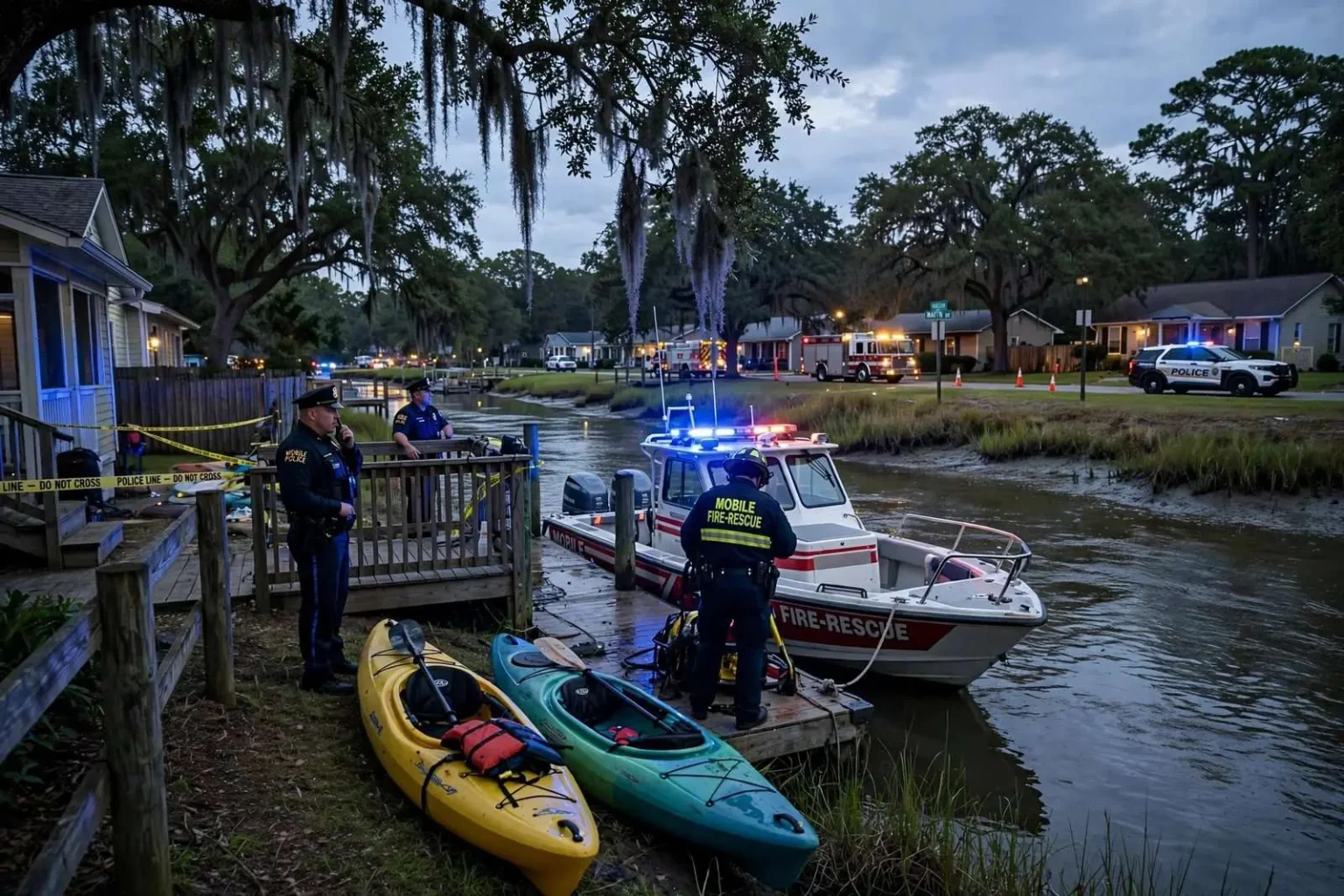
A group of kayakers made a grim discovery on Dog River Monday evening, finding a man’s body in the water near a residential stretch of the river. Mobile Police and Mobile Fire-Rescue responded and set up outside a home on Martin Drive, where the property backs up to the river. Police said kayakers spotted the man while out on the water. Authorities could not confirm how the person died as the investigation got underway.
The discovery came at the end of a day on the water, as the kayakers paddled the residential stretch of one of Mobile’s most familiar urban creeks-turned-river and saw something in the water that did not belong there. They reported it, and within a short time police officers and fire-rescue crews had gathered on the bank outside a home on Martin Drive, the street whose backyards face the river on the stretch where the body was found. What followed was the methodical work of a death investigation conducted from both water and land: securing the scene, recovering the man from the river, and beginning the effort to establish who he was and how he died.
Police said kayakers spotted the man while out on the water, and authorities could not confirm how the person died as the investigation got underway. That caution is standard in the early hours of any recovery from a public waterway. A body found in a river presents investigators with an array of possibilities — accidental drowning, a medical emergency, a suicide, or something more sinister — and none of them can be ruled in or out until the medical examiner’s examination and the scene investigation converge on an answer.
Dog River and its waters
Dog River is one of the best-known waterways in Mobile, a tidal branch of Mobile Bay that winds through residential neighborhoods in the city’s western reaches before emptying into the bay. Along its banks sit homes whose backyards open onto the water, private docks lining both sides, and the boat launches and marinas that make it a favorite of paddlers and small-craft boaters. The river is popular for kayaking precisely because it offers easy access from the city and a quiet, sheltered paddle — flat water, tidal currents that reverse with the bay, and a shoreline of live oaks and waterfront houses. Martin Drive is one of the residential streets whose properties back up to that shoreline.
The waterway’s accessibility cuts both ways. The same easy access that draws recreational paddlers means the river sees steady traffic of all kinds — anglers, jet skis, pontoon boats on their way to the bay — and it means that anything in the water, or anyone, can arrive from many directions. Tidal flow moves objects along the river with each cycle, which matters in recovery investigations: where a body is found may be some distance from where it entered the water, and investigators work with the tides, the currents, and the physical evidence to trace that path back.
Recovery operations on a narrow urban river also present logistical puzzles that Mobile Fire-Rescue’s marine and dive-capable units know well. Crews must position boats in waterways lined with private docks, coordinate with property owners whose yards become temporary staging areas, and manage the spectators who gather on docks and shorelines whenever something serious happens on the water. The scene outside the Martin Drive home on Monday evening reflected that reality: police tape on the bank, apparatus parked along the street, and officers managing both the investigation and the neighborhood’s attention.
How waterway death investigations work
When a body is recovered from a waterway, the investigation begins at the water’s edge and follows the evidence wherever it leads. Detectives document everything about the location — where in the river the body was found, the depth, the state of the tide, what the person was wearing, and whether anything on the body suggests identification or circumstances. Investigators canvass the shoreline for security cameras and for residents who may have seen anything in the hours before the discovery, and they check whether anyone has been reported missing in the area.
The medical examiner’s role is central. An autopsy will establish the cause of death — drowning, injury, or something else — and tests will look for indicators that bear on the manner of death. Toxicology screening, examination for signs of struggle or trauma, and the condition of the body all feed into the determination, which may take days or weeks to finalize. Police typically hold back on any public characterization of the death until that work is done, which is why authorities said they could not confirm how the person died as the investigation got underway.
Identification follows its own track. If the man carried identification, or if family members have reported someone missing, the process can move quickly; otherwise, investigators use fingerprints, dental records, and distinctive features to establish who he was. Until identification is confirmed and next of kin notified, authorities generally release few details, respecting both the investigation and the family’s privacy.
The paddlers who found him
The timing of the discovery — Monday evening, as daylight faded — also shaped the response. Water recoveries at dusk force crews to work against the light, and investigators often establish the scene and suspend detailed work until morning when darkness falls. Tide cycles and weather add pressure of their own, since the movement of the water can shift evidence in the hours after a recovery. That is one reason investigators ask witnesses to come forward quickly: memories and video from the same evening are worth far more than recollections gathered days later, and the river does not hold still for anyone.
For the kayakers who made the discovery, the encounter was the kind of experience that stays with anyone who spends time on the water. Recreational paddlers on urban waterways are frequently the first to spot trouble — a capsized boat, a swimmer in distress, or in this case a body in the current — and their reports bring official help to scenes that would otherwise go unnoticed for hours. Water rescue and recovery officials have long noted that boaters and paddlers function, in effect, as extra eyes on the region’s waterways, and the Monday evening discovery was a somber example of that role.
The standard advice for anyone who finds a body or a person in distress on the water is consistent: call 911 immediately, give the best possible location — a nearby address, dock, or landmark — and do not attempt a recovery on your own. Moving a body or disturbing the scene before responders arrive can complicate both the medical examination and any investigation into the death. Paddlers who stay nearby to mark the location and guide responders in perform a genuine service; those who touch or move the person can, however unintentionally, make the work of investigators harder.
Dog River’s community of waterfront residents and paddlers knows the river’s moods — the afternoon squalls that roll in from the bay, the tidal currents that catch an inattentive kayaker, the boat wakes that rock small craft near the channel. Safety on the river has been a recurring topic among the civic groups and residents who watch over it, and incidents like Monday’s discovery renew attention to the practical measures that make paddling safer: wearing a life jacket, paddling with a partner, carrying a phone in a waterproof case, and letting someone on shore know the plan.
What comes next
As the investigation got underway Monday evening, the questions outnumbered the answers. Who the man was, how long he had been in the water, whether anyone had reported him missing, and what caused his death — all of it awaited the work of detectives and the medical examiner. Police had not announced any identification, any ruling on the manner of death, or any indication of foul play, and they were unlikely to do so until the examination and the scene work were further along.
For residents along the river, the discovery was an unsettling event on a waterway they treat as an extension of their backyards. Bodies found in Mobile-area waterways range across the full spectrum of circumstances — swimmers who went under, individuals who entered the water from boats or bridges, and people who died for reasons that only an autopsy can establish — and each case is worked on its own evidence rather than on assumption. The Mobile Police Department’s investigators, working with Mobile Fire-Rescue’s recovery teams and the medical examiner’s office, will follow the process through to its conclusions.
In the meantime, the kayakers who found the man will carry the memory of the evening they spotted something in the water near Martin Drive, and the neighborhood along Dog River will watch the investigation with the particular attention of people who live beside the scene. The river, which on ordinary evenings carries paddleboards and fishing lines past the docks, gave up its sad discovery on Monday, and the work of answering the questions it raised has only begun.
Authorities asked anyone with information that may be relevant to the case to contact Mobile Police as the investigation continued.


