
Kelsey Grammer film shooting on the Gulf Coast needs about 1,000 extras
Producers of Jesus Revolution, starring Kelsey Grammer, sought about 1,000 extras for a Gulf Coast shoot, including adult and teen period roles.
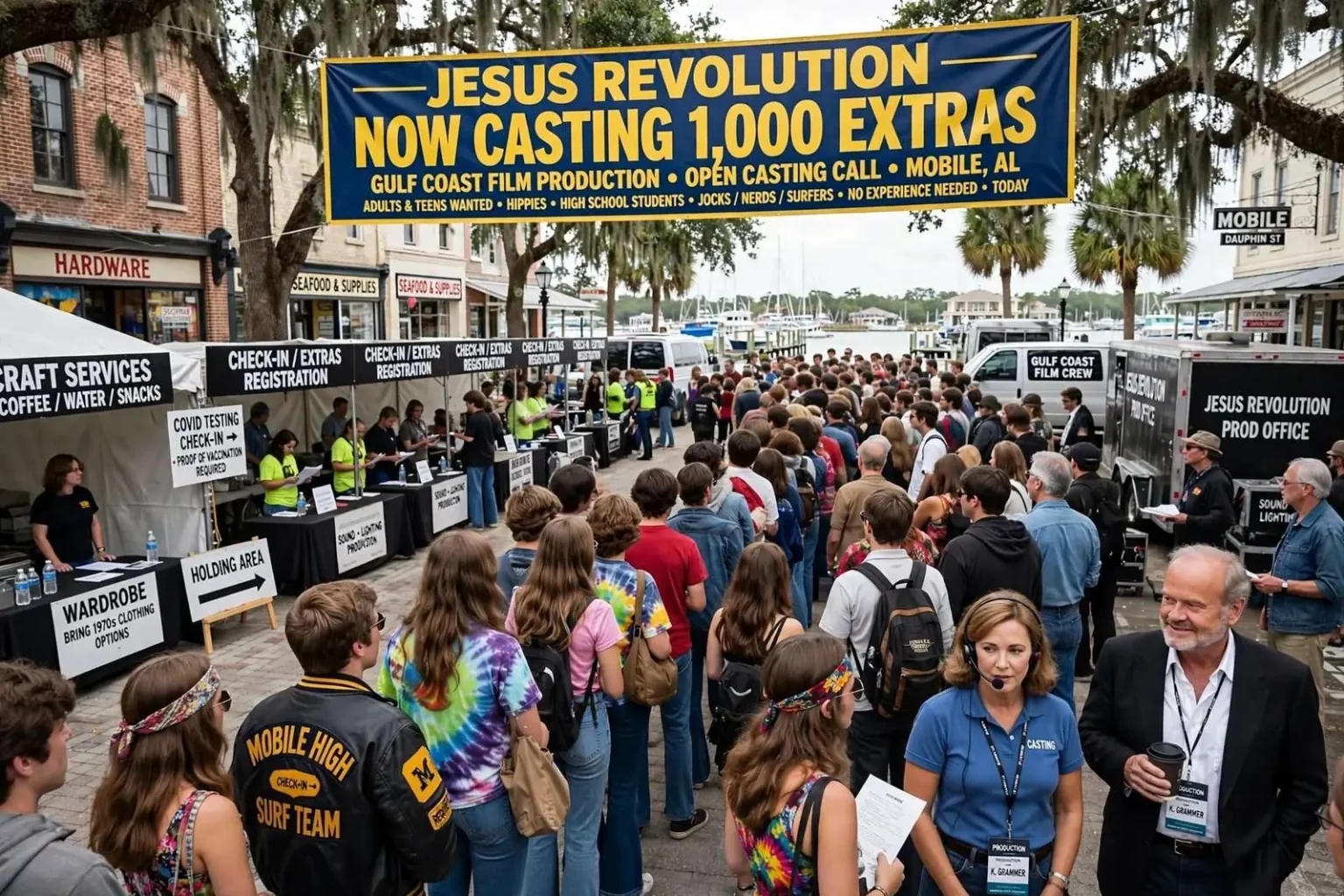
A feature film shooting on the Gulf Coast is casting a wide net for background actors, and producers say they need roughly a thousand of them. The production is “Jesus Revolution,” a film starring Kelsey Grammer, and casting notices went out seeking local residents willing to appear on screen as extras when cameras roll in the region.
Background calls of this size are unusual even for a busy production market, and the sheer number involved means the production will rely almost entirely on Gulf Coast residents to fill its crowd scenes. For the people who sign up, the work requires no acting experience, no headshots beyond a simple photo and no membership in any union — just the willingness to spend a long day on set doing what background actors do, which is mostly waiting and then walking through a scene on cue.
Who producers are looking for
The casting call sought adults and teenagers to fill period roles, including adult and teen hippies. Producers also asked for teenagers to play a range of high school types — jocks, nerds, surfers and ordinary students. The category list is a signal of the film’s setting and its storytelling, which reaches back to an era when counterculture and mainstream teenage life collided in ways the movie set out to capture on screen.
According to the casting notice, extras were required to be fully vaccinated against COVID-19 and to undergo testing before working on set, in line with the health protocols most productions were operating under at the time. The requirement became standard practice across the film industry during the pandemic, with testing regimens and quarantined zones around sets designed to keep shooting schedules from being derailed by outbreaks among cast and crew.
What working as an extra actually involves
First-time extras are often surprised by the rhythm of a film set. A single scene that lasts a minute on screen can take hours to shoot, with background actors reset to their starting positions take after take while cameras and lighting are adjusted. Wardrobe checks, hair and makeup, and the logistics of moving a large crowd through holding areas all add to the day. Extras are typically asked to bring several wardrobe options suited to the period so the costume team can dress them believably into the crowd.
The payoff, beyond a day’s pay, is a firsthand look at how a major motion picture is assembled. For students considering film careers, for retirees curious about the process, or for anyone who wants the story of having walked through a Hollywood production, an open background call is one of the few points where a film production is directly accessible — no experience required, and a day on set that mostly involves waiting, punctuated by moments when a thousand people move together on a director’s cue.
Film work on the Gulf Coast
Large background calls like this one tend to have an outsized local footprint. A production needing a thousand extras has to pull almost entirely from the surrounding area, which means hotel bookings, catering, equipment rental and short-term hires spread across the region for the length of the shoot. Restaurants, dry cleaners, hardware stores and rental houses all see business from a production that spends weeks in a community, even when the studio’s name never appears on a local marquee.
Alabama has courted film work through a state incentive program, and the Mobile area’s mix of historic architecture, waterfront and mid-century streetscapes has drawn productions looking for period settings without building them from scratch. For a story set in an earlier decade, those existing streetscapes cut set-construction costs considerably, letting directors point cameras at blocks that already look like the past rather than manufacturing the look on a soundstage.
The film and its subject
“Jesus Revolution” stars Kelsey Grammer in a story drawn from the era of the Jesus movement, when a wave of spiritual searching among young people — many of them countercultural figures the broader culture barely understood — reshaped congregations in Southern California and eventually far beyond. The film’s need for adult and teen hippies, alongside the high school crowds of jocks, nerds and surfers, mirrors that collision of worlds: churchgoing families and long-haired seekers sharing the same pews and the same streets.
Productions of this scale bring Hollywood crews into communities that rarely see them, and the economic ripple extends beyond the payroll for extras. Location fees pay property owners whose buildings and land appear on screen, while the need for base camps, staging areas and parking for equipment trucks turns vacant lots and fairgrounds into temporary production hubs for the duration of the shoot.
How background casting works
Background casting typically runs through a local casting agency working for the production, with applicants responding to the notice by submitting a photo and basic information — height, weight, sizes and availability. Selected extras are then booked for specific shoot dates, given a call time and location, and told what to bring. Punctuality and patience matter more than polish; a background actor who arrives late can hold up a scene involving hundreds of people.
For teenagers answering the call, the process usually involves a parent or guardian’s sign-off, and school-age extras work under the hour restrictions that productions apply to minors. The high school categories in the notice — jocks, nerds, surfers and ordinary students — suggest day-after-day crowd scenes built from local teens, the kind of scenes that give a period film its texture and that local families will be spotting on screen for years after release.
A regional casting footprint
While the notice went out across the Gulf Coast, a thousand-person background pool is larger than any single city can comfortably supply in a hurry, which means the casting net typically stretches across the whole region — Mobile and Baldwin counties, the Florida Panhandle and the Mississippi coast. Residents willing to make the drive for a day of work become the crowd, and the production’s footprint spreads with them through gas stations, restaurants and motels along the corridors between home and set.
The “Jesus Revolution” shoot adds to a growing resume of film and television work along the northern Gulf Coast, where incentives, architecture and weather have combined to make the region a practical alternative to shooting in California. For the roughly thousand residents who end up in the background of the finished film, the experience will come full circle when the movie reaches theaters and they point to the screen — somewhere in that crowd, moving on cue, is someone from down the street.
What a production brings to a local economy
When a film crew settles into a region for weeks at a time, the spending reaches well past the gate at the production office. Crew members rent apartments and hotel rooms, eat in local restaurants between setups, and buy supplies from hardware stores and lumber yards that suddenly see orders the size of small construction projects. Local trucking companies, security firms and sanitation services pick up contract work, and the caterers who feed a crew of hundreds three times a day source as much as they can from area vendors.
That spending is one of the reasons states maintain film incentive programs at all. Alabama’s incentive structure is designed to make a production’s dollars go further when it shoots in the state, encouraging producers to keep location work — and the hiring that comes with it — in Alabama rather than shipping it to Louisiana, Georgia or back to California. Every shoot that takes advantage of the program also builds a base of experienced local crew, which makes the next production easier to staff.
Why the Gulf Coast stands in for elsewhere
The Mobile area’s appeal to productions shooting period material comes down to what survives in its built environment. Oakleigh Garden District streets, downtown blocks of turn-of-the-century commercial architecture, mid-century neighborhoods and working waterfronts give location managers a range of looks within a short drive of each other. A film set fifty years ago needs streets without modern clutter, buildings with the right rooflines and signage, and water views that read as timeless — and the Gulf Coast offers all of it without the price tag of a major West Coast location.
Standing in for another place is a specialty of the region. The same stretch of coast has doubled for other states, other decades and other countries in previous productions, and each shoot refines the local knowledge that makes the next one run smoother: which streets can be closed, which seasons the weather cooperates, which municipal offices handle film permits quickly. That accumulated experience is invisible to audiences but decisive for producers choosing where to spend tens of millions of dollars.
Extras as the face of a community
There is a reason productions shoot large crowd scenes locally rather than importing background actors: authenticity. A thousand local faces carry the region’s actual character onto the screen in a way no casting office can manufacture. When “Jesus Revolution” reaches audiences, the crowds surrounding its stars will be Gulf Coast residents — teenagers from area high schools, workers on their days off, retirees trying something new — standing in for a story that happened somewhere else entirely.
That is the quiet appeal of an open background call. It asks nothing but availability and patience, pays a day rate, and hands back an experience no one in the region forgets: a dawn call time, a wardrobe check, hours in a holding tent, and then a director’s voice over the loudspeaker calling a thousand neighbors to walk through history together. For the production, the extras are the crowd. For the community, the shoot is a few weeks of Hollywood in town, and a permanent record of the place it happened to land.


