
Kitchen on George Shares Its Crawfish Bisque Recipe, Stuffed Heads and All
Mobile's Kitchen on George shares its full crawfish bisque recipe, from dark roux to the fried stuffed crawfish heads that garnish every bowl.
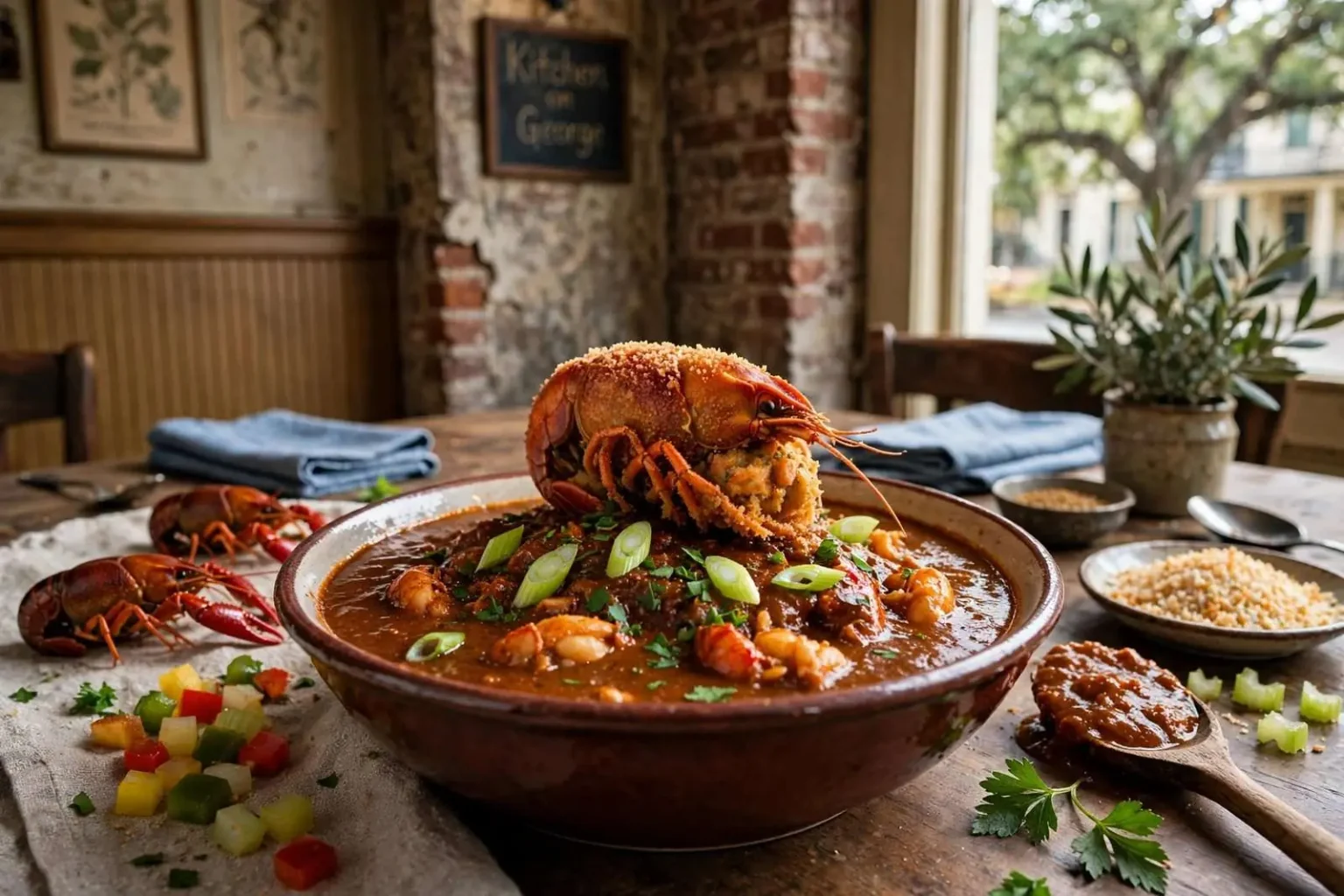
Crawfish season on the Gulf Coast runs deep, and few dishes show it off like crawfish bisque — the Cajun tradition that treats the season’s last crawfish as an occasion rather than an ingredient. The team at Kitchen on George, the restaurant at 351A George Street in Mobile’s Oakleigh neighborhood, shared its full recipe, including the traditional stuffed crawfish heads that crown each bowl. It is a dish most Gulf Coast home cooks know by reputation more than by practice, and the restaurant’s decision to publish its method hands over the details that usually stay in a working kitchen.
Kitchen on George occupies a corner of the Oakleigh Garden Historic District, the leafy neighborhood south of Government Street where Mobile’s oldest surviving mansion gives the area its name. The restaurant has built its following on regional cooking served in an intimate neighborhood dining room, and crawfish bisque — a dish with deep Louisiana roots that Mobile cooks have long shared — fits squarely in that identity. The recipe’s length alone tells the story: this is a weekend project, the kind of dish a family assembles over an afternoon while the pot works.
Building the Bisque
The bisque starts with a roux, the flour-and-fat foundation of half the Gulf Coast’s greatest dishes. Kitchen on George builds its roux from a cup of vegetable oil and a cup of flour, stirred carefully so it never burns. The color target is peanut butter — the stage where the roux has developed its nutty depth but has not crossed into bitterness. Every Gulf Coast cook knows the hazard: a roux demands constant attention, and a few seconds of inattention at high heat can turn the whole pot acrid and send the cook back to square one.
Into the finished roux go diced yellow onion, red and green bell pepper and celery — the trinity that anchors Cajun and Creole cooking across the region. The vegetables cook soft in the roux, releasing their sweetness into the base, before three quarts of crawfish stock are added. The stock, typically made from the boiled heads and shells of the season’s crawfish, is what gives the bisque its intense crustacean depth; a bisque built on plain water or generic seafood stock never achieves the same flavor.
The pot simmers for an hour, long enough for the flavors to marry and the base to thicken, then two pounds of crawfish tails go in for ten final minutes — just enough time to heat them through without turning the tails rubbery, a timing discipline that separates a good bisque from an overcooked one. The finished bisque is garnished with sliced green onions and parsley, the fresh green counterpoint the rich, red-brown base needs on the spoon.
The result is a soup that carries the whole geography of the Gulf Coast in a bowl: the Louisiana roux tradition, the crawfish season that peaks in spring across the region’s ponds and basin waters, and the Mobile habit of borrowing freely from its western neighbor’s kitchen while putting its own table on it. Restaurants along the coast treat crawfish bisque as a signature statement precisely because it cannot be faked — the labor is visible in every bowl.
The Stuffed Heads
The signature garnish takes more work than the bisque itself. Finely chopped crawfish tails are sautéed with butter, onion, bell pepper, celery, garlic and stock, building a second, denser filling from the same flavors. The mixture is bound with beaten egg and panko, the Japanese-style breadcrumbs that have quietly replaced the cracker crumbs and plain breadcrumbs of older recipes in Gulf Coast kitchens, giving the filling a lighter hold.
That filling is then packed into cleaned crawfish heads — the part of the crawfish most diners leave on the plate, here reclaimed as the dish’s crowning vessel. The stuffed heads are dredged in seasoned flour, dipped in egg wash and coated in panko before frying until golden brown. One stuffed head, set atop a bowl of bisque, delivers a crisp-fried exterior, a savory crawfish filling and the traditional eat-the-head ritual that Gulf Coast crawfish lovers regard as the best part of the animal.
Crawfish bisque is among the most labor-intensive dishes in the Cajun repertory, traditionally associated with end-of-season boils when the last crawfish of the year are plentiful and the family is already gathered. Cleaning heads, stuffing and frying them, and building a dark roux from scratch is a full kitchen day — which is exactly why a restaurant version, done properly, is worth ordering. Kitchen on George’s decision to share the full method, heads and all, is a gift to Mobile home cooks willing to spend a Saturday on it.
Where and When to Try It
For diners who would rather leave the deep fryer to professionals, Kitchen on George serves dinner Monday through Thursday from 5 to 10 p.m., Friday and Saturday from 5 to 11 p.m., and Sunday from 10:30 a.m. to 9 p.m. The Sunday service, starting mid-morning, opens the restaurant for the brunch-into-dinner stretch that Oakleigh neighborhood restaurants count on, while the late Friday and Saturday seatings serve the Oakleigh Garden district’s busy weekend evening trade.
The restaurant at 351A George Street sits within walking distance of Oakleigh Mansion and the historic district’s oak-lined streets, making it a fixture of the Mobile dining scene that prizes neighborhood character over scale. A bowl of its crawfish bisque, crowned with a fried stuffed head, is about as complete an expression of Gulf Coast cooking as Mobile’s tables offer — and now, thanks to the shared recipe, one that home cooks can attempt themselves while crawfish season lasts.
Crawfish Season on the Gulf Coast
The timing of the recipe matters as much as the method. Crawfish season on the Gulf Coast generally runs from late winter through early summer, peaking in the spring when the ponds and wetlands of south Louisiana and the Florida parishes — the source of most of the live crawfish sold across the region — reach peak production. Mobile’s seafood markets and restaurant suppliers draw from that same network, and crawfish boils become a weekend institution across south Alabama from Mardi Gras season through the end of the school year.
Crawfish bisque occupies a particular place in that season’s calendar. Because the dish requires whole crawfish — heads cleaned and reserved, tails peeled and divided between the bisque and the stuffing — it is traditionally made from a boil’s leftovers, when a family already has the pile of peeled tails and cleaned heads that the dish demands. That is why the dish appears at the end of crawfish season: it is the grand finale, the way Gulf Coast cooks use every part of the harvest and turn the season’s last abundance into its most elaborate meal.
The roux discipline at the heart of Kitchen on George’s recipe is also the lesson that separates Gulf Coast cooking from everything else in American cuisine. A cup of oil and a cup of flour, stirred over heat until it reaches the color of peanut butter, is the foundation of gumbos, stews and étouffées from Mobile Bay to the Sabine. The technique came down through generations of Louisiana cooks, crossed into Mobile’s kitchens long ago, and remains the single skill that home cooks most often fear and most often get wrong. A restaurant sharing its roux stage-by-stage — the color, the caution, the vegetables that follow — is passing along the region’s foundational craft.
The stuffed heads, meanwhile, are the dish’s connection to the old ways. In an era when most restaurant crawfish dishes reduce to peeled tails in a sauce, the fried stuffed head survives as a marker of the full tradition — the garnish that says the cook treated the crawfish whole, the way the dish was made in the south Louisiana kitchens where it was born. Finding it on a Mobile menu, made in-house, is worth the drive to Oakleigh.
Home cooks attempting the recipe should plan the work in stages, as Gulf Coast families traditionally do. The stock can be made a day ahead from boiled heads and shells; the bisque base holds overnight and improves; the stuffed heads can be filled and refrigerated before their final dredge and fry, then finished in batches just before serving so the panko shell stays crisp. Assembled in that order, the dish becomes a manageable weekend project instead of an all-day ordeal, and the frying — the step that needs the freshest timing — stays at the end.
The recipe also rewards a crawfish boil the day before. A weekend boil with friends produces exactly the materials the bisque requires: peeled tails in the freezer, cleaned heads in the refrigerator, and a stockpot of liquid already seasoned from the boil. Gulf Coast households that boil crawfish a few times a season are, without realizing it, halfway to the region’s most elaborate crawfish dish — they just need the roux, the trinity and an afternoon.


