Kurt Wielkens Returns with New CD and a Rebuilt Band
Mobile songwriter Kurt Wielkens returns with a self-titled Kurt Wielkens Band album recorded in a home studio with Haere Marue alumni.
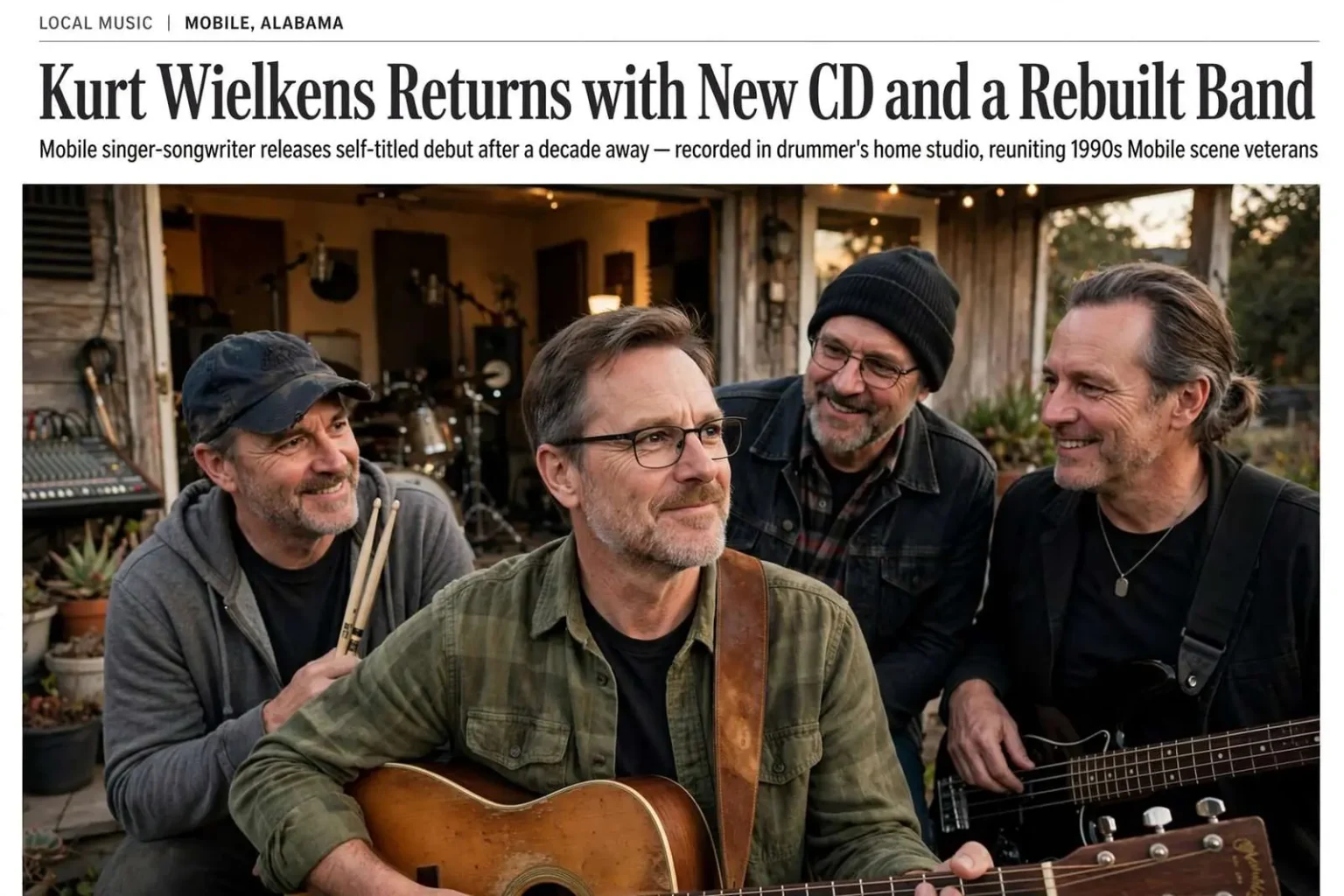
Mobile singer-songwriter Kurt Wielkens is back on record after a decade away from band life, releasing a self-titled debut for the Kurt Wielkens Band this month — an album born in a drummer’s home studio and staffed by familiar faces from Mobile’s 1990s rock scene.
The record is less a comeback than a culmination: a stockpile of songs written quietly through the years Wielkens spent out of music, finally recorded with players who shared a stage history with him and finished well before the band had ever played a single show together. That ordering — album first, band second — gives the release an unusual origin story for a debut.
From Haere Marue to the day job
Wielkens started playing solo acoustic in the late 1980s while in high school, then cut his teeth in bars and parties during his years at the University of South Alabama. The college years are where many Mobile musicians learn their trade, cycling through open-mic nights, fraternity parties and bar gigs around town, and Wielkens was no exception — building the live chops and the songbook that would carry him into his first real band.
The project that stuck was Haere Marue, one of Mobile’s defining 1990s bands, where he sang and wrote the bulk of the material from 1992 until dissolving the group in 2001. For a local scene, a band like that becomes part of its shared memory — the shows people still talk about, the songs other musicians learned from, the standard against which later bands get measured.
He stepped into the insurance business afterward to raise a family, but never stopped writing songs — stockpiling material through the years with the stated goal of returning to the studio. The decision to prioritize family over music is a familiar one for working musicians, and the stockpile it produced turned out to be the foundation of everything that followed: a decade of songs written without deadlines, pressure or an audience, waiting for their moment.
A homecoming album
The return came last year over a conversation with former Haere Marue drummer John Milham, who mentioned he had built a home studio. The two recorded the songbook Wielkens had accumulated, finishing the album in November 2010. What began as a catch-up between old bandmates turned into a recording project, with the drummer’s home studio providing a low-stakes environment for revisiting material written across a decade.
Home studios have changed the economics of records like this one. Without the clock running at commercial rates, a returning songwriter can take the time to get the takes right, experiment with arrangements and decide on his own schedule — the difference between making a record because it must be made and making one because it is ready to exist.
Then the old band’s orbit pulled tighter: bassist Dave Smithweck, who played on the record, connected Wielkens with players looking for a new project. With Johnny Gwin on bass, Joey Waits on drums and Dan Nobles on keys, the Kurt Wielkens Band was complete — a lineup drawn from the same Mobile scene that had produced Haere Marue, and one whose members had their own histories in local bands of the era.
Live dates ahead
The band is rehearsing now and expects to be stage-ready by early spring, with hometown shows planned once the set list is fully broken in. The sequencing is deliberate: with the album already recorded and released, the live band can grow into the material at its own pace, playing the songs until they feel like a band’s own rather than a studio project’s.
For Mobile audiences, the spring shows will double as a reunion — of Wielkens with the stage after a decade away, and of the scene with a songwriter whose 1990s work still holds a place in local memory. Hometown crowds tend to greet returning musicians with a mix of nostalgia and curiosity, eager both to hear the old favorites and to hear what a decade away from the stage produces.
The new album is available online, including through Amazon, giving listeners outside Mobile their first exposure to the material before the band takes it on the road. If the hometown shows go as planned, the Kurt Wielkens Band will have completed an arc that began in a high school bedroom in the late 1980s: songs written, shelved, recorded in a friend’s studio and finally played, live, for the city that first heard them.
How Mobile’s 1990s scene shaped its survivors
The Mobile rock scene that produced Haere Marue was a product of its era and its geography. In the 1990s, original-music venues along Dauphin Street and scattered through the city gave college-age musicians places to play original sets rather than covers, and the proximity of the University of South Alabama kept a steady supply of new players, new audiences and new bands cycling through town. Bands rose and dissolved quickly, but the best of them — the ones that could write, perform and hold a weekend crowd — became fixtures whose names still circulate among local musicians decades later.
That scene also taught its players the practical skills a comeback requires. Booking a show, filling a lineup, rehearsing around day jobs, spreading the word without a label’s help — those are the muscles a working local band develops, and they do not atrophy entirely with time. The musicians Wielkens assembled for his new project came up through the same school: players from the 1990s scene who had continued playing in other projects, teaching, or recording around town.
There is a reason reunions of this kind tend to happen in Mobile and cities like it. Scenes of this size hold their memories tightly; a decade after a band dissolves, its former members still know where everyone is, who kept playing and who owns a home studio. The network never really breaks — it just goes dormant until someone with a stack of songs picks up the phone.
The insurance years: writing without an audience
The decade Wielkens spent in the insurance business is the quiet heart of the story. Most songwriters’ material emerges under the pressure of performance — written for a gig next weekend, tested on a live crowd, revised in response to what works in a room. Writing through those years instead meant writing for no one: songs composed in spare hours, filed away, and added to a stockpile with no release date and no guarantee of ever being heard.
That mode of writing has its own creative advantages. Without a live audience to please, the songs could develop at their own pace, in whatever style the moment suggested, unburdened by the commercial expectations that come with an active band. When the material was finally brought to the studio, it arrived as a body of work rather than a batch of demos — a decade’s worth of matured writing that had already survived the songwriter’s own editing over years of reflection.
The stated goal of returning to the studio, kept alive through family responsibilities and a day job, is what separated the stockpile from a hobby. Plenty of former musicians keep writing privately; fewer convert the writing into a record. The difference is intention — a standing commitment to oneself that the songs will eventually be heard, and the discipline to keep writing toward that day.
Why the drummer’s studio mattered
The reconnection with John Milham supplied the practical catalyst the stockpile needed. A home studio in the hands of an experienced drummer removes the two biggest obstacles to a record: cost and scheduling. There is no block of expensive studio time ticking against the project, and the musicians can record when their families and jobs allow, over weeks or months, until the album is genuinely finished.
For an album of songs written across a decade, that patience is essential. Some of the material likely needed only a guitar and a vocal; other songs probably demanded arrangement decisions — what to keep from the original conception, what to update, what to let the players discover in the room. A home setting accommodates all of it, treating each song as its own project rather than forcing uniformity on a diverse songbook.
The result, finished in November 2010 and released this month as the Kurt Wielkens Band’s self-titled debut, is in a sense two records at once: a document of the 1990s Mobile scene’s durability, and a fresh start for a songwriter whose best material, by his own account, was still ahead of him. The band that formed around it — Gwin on bass, Waits on drums, Nobles on keys, with Smithweck’s bass already on the record — gives the songs a future on stage to match their history on tape.
Between now and the spring shows, the rehearsal room will do the last of the work the studio started — settling tempos, assigning solos and learning the set list until the band sounds less like a collection of veterans and more like a single unit. By the time the hometown audience arrives, the plan is for the decade away to feel, on stage, like it never happened at all.