Langan Park’s 18-Month Overhaul Passes the Halfway Mark, With a Boathouse Still to Come
Mobile's 18-month Langan Park project has finished dredging the upper lake and is nearing the end of the lower lake, with a boathouse for kayaks and canoes planned once the work wraps in May.
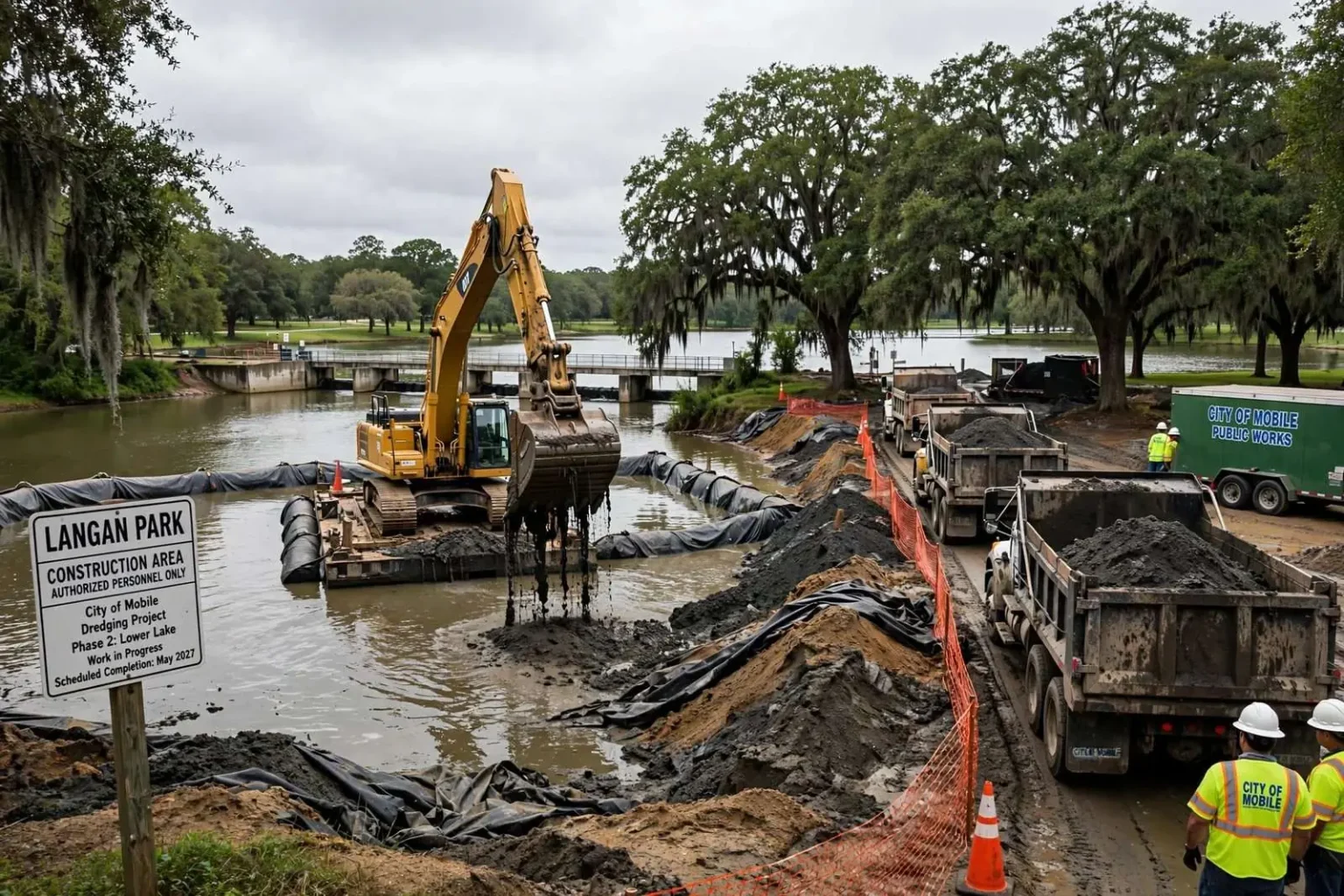
The work at Langan Park has been going on long enough that most people who drive Zeigler Boulevard have stopped noticing the equipment. That is generally what a dredging project looks like from the road: slow, muddy and unglamorous. Inside the park, though, the City of Mobile says the job is now more than halfway done.
“We’ve been making really great progress on Langan Lake,” said Jennifer Greene, the City of Mobile’s director of programs and project management. “This is an 18-month project, as you know. We have completely finished dredging of the upper lake, so we’re able to drive a 17-foot boat in through there and do our inspections.”
The city began work at the park in November. The first phase — dredging the upper lake — is complete. The second phase, dredging the lower lake, is nearing its end. The full project is scheduled to wrap in May.
What Is Actually Being Removed
The headline number in a dredging project is never the water. It is the sediment.
“You’ll see us taking large amounts of sediment out,” Greene said. “That’s one of the biggest things with us is controlling sediment going back into the lake, so we’re excited about that. You’ll see that more in the beginning of next year.”
Sediment accumulation is the ordinary fate of any urban lake. Rain moves soil off yards, parking lots, construction sites and roadsides and carries it downhill into the nearest low point. In a watershed as developed as this one, that low point is a lake that was never designed to function as a settling basin but ends up serving as one anyway.
The consequences build gradually. As the bottom rises, the average depth falls. Shallower water heats faster and holds less dissolved oxygen. Sunlight reaches further down, which encourages aquatic plant and algae growth. Fine sediment stays suspended after storms, clouding the water. Over a long enough period, open water becomes marsh, and marsh becomes ground.
Removing accumulated material resets that clock. It restores depth and volume, improves the lake’s ability to hold and slow stormwater, and gives the system room to absorb the sediment that will inevitably keep arriving. What dredging does not do is stop the arrival — which is why Greene’s emphasis on “controlling sediment going back into the lake’” matters as much as the excavation itself. A lake that is dredged and then left exposed to the same inputs will fill in again.
A Drainage Project Wearing a Park’s Clothes
Langan Lake is not a decorative feature that happens to sit in a park. It is part of the city’s drainage system.
“There’s been a lot of work going on inside the park,” Greene said. “There’s a plan to have a boathouse where people can have kayaks and canoes when the dredging is finished. This is also an environmental project. Langan Lake is part of the city’s drainage program so it drains Three Mile Creek, and so it’s really important.”
That connection is the part of the project most residents never see. Three Mile Creek runs west to east across northern Mobile before reaching the Mobile River, and it drains a large, heavily developed portion of the city. What enters the creek system upstream eventually passes downstream, and the condition of the water bodies along its route affects everything below them.
A lake sitting in that path performs two jobs at once. It holds water during heavy rainfall, releasing it more slowly than a hardened channel would, which reduces the intensity of downstream flooding. And it acts as a trap, allowing suspended material to settle out rather than continuing on. Both functions depend on capacity. A silted-in lake holds less water and traps less sediment, which means the surrounding neighborhoods get less flood buffering and the creek below gets more of what the lake used to catch.
Framed that way, the dredging is not a park amenity project that happens to have an environmental benefit. It is a stormwater project that happens to be located in a park.
The Recreation Side of the Ledger
City officials said the work is intended to make the park more environmentally sound and more family-friendly, and the boathouse Greene described is the clearest example of the second goal.
Paddle access is one of the least expensive ways a city can add usable recreation to water it already owns. There is no engine, no fuel, no ramp queue and comparatively little conflict with anglers or shoreline users. It also requires water deep enough and clean enough to be worth paddling on — which is precisely what the dredging is meant to deliver.
The sequencing matters. A boathouse built before the dredging finished would sit on a lake still being worked, with equipment in the water and shifting depths. Putting the amenity at the end of the schedule means the recreational improvement arrives on top of a lake that has already been restored, rather than in the middle of a construction zone.
An 18-Month Timeline, and Why It Is Long
Eighteen months is a long time for a project confined to a single park, and residents who have watched the fencing and staging areas come and go can be forgiven for wondering why.
Dredging is slow by nature. Material has to be pulled from the bottom, moved, dewatered and hauled away. Dewatering — separating water from the removed sediment so that what leaves the site is manageable material rather than slurry — is often the rate-limiting step, and it takes space and time. Weather adds to it. Heavy rain both interrupts the work and reintroduces the material the crews are there to remove.
Splitting the job into phases, as the city has done with the upper and lower lakes, is the standard way to manage that. It allows one basin to be finished and returned to a stable condition while work continues on the next, rather than leaving the entire system disturbed for the full duration.
Greene’s detail about driving a 17-foot boat through the upper lake is a small but useful benchmark. It is a working measure of the result: the basin is now deep enough and clear enough of obstruction that city staff can move a boat through it for inspection, which was not the case before.
What Residents Are Watching
Bernard Brown, a lifelong Mobile resident, said he is glad to see the investment.
“I’m all for it, you know, I’m all for upgrades and making things, you know, better for, for the city because the city need it,” Brown said.
That reaction is common with projects of this kind, and it points to a real tension in how they are experienced. The benefits of a dredging project are mostly invisible — a lake that does not flood as badly, water that stays clearer after a storm, a creek that receives less sediment. The costs are entirely visible: closed areas, heavy equipment, mud, noise and months of disruption in a park people use.
Projects like this tend to be judged on the visible half until the work is finished and the invisible half starts paying out.
A Park With a Long Civic History
Langan Park is one of the largest public green spaces inside Mobile’s city limits, and it has long carried more civic weight than a typical neighborhood park. The grounds are home to the Mobile Museum of Art, and the park’s lakes, walking paths and open lawns have made it a default gathering place for the surrounding neighborhoods on the city’s west side for generations.
That history is part of why the current work has drawn attention. A park used by that many people for that long accumulates a constituency, and a project that closes portions of it for a year and a half is felt. It is also why the city has been describing the schedule in phases rather than as a single closure — the goal is to keep as much of the park usable as possible while the lakes are worked one at a time.
What Comes Next
The remaining schedule is straightforward as the city has laid it out. Phase two, the lower lake, is nearing completion. The most visible sediment removal is expected to continue into the beginning of next year. The overall project is expected to be finished in May, with the boathouse planned once dredging is done.
Between now and then, the main thing park users will notice is the hauling. Sediment removal generates truck traffic, staging areas and temporary closures around whichever section of shoreline is active. Those are the ordinary conditions of the work, and they typically move around the site rather than affecting the entire park at once.
What follows is harder to photograph but easier to live with: a deeper lake, better water quality, more storage for stormwater, less material moving downstream into Three Mile Creek, and a place to put a kayak in the water in a part of the city where that has not been an option.
Why It Matters
Mobile has no shortage of water, and that is exactly the problem. The city sits in a high-rainfall region on flat, low ground, and nearly every drainage decision made inside its limits shows up somewhere downstream. Restoring capacity in an existing water body is one of the few flood-mitigation tools that does not require acquiring new land or building new infrastructure — the basin is already there. It just has to be emptied of what has accumulated in it.
That the same work also produces a better park is a genuine bonus, not the justification. The justification is the drainage system. The kayaks are the part people will see.
Update: The Full Timeline, Start to Finish
Two dates now bracket the Langan Park work. The City of Mobile began construction at the park on Zeigler Boulevard in November 2025, and the 18-month project is expected to be finished in May 2027.
That places the current moment — with the first phase of dredging complete and phase two, the dredging of the lower lake, nearing its end — a little past the midpoint of the schedule. Roughly ten months of work remain.
The lower lake dredging is the step with the most direct bearing on water quality, and finishing it clears the way for the remaining elements, including the planned boathouse for kayaks and canoes.
Langan Lake is part of the city’s drainage program and drains Three Mile Creek, which is why the dredging is not solely a park amenity question. Sediment removal in a lake that functions as part of a drainage system affects storage capacity and flow downstream as well as the water quality visitors notice.
Update: Upper Lake Dredging Complete, Crews Move to the Lower Lake
District 7 Councilwoman Gina Gregory provided a fresh progress report on the Langan Park work in her most recent district newsletter, saying the dredging project “is going really well.”
According to Gregory:
- Dredging of the Upper Lake is finished, and crews were able to preserve some of the lake’s historical islands in the process.
- Work has shifted to the Lower Lake, just below the dam, where long-reach excavators, barges and boats are working daily.
- Crews are hauling sediment out of the park at a rate of roughly 70 to 90 dump trucks a day.
- Work will soon move further into the middle of the Lower Lake.
- On the northeast side of the park, the drainage ditch will be rehabilitated to look more like a natural stream than a concrete ditch, and new bridges will be added in that area.
“There’s a lot of work going on, but it’s all part of taking care of Langan Park and making sure this is a place our community can enjoy for many years to come,” Gregory said.
Park visitors should expect continued heavy equipment and truck traffic in and around the park while the Lower Lake work continues.