
Leaning Power Pole at Highway 90 and Pleasant Valley Road Goes Unrepaired Ahead of Storms
A damaged, leaning power pole over Highway 90 at Pleasant Valley Road went unrepaired for days as storms approached, worrying Mobile drivers.
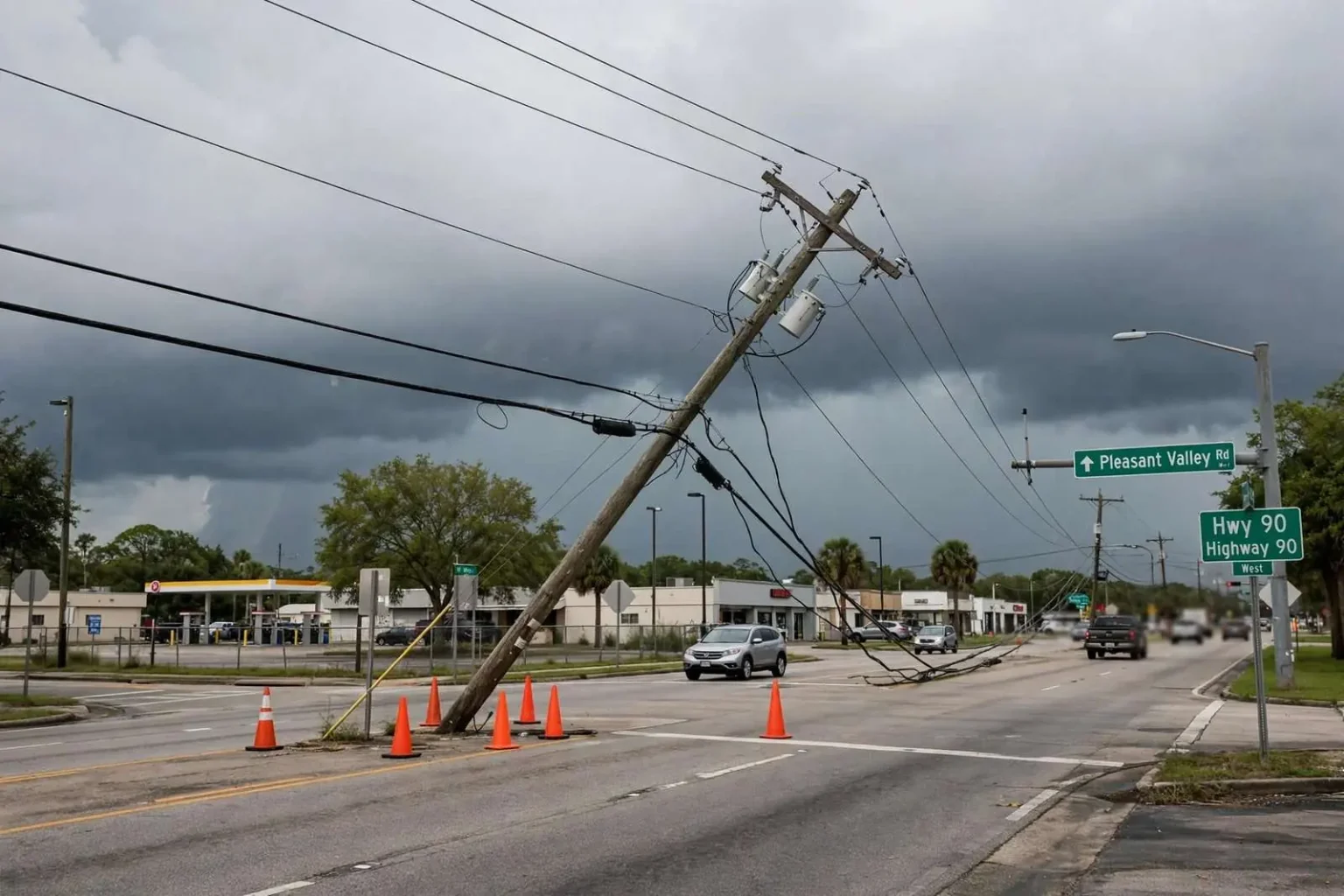
MOBILE, Ala. — For more than a week, drivers moving through one of west Mobile’s busiest crossings — the intersection of Highway 90 and Pleasant Valley Road — passed beneath a sagging power line attached to a badly leaning utility pole, and the damage was impossible to miss. The pole had tilted well out of plumb, with its lines drooping low across traffic, and the longer it stood unrepaired, the more it became a fixture of worry for the commuters who cross it daily. As the days passed and storms gathered in the forecast, the leaning pole turned into a question the whole corridor seemed to be asking: when would somebody fix it?
The intersection is one of the workhorses of the Highway 90 corridor, the historic thoroughfare that parallels Interstate 10 through Mobile and ties the city’s western neighborhoods to Spring Hill, the State Docks and the communities beyond the city limits. Thousands of vehicles move through the Pleasant Valley junction on an ordinary weekday, which meant whatever happened to that pole would unfold in front of a large and continuing audience — including drivers stopped directly beneath the drooping line at rush hour. Pleasant Valley Road itself is a major north-south connector, carrying traffic between Highway 90 and Airport Boulevard through some of the densest residential parts of west Mobile.
Christina Wilson, who drives the route regularly, said the condition of the pole stood out immediately, and she worried aloud about what could happen if the pole gave way during midday traffic, when cars and trucks stack up in every direction through the crossing. The timing of a failure, she recognized, was the real danger: a pole that toppled at the wrong moment could land across lanes full of vehicles or bring live lines down onto the roadway below.
Wilson did not just worry — she reported it. “I called the police Monday before 6 a.m. and told them that the pole was leaning,” she said. Her early-morning call made her one of the first members of the public to put the hazard on the record with city authorities, and it set in motion a chain of notifications that would stretch across the following week.
When Wilson drove past the intersection again the next day, she found cones had been set around the pole — a standard step to warn drivers and pedestrians away from the immediate footprint of a damaged fixture — but nothing had actually been repaired. The pole still leaned. The lines still sagged. “I went by today, and it’s actually worse,” she said, describing a hazard that had visibly deteriorated even after it had been flagged to authorities and marked with cones.
That pattern — a hazard reported, then marked, but left standing — is a familiar frustration in hurricane country, and residents along the Gulf Coast know why. The days or weeks before a named storm arrives are precisely when weak infrastructure tends to fail, which is why utility companies generally work through repair backlogs long before the first bands of rain come ashore. A pole left leaning into storm season keeps a neighborhood’s worst possibilities on the table: a toppled pole, downed energized lines, and a major intersection blocked for days.
A Report That Traveled the Expected Route
Mobile police confirmed they were called about the damaged pole on Sunday, Aug. 7, 2022, and said they notified an AT&T representative that same day. The confirmation showed the report had traveled the expected route: a hazard noticed by a resident, relayed to police, and passed along to the utility that owns and maintains the pole and its attachments. Police departments along the Gulf Coast routinely serve as the first point of contact for street-level infrastructure hazards like this one, logging the complaint and handing it off to the responsible utility, since officers cannot repair poles themselves — only secure the scene and escalate.
For the residents and commuters who kept watching the pole lean a little further each day, the question quickly became less about who had been told and more about when a crew would actually arrive. With storms in the forecast, residents pressed for the fixture to be replaced quickly rather than merely monitored — an urgency shaped by hard local experience with what wind and saturated ground can do to a weakened pole during a Gulf storm.
An AT&T representative said the company would try to get a repair crew out before 8 p.m. that evening — and if none was available, one would be dispatched the next morning to straighten up the leaning pole. The commitment put a clock on the repair and gave neighbors a concrete window to watch for, but it also underscored the practical realities utilities face along the Gulf Coast, where aging pole infrastructure, routine construction schedules and frequent severe thunderstorms all compete for the same limited pool of line crews.
Storm-repair triage is a familiar exercise for utility providers in south Alabama. During and after tropical weather, crews are dispatched first to outages affecting hospitals, water systems and traffic signals, then to neighborhood distribution lines, and only afterward to cosmetic problems that have not yet caused an outage. A leaning pole with intact service is typically classified as a hazard to be scheduled rather than an emergency, which helps explain how a visibly damaged fixture in a high-traffic intersection could wait out more than a week of reporting, cones and follow-up calls before a repair plan took shape.
Highway 90’s Aging Overhead Network
The pole in question is part of the dense web of joint-use infrastructure that lines Highway 90 through Mobile. Poles along corridors like this one typically carry electrical distribution lines for one utility plus attachments for telephone, cable and fiber providers, meaning a single leaning pole can involve several companies in a repair decision before a crew ever rolls. Many of the wood poles in older urban corridors were set decades ago, and inspectors grade them for rot, lean and hardware wear on rotating cycles — which is why a pole can stand for years without trouble and then fail in a stretch of days after ground shifts or a vehicle strike.
Mobile’s location on Mobile Bay also makes the condition of overhead lines a recurring civic concern. The city has absorbed direct and near-direct strikes from major storms over the decades, from Hurricane Frederic in 1979 through Hurricane Danny in 1997 and, more recently, the 2020 season that brought Hurricane Sally’s destructive winds ashore on the Alabama coast. Every one of those events reinforced the same lesson for residents: the poles and lines that survive a storm are only as strong as their weakest neighbor, and any pole already leaning when the forecast turns is a hazard in waiting.
What Residents Can Do About Utility Hazards
For drivers who spot a leaning pole, sagging line or other electrical hazard, safety officials recommend reporting it promptly and giving the utility a chance to respond before escalating. A call to the police non-emergency line creates a time-stamped record, as Wilson’s did, and police departments in Mobile and across Baldwin County routinely forward such reports to the utility the same day. Utilities also maintain their own hazard and outage lines around the clock, and providing a specific address or cross-streets — in this case, Highway 90 at Pleasant Valley Road — helps dispatchers pinpoint the exact structure among the hundreds that line a corridor.
The stakes of a quick report are real. A leaning pole can fall without warning, and downed power lines can energize the ground around them even when they appear dead. Safety guidance from utilities and emergency agencies is consistent: never touch or drive over a downed line, stay at least 30 feet away, and call 911 if a line is sparking, burning or blocking a roadway. Cones or barricades placed around a damaged pole, as happened at the Highway 90 crossing, are a warning to keep distance, not an indication that the danger has passed.
Watching and Waiting at the Crossing
By the end of the week, the saga of the leaning pole had become a small test of how well the region’s hazard-reporting machinery works when the pressure of an approaching storm is added. A resident noticed, called, followed up, and kept documenting; police logged the complaint and notified the utility the same day; and the utility, for its part, committed to a crew by a specific hour, with a backup plan for the next morning. Each link in that chain functioned, even if the visible repair lagged well behind the initial calls.
For Wilson and the other regulars who drive Highway 90 through Pleasant Valley Road every day, the episode ended where Gulf Coast residents always seem to end up: watching the sky, watching the pole, and hoping the crews arrive before the weather does. The repair promise from AT&T — a crew before 8 p.m., or first thing the next morning — gave the intersection its answer. But the week it took to get there left a familiar impression in a storm-prone city, where the difference between a cone and a completed repair is measured in days, and the forecast rarely waits.


