Mobile has weathered epidemic disease before. Long before COVID-19 reached the Gulf Coast in 2020, the city endured repeated outbreaks of cholera, typhoid, tuberculosis and, most persistently, yellow fever, which struck Mobile again and again through much of the 18th and 19th centuries.
Between 1819 and 1853 alone, the city suffered 11 major yellow fever epidemics, and smaller flare-ups continued well into the 20th century. The pattern was a fact of Gulf Coast life: steamships and sailing vessels arriving from Havana, New Orleans and the Caribbean carried both cargo and the Aedes aegypti mosquitoes whose bites spread the virus, and every summer Mobile braced for what the shipping season might bring. A hot port city with standing water in its streets and bayous was, by the standards of the age, an almost ideal breeding ground.
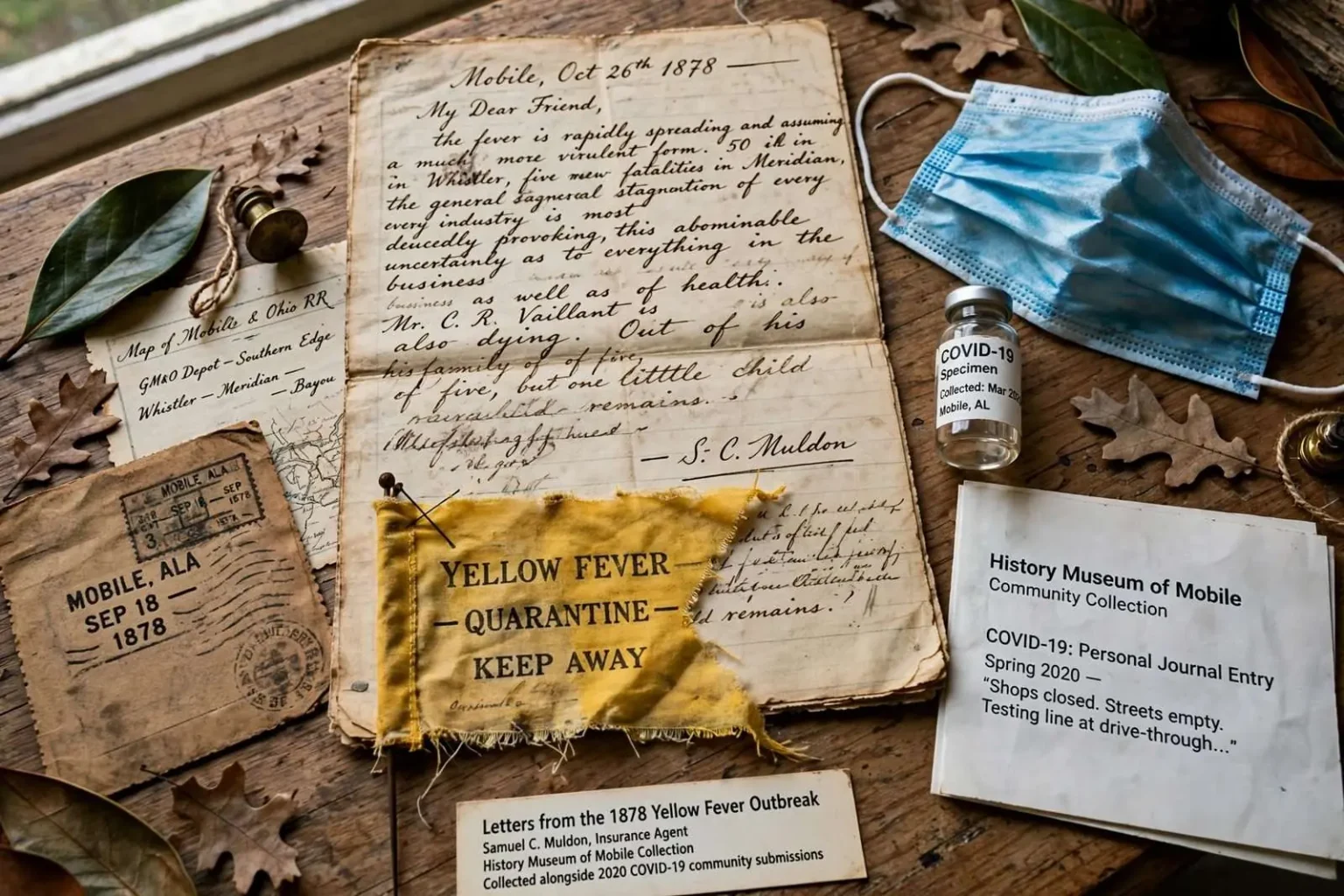
A collection of letters held by the History Museum of Mobile offers a rare, personal window into one of those outbreaks. Written between 1878 and 1879 by Samuel C. Muldon, a Mobile man working in the insurance business, the letters describe daily life during the 1878 yellow fever epidemic in language that feels strikingly familiar in light of the modern pandemic.
Muldon wrote to a friend that while official case counts from the Board of Health were troubling, most people assumed the true number of infections was even higher. He tracked outbreaks methodically, noting, for instance, 50 people ill in Whistler and five new fatalities in Meridian — two neighborhoods on the western side of the city, whose rail lines and work camps put them squarely in the path of the fever’s spread.
Much of Muldon’s correspondence wrestles with a question that would sound familiar to any 2020 business owner: how to balance commerce with quarantine. He wrote with concern about “the general stagnation of every industry” and urged a business correspondent to proceed with a contract settlement “with the greatest care and with [a] high degree of charity.”
In 1878, keeping the economy moving meant negotiating quarantine rules that determined whether cotton could move on and off railcars passing through the GM&O Station. The Mobile and Ohio Railroad’s passenger and freight depot sat at the southern edge of downtown, and cotton — the crop on which the city’s banking, warehousing and export trades all depended — could not move without passing through whatever restrictions the health authorities had imposed. Merchants weighed the cost of delayed shipments against the risk of carrying the fever inland along the rail lines.
As the disruption dragged on, he complained that “it is most deucedly provoking this abominable uncertainly as to everything in the way of business as well as of health.”
Muldon also followed reports of a more severe outbreak in New Orleans and the efforts underway to keep yellow fever from spreading between Gulf Coast cities. Historians note that Mobile required multi-day quarantines of travelers arriving from cities like New Orleans by train, and in some cases passengers from severely affected cities were not permitted to disembark at all.
Fear, flags and quarantine
Fear runs through the letters as a constant undercurrent. “Fearful anxiety” over the “prevailing scourge” led Muldon to move his family to the countryside for months at a time, a common response among Mobilians who could afford it during yellow fever seasons; entire neighborhoods, or the city itself, were sometimes placed under forced quarantine for extended stretches.
Households with a sick family member flew yellow flags outside their homes, a visible warning of the disease within. The flags functioned as both public health notice and social marker: a street of yellow pennants told every passerby which houses were stricken, and families inside them often found neighbors keeping their distance — a dynamic residents of 2020 would recognize in the anxieties around infection and isolation.
Muldon’s letters record personal loss as well as public anxiety. On October 26, he wrote of a family devastated by the outbreak: “Mr. C. R. Vaillant … is also dying. His is particularly a sad case, out of his family of five — consisting of himself, his wife and three children, but one little child remains. There is no doubt the fever is rapidly spreading and assuming a much more virulent form.”
The 1878 epidemic was part of one of the worst yellow fever years in the South’s history. That same summer the disease devastated Memphis, Tennessee, killing thousands and effectively bankrupting the city, and the panic radiated along the railroads that connected river cities to the Gulf. Mobile’s outbreak unfolded against that regional backdrop, with newspapers tracking the advance of the fever city by city and rail officials deciding where to stop, inspect and turn back trains.
How the fever shaped the city
Yellow fever did more than terrify Mobile residents in any given year, it reshaped the city itself. The original French settlement of 1702, located north of present-day Mobile at what is now known as 27 Mile Bluff, was abandoned after a devastating yellow fever outbreak, reportedly introduced by a group of French women, later called the “Pelican girls,” who had contracted the disease during a stopover in Havana before arriving to marry colonists.
Mobile’s present location was chosen afterward, and Fort Condé was built soon after in response to the epidemic. The move downriver placed the town closer to the Bay and the harbor, trading the Bluff’s elevation for commercial access — a decision that would keep Mobile tied to waterfront geography for the next three centuries, with all the mosquito exposure that came with it.
In the early 1800s, some Mobilians began building summer homes in what became Spring Hill, believing the higher, drier ground offered protection from the “miasmas” they blamed for the disease. Without knowing it, they were partly right: the added elevation and distance from the waterfront reduced exposure to the mosquitoes that actually carried yellow fever, and the migration helped drive Mobile’s early westward expansion toward Spring Hill. The neighborhood that grew around those summer retreats — later home to schools, churches and some of the city’s most established families — owes its existence to a theory of disease that was wrong in its reasoning and useful in its effect.
A brutal disease, and the end of the era
Yellow fever was a brutal disease by any measure. Victims could suffer jaundice, severe vomiting, internal hemorrhaging, organ failure and death within days, and 19th-century doctors had little understanding of how it spread or how to treat it. Treatment amounted to nursing care, quinine, and hope; prevention meant fumigation, quarantine, and the burning of tar pots in the streets in the mistaken belief that smoke would cleanse the air.
The mystery was finally broken by work done, fittingly, in Cuba. At the turn of the 20th century, a U.S. Army medical commission — including Army physician Maj. Walter Reed — demonstrated that the mosquito, not filth or “bad air,” carried the virus. Mosquito control, screening and the elimination of standing water followed, and the last major American yellow fever epidemics faded. Mobile’s flare-ups dwindled to scattered cases and then to history, with the disease’s decline well under way by the first decades of the 20th century.
Modern medicine has made outbreaks like the one Muldon described almost unimaginable today, but the emotional experience he recorded, uncertainty, fear for family, economic disruption and grief, has proven durable across more than 140 years.
Building the record for 2020
In the spring of 2020, as the modern world confronted its own pandemic, the History Museum of Mobile launched a call for community members to help build a similar historical record for future generations. Residents were invited to submit emails, letters, texts, social media posts or personal journal entries documenting their experience of the COVID-19 outbreak, with the goal of preserving those accounts as part of the museum’s permanent collection, much as Muldon’s letters have preserved a firsthand account of 1878.
The parallel was deliberate. Museum staff understood that the official record — case counts, closure orders, press releases — captures only part of what a pandemic does to a city, and that the texture of daily life survives in ordinary people’s own words. Muldon’s letters, preserved by the museum and read anew in 2020, offered the proof: a mid-level insurance man’s complaints about quarantine paperwork, his worry over a client’s contract settlement, his tally of the sick in neighborhoods like Whistler and Meridian, outlasted every official report of the year.
What the museum asked of Mobilians in 2020 was, in effect, that they write the next installment of Muldon’s correspondence. The emails and journals collected during the COVID-19 shutdowns — the documents recording closed storefronts, empty school buildings, drive-through testing lines and funerals held over video calls — will sit in the same archive as the yellow flags and quarantine notices of 1878, available to researchers a century and a half from now who, like their predecessors, will find that the details of commerce, fear and grief in a crisis city change far less than the diseases themselves.