A Bloodmobile Parks at Orange Beach City Hall Thursday, and Donors Leave With More Than a Sticker
The LifeSouth Bloodmobile will be parked at Orange Beach City Hall from 10 a.m. to 4 p.m. Thursday, Sept. 10. Walk-ins and appointments are both accepted, and every donor gets a T-shirt, a gift card and a free cholesterol screening.
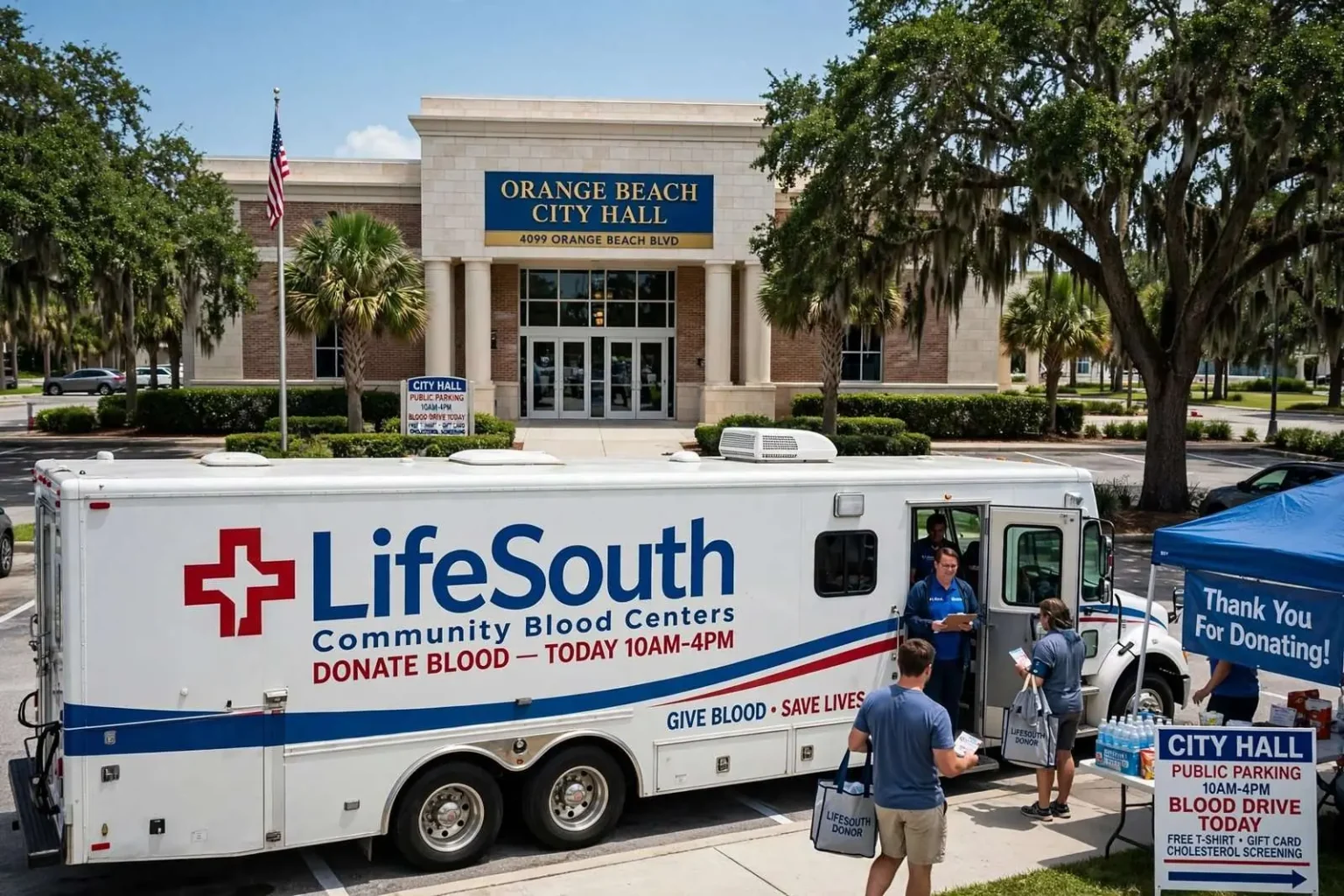
For six hours on Thursday, the parking lot at Orange Beach City Hall will do double duty as a medical facility.
The LifeSouth Bloodmobile is scheduled to be there from 10 a.m. to 4 p.m. on Thursday, Sept. 10, collecting whole blood donations from anyone in the area who is eligible and willing to spend part of an afternoon on it. City Hall is at 4099 Orange Beach Blvd. Donors can walk up without an appointment or reserve a time slot online in advance.
Everyone who donates will receive a free T-shirt, a gift card and a free cholesterol screening.
Who Can Give
The eligibility rules for this drive are the standard ones for community collections in the region. Donors must be at least 16 years old and weigh at least 110 pounds, and every donor must bring a valid photo ID. Donors who are 16 must also provide written parental permission before giving blood.
That age floor is worth pausing on, because it is the reason blood centers put so much energy into high school and college drives. Sixteen- and seventeen-year-old donors, giving with parental consent, represent a meaningful share of the volunteer donor base in many parts of the country, and they are also the pipeline: people who donate for the first time as teenagers are far more likely to become repeat donors as adults. A community blood center that loses access to student donors for a few months loses both the collection and the recruitment.
Beyond age and weight, most donor screening happens on site, in private, and takes only a few minutes. The final decision on whether any individual can donate on a given day is made by the collection staff at the drive, not in advance.
What Actually Happens Inside a Bloodmobile
A bloodmobile is a self-contained donation center on a chassis. Rather than asking donors to travel to a fixed collection facility, the center brings the facility to a parking lot, a church, a workplace or a city hall — which is the entire reason mobile drives account for such a large share of the volunteer blood supply.
The visit itself is more paperwork than needle. A typical whole blood donation runs through four stages:
- Registration. Photo ID, contact information, and confirmation of the donor’s record if they have given before.
- Health history. A confidential questionnaire covering medications, recent travel, recent illness and other factors, followed by a short private interview with a staff member.
- Mini-physical. Temperature, pulse, blood pressure and a finger-stick test to check hemoglobin, which confirms the donor has enough iron in their blood to give safely.
- The donation. The draw itself — roughly a pint of whole blood — usually takes eight to twelve minutes. The whole appointment, start to finish, generally runs under an hour.
Afterward, donors are asked to sit for a few minutes with something to eat and drink before heading back out. That step is not ceremonial. The most common reaction to donating is a brief lightheaded spell, and it is far less likely in someone who has eaten, hydrated and stayed seated for ten minutes.
Donors who want an easier experience are generally advised to drink extra water in the hours beforehand, eat a real meal rather than skipping lunch, wear a shirt with sleeves that push up easily, and avoid scheduling the donation immediately before strenuous exercise.
Why One Pint Goes Further Than It Sounds
A single whole blood donation is rarely transfused as whole blood. At the processing lab, it is separated by centrifuge into components — red cells, plasma and, depending on the collection method, platelets — because different patients need different things.
Red cells go to trauma patients, surgical cases and people with severe anemia. Plasma is used in burn care, liver disease and clotting disorders. Platelets are essential for cancer patients whose treatment has suppressed their bone marrow, and for many bleeding emergencies. Splitting one donation across those uses is why blood centers describe a single visit as helping more than one patient.
Component separation also explains why blood supply is a perishable-goods logistics problem rather than a warehouse problem. Under standard refrigeration, red cells have a shelf life measured in weeks. Platelets are far more fragile and must be used within days of collection. Plasma can be frozen and stored much longer. The practical consequence is that a blood center cannot stockpile its way out of a shortage: the shelf clears itself continuously, and the only fix is a steady stream of new donations arriving week after week.
Why Late Summer Is Hard on the Blood Supply
Blood centers across the country describe the same recurring pattern, and it is not a coincidence of any single year. Supply tends to tighten in summer and again around the winter holidays, for reasons that stack on top of one another.
- School is out. High school and college drives are among the most productive collection events on the calendar, and they largely stop between May and late August. Campuses come back online only gradually in September.
- Regular donors travel. The people most likely to give are the people most likely to be somewhere else in July and August. A missed donation in a repeat donor’s cycle is not made up later; it is simply a unit that never got collected.
- Demand does not take a vacation. Summer brings more driving, more boating, more construction and more outdoor activity, and with them more trauma cases. Scheduled surgeries continue year-round.
- Weather interrupts collections. Along the Gulf Coast, late summer and early fall coincide with the most active stretch of hurricane season. Storms cancel drives, close roads and can force a region to draw down inventory precisely when it is hardest to replace.
That last point is the one that makes coastal drives a little different from inland ones. A hurricane threat does not usually create a surge in transfusion demand, but it reliably destroys the collection schedule — drives get canceled, donors evacuate, and mobile units are pulled off the road. Blood centers in coastal regions therefore try to enter the peak of storm season with inventory in hand, which puts a premium on drives held in late August, September and October.
How a Community Drive Comes Together
A blood drive looks simple from the donor’s side: show up, sign in, give, leave. From the organizing side it is a scheduling exercise with several moving parts.
The blood center supplies the vehicle, the licensed collection staff, the supplies and the regulatory compliance. The host site supplies the location, the parking, the electrical hookup where needed and, most importantly, the audience — the pool of people who will actually walk up. A drive at a location with steady foot traffic and easy parking outperforms a drive at a location that requires a special trip.
That is the logic of holding this one at a city hall. Municipal buildings sit at addresses residents already know, on roads they already drive, with parking designed for the public. Orange Beach City Hall has long served as a gathering point for community events and services, and the six-hour window is wide enough to catch people before work, on a lunch break and after the workday ends.
Appointments and walk-ins serve different purposes in that setup. Scheduled slots let the collection staff pace the day and avoid a bottleneck at the registration desk. Walk-ins fill the gaps left by the no-shows that every drive has. Both are accepted here, and donors who want to lock in a time can reserve one online in advance.
The Cholesterol Screening Is Not a Throwaway
Donor incentives are a standard part of community drives, and the T-shirt and gift card offered on Thursday are the familiar version. The free cholesterol screening is the more substantive one.
Because a blood center is already drawing and processing a sample, adding a basic screening test costs it comparatively little, and for the donor it is a piece of health information they might not otherwise seek out. Cholesterol levels are one of the routine markers used in assessing cardiovascular risk, and many adults go years between checks. A screening result is not a diagnosis and does not replace a visit to a physician, but an unexpected number is a reasonable prompt to schedule one.
The mini-physical performed before every donation carries a similar side benefit. Blood pressure, pulse and hemoglobin are all measured as safety checks for the donation itself, and donors are told the results. Low hemoglobin is the most common reason a would-be donor is deferred, and it is also, occasionally, the first hint of an iron issue worth following up on.
A Nonprofit in the Middle of the Chain
LifeSouth Community Blood Centers is a nonprofit organization that collects blood donations and distributes them to hospitals throughout the Southeast. Blood drives like this one help keep local hospital blood supplies stocked for patients in need, and community events are one of the primary ways LifeSouth collects donations across the region.
The structure is worth understanding, because most people never see it. Hospitals in the United States generally do not collect their own blood. They buy it from community blood centers and regional suppliers, which recruit volunteer donors, run the collection events, test and process every unit, store the components under the required conditions, and deliver them on demand. A hospital calling for units at two in the morning is drawing on a network that was built weeks earlier by people who gave in a church hall or a parking lot and then went back to work.
That is also why the geography of donation is looser than people assume. Blood collected in Baldwin County does not necessarily stay in Baldwin County, and blood transfused in a local hospital may have been drawn hundreds of miles away. Regional inventories are pooled and moved to wherever the need is greatest, which is what allows a small coastal community to have access to specialized components it could never collect on its own — and what makes a single afternoon drive part of a much larger supply than its own parking lot suggests.
If You Plan to Go
The drive runs Thursday, Sept. 10, from 10 a.m. to 4 p.m. at Orange Beach City Hall, 4099 Orange Beach Blvd. Donors need to be at least 16 years old, weigh at least 110 pounds and bring a valid photo ID, with written parental permission required for 16-year-olds. Appointments can be reserved online in advance, and walk-in donors are welcome during the six-hour window. More information and scheduling options are available online.