
LifeSouth Calls on Gulf Coast Donors to Replenish Blood Supply After Hurricane Michael
LifeSouth called for blood and platelet donors at its Mobile and Daphne centers after Hurricane Michael drained regional supplies.
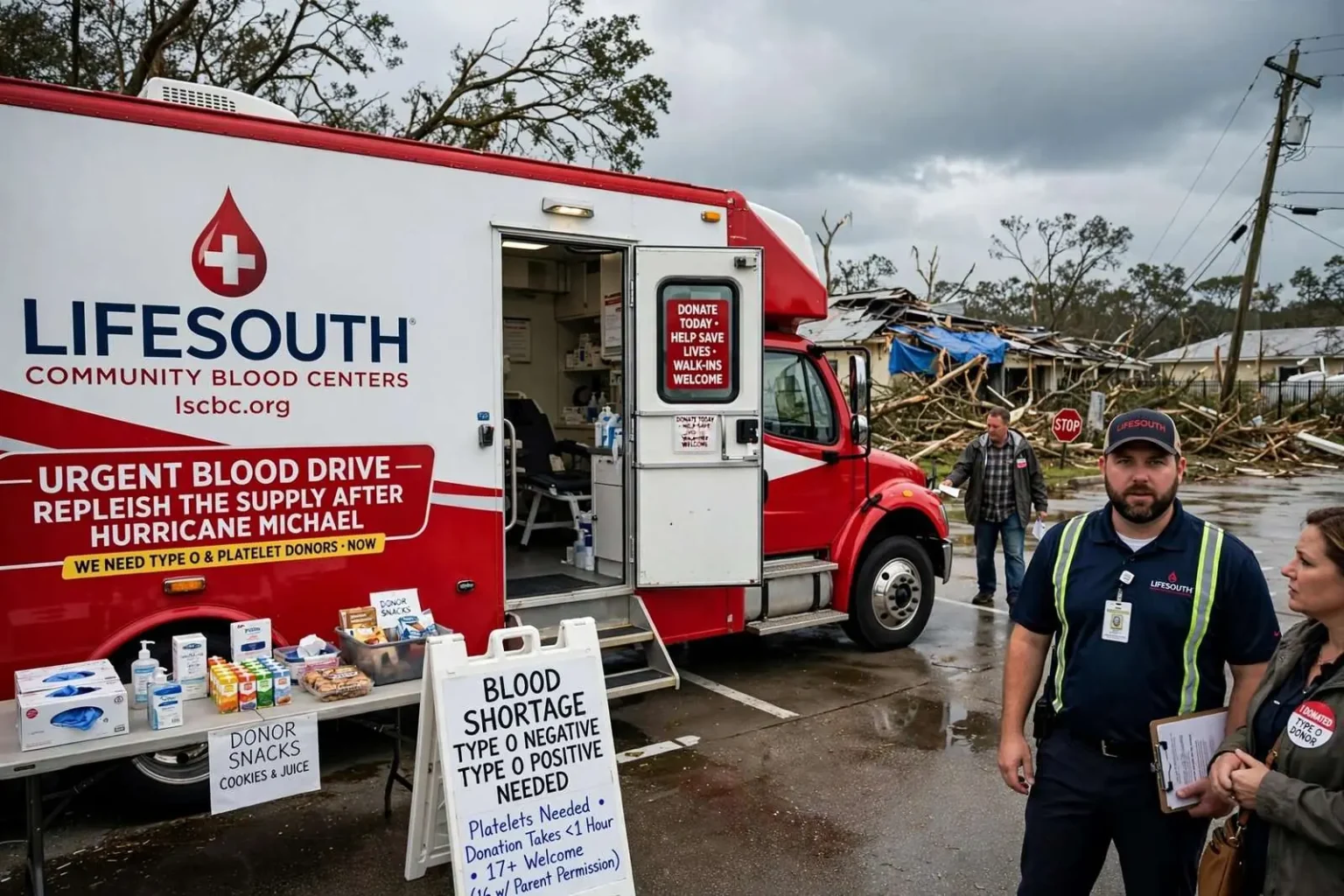
Blood centers across the Mobile area put out an urgent call for donors in the days after Hurricane Michael devastated parts of the Florida Panhandle, as hospitals treating storm injuries strained an already thin blood supply. The Category 4 storm, which came ashore with historic force near Mexico Beach and Panama City, left hospitals in its path damaged, power lines down and communities cut off — and it set off a regional scramble for the blood products that trauma care, surgeries and emergency treatment consume by the unit.
LifeSouth Community Blood Centers reported a significant shortage of type O blood and platelets of all types, the two most critical supplies in any emergency. Type O negative is the universal donor type carried by trauma teams and helicopters when there is no time to match a patient’s blood, while type O positive serves as the workhorse of hospital transfusions. Platelets, the cell fragments that control bleeding, are shorter-lived still and essential for cancer patients, surgical cases and injury care alike.
The shortage had a cruel timing to it. School and business closures caused by the storm had triggered a substantial drop in donations just as demand spiked — a familiar dynamic in disaster response, since a large share of the region’s blood supply is collected at school drives, office blood drives and campus events, all of which shut down when the Panhandle and south Alabama braced for landfall. The same storm that filled hospitals with patients emptied the collection calendar that keeps shelves stocked.
Why storms drain the blood supply
Hurricane Michael’s path cut through some of the most productive blood-collection territory on the northern Gulf Coast. Blood centers in Panama City, Tallahassee and the surrounding counties — including LifeSouth operations serving hospitals in the storm’s footprint — lost the ability to collect in their own communities, damaged buildings and displaced staff compounding the problem. When a regional blood bank cannot collect, its hospital customers must turn to neighbors, and the demand ripples outward across state lines to places like Mobile and Baldwin County that were spared the worst of the damage.
The arithmetic of trauma care makes the ripple effect severe. A single serious trauma case can require dozens of units of blood and platelets, and a storm producing mass casualties produces those cases by the batch. Meanwhile routine surgeries, cancer treatments and obstetric care continue at every hospital that still has lights and water, drawing on the same shelf. Blood cannot be manufactured, cannot be stockpiled for long — red cells carry a shelf life measured in weeks, and platelets in days — so the system depends on a constant, steady stream of donors.
That dependence is why blood centers describe supplies as “thin” in ordinary times and why a single disruptive week can push a region into emergency footing. LifeSouth, the nonprofit community blood center headquartered in Gainesville, Florida, serves hospitals across Alabama, Florida and Georgia, and its Mobile-area operations sit close enough to the Panhandle to be first in line when neighboring hospitals need help.
Where to give
Area residents could give at LifeSouth’s community donor centers, including locations on Hillcrest Road in Mobile and Capital Drive in Daphne, or at a traveling bloodmobile — the mobile collection units that carry the donor chairs, screening stations and staff to church lots, business parking areas and community events across the two-county region. For donors in west Mobile and Tillman’s Corner, the Hillcrest Road center is the convenient stop; Eastern Shore residents can reach the Daphne location near the U.S. 98 corridor without crossing the bay. The centers accommodate walk-ins, and donors can also schedule appointments in advance to keep the wait short.
The bloodmobile route matters most in smaller communities — Bayou La Batre, Citronelle, Fairhope, Foley, Gulf Shores — where a fixed donor center is a drive away. After major storms, mobile units are frequently dispatched to neighborhoods and workplaces that organize last-minute drives, since the fastest way to restock a shelf is to bring the collection site to the donors instead of the reverse.
Who can donate
First-time donors were welcome, and LifeSouth’s requirements are simple enough that most healthy adults qualify. Donors must be at least 17 years old — or 16 with parental permission — weigh a minimum of 110 pounds, be in good health, and bring a photo ID. The whole appointment, from registration and a brief health screening through the donation itself and the cookies-and-juice recovery period afterward, generally takes less than an hour, and the needle time itself runs roughly ten minutes.
The 16-year-old pathway exists because high school blood drives supply an outsized share of collections, and students who start donating young tend to become lifelong donors. Parental permission forms are available from the blood center and at school drives. The photo ID requirement keeps records accurate across visits and ensures donors meet eligibility rules.
Eligibility screening covers the standard safety questions — medications, travel history, recent illnesses — designed to protect both the donor and the patient who will receive the blood. Staff at the donor centers walk first-timers through each step, and donors who are unsure whether a medication or condition disqualifies them are encouraged to ask rather than assume; many common concerns turn out not to be barriers at all.
Type O donors carried special weight in the appeal. Because type O negative can be transfused into almost any patient in an emergency, hospitals keep it on helicopters, in emergency departments and in trauma bays, and it is the first product to vanish from shelves when demand surges. Type O positive, found in roughly one of every three Americans, is the most commonly transfused type overall. People with either type were asked to make donating a priority; platelet donors — who give through an apheresis process that returns red cells to the body while collecting platelets — were needed just as urgently, since platelet shelf life is measured in days and hurricane-season demand does not pause for logistics.
What happens to a donation
Every unit collected in Mobile or Daphne moves quickly through the pipeline. After donation, blood is tested for infectious diseases, processed into components — red cells, plasma, platelets — and released to hospitals according to need. During a regional emergency like Michael’s aftermath, that routing becomes a coordination exercise: LifeSouth’s distribution network moves units toward the hospitals with the most urgent demand, and the centers that collect more than their own service area needs send the surplus down the corridor toward the Panhandle.
The donors who answered the post-storm call were therefore helping two sets of patients at once: neighbors in Mobile and Baldwin County hospitals, and storm victims in the disaster zone whose local supply was gone. Hospital administrators along the coast have long noted that blood is among the first resources requested in a mass-casualty event and among the hardest to replace quickly, because collection depends on thousands of individual decisions rather than a single supply chain. When LifeSouth appealed across its tri-state service area after Michael, it was asking those thousands of individuals to act within days, not weeks — and donors who might otherwise have waited for the next scheduled drive in their neighborhood were urged to travel instead to a donor center or bloodmobile site.
The response to appeals like this one also tends to determine how long a shortage lasts. A surge of donations in the first week after a disaster restocks shelves, but platelets expire within days and red cells within weeks, so a single strong weekend cannot carry a region through a months-long recovery. Blood centers therefore pair emergency appeals with a request that donors return — and that healthy first-timers become regulars — so the pipeline refills on a schedule rather than in one heroic burst. Groups that want to organize a drive of their own can contact the center to sponsor a bloodmobile visit, a step that multiplies one donor’s hour into a whole neighborhood’s contribution.
For residents deciding whether to give, the math is personal and immediate: one whole-blood donation can help as many as three patients once separated into components, and regular donors — those who give every couple of months — form the reliable base that gets a region through exactly this kind of crisis. The centers on Hillcrest Road and Capital Drive remained open to collect through the emergency period, and the traveling bloodmobile schedule filled with the makeup drives that closed schools and businesses had postponed.
Hurricane Michael eventually moved on, and the Panhandle’s recovery stretched on for months and years. But the lesson the storm left with Gulf Coast blood banks was permanent: the region’s blood supply is only as strong as the schedule of donations behind it, and the best time to give is before the next emergency — because once the hurricane is bearing down, the schools close, the drives cancel, and the shelves start emptying just as the need climbs. Mobile-area residents who want to be ready for the next crisis can find the donor centers on Hillcrest Road in Mobile and Capital Drive in Daphne, check the bloodmobile schedule, and put an hour on the calendar. Type O donors and platelet donors, as this appeal made plain, are always first in line when the coast needs help.


