University of South Alabama Mobile
Local College Basketball Teams Tip Off Busy Season Across Mobile
South Alabama, Spring Hill College, the University of Mobile and Bishop State Community College have all opened their men's and women's basketball seasons, with new faces stepping into key roles across the local programs.
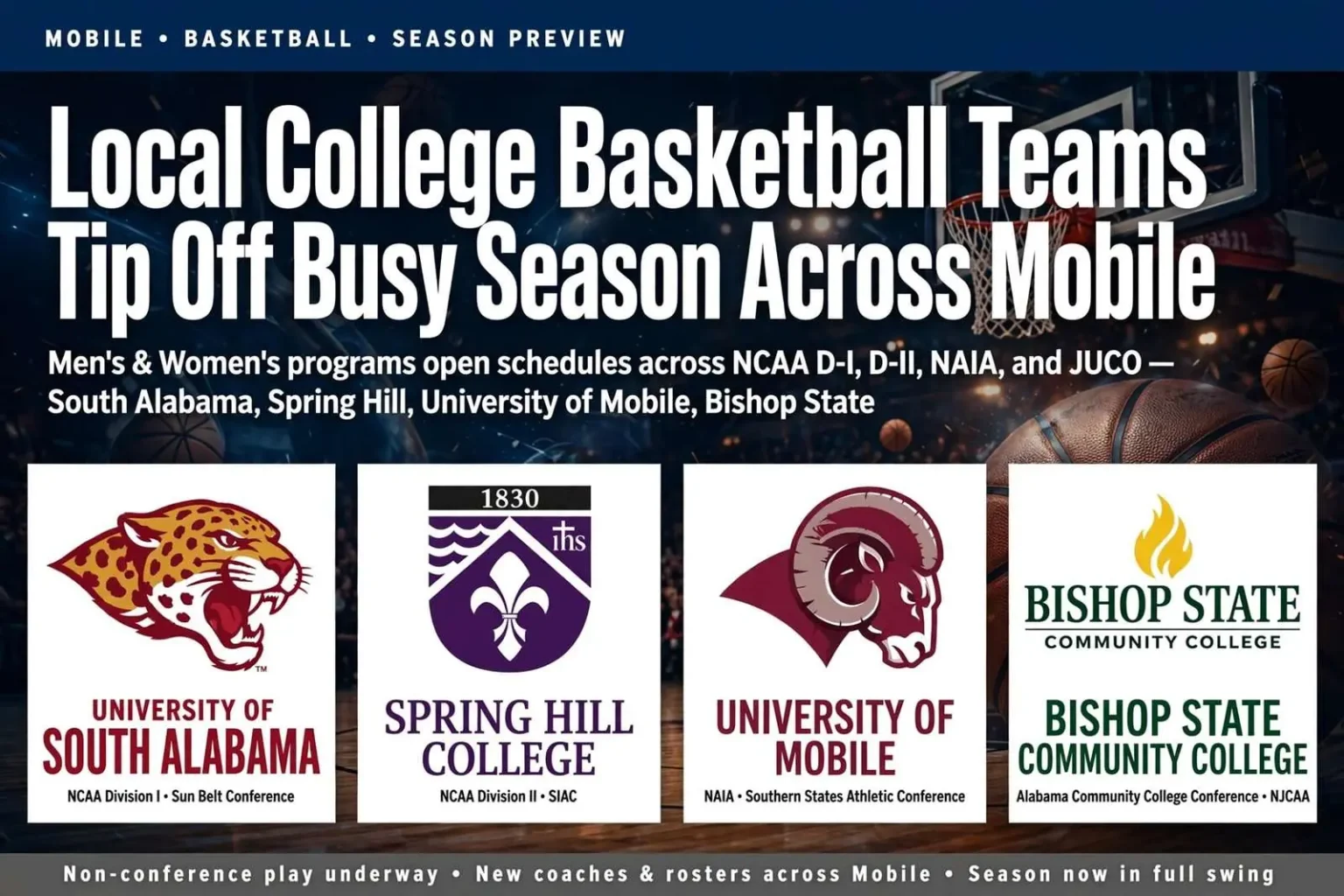
College basketball season is in full swing across the Mobile area, with the University of South Alabama, Spring Hill College, the University of Mobile and Bishop State Community College all opening their men’s and women’s schedules over the past two weeks. The early slate of games has been dominated by non-conference matchups, the traditional proving ground where coaches experiment with lineups and get a first look at new talent before conference play begins.
Roster turnover has been a common theme for several of the local programs this season. Bishop State enters the year with new head coaches leading both its men’s and women’s teams, while South Alabama, Spring Hill and the University of Mobile are each relying heavily on newcomers to fill out their rotations.
The South Alabama men’s team opened the season with a 1-1 record before heading to Tuscaloosa for a Tuesday night matchup against Alabama. The Jaguars routed Spring Hill 102-41 in an exhibition contest at home before dropping a tight 64-58 decision on the road at Wichita State.
In the win over Spring Hill, Jay Jay Chandler paced South Alabama with 21 points, seven rebounds, three assists and three steals. Diante Smith added 16 points, seven rebounds, two blocked shots and two steals, while Kayo Goncalves scored 14 points and grabbed four rebounds. Javon Franklin chipped in 12 points and nine rebounds, Alex Anderson had 11 points and seven boards, and Charles Manning Jr. scored nine points. Spring Hill was led by Jaden Gary’s eight points and four rebounds, with Steven Lyles adding seven points and three rebounds, John Abate contributing seven points and five rebounds, and Denys Bobchuk scoring seven points.
Against Wichita State, Franklin turned in a strong all-around performance with 18 points and 12 rebounds. Manning scored 13 points and grabbed four boards, while Goncalves and Chandler each finished with eight points.
The South Alabama women’s team has jumped out to a 2-1 start, defeating Spring Hill 85-49 and Auburn-Montgomery 70-49 before falling 64-45 on the road at Rutgers. Scoring has been spread across the roster through the first three games. Against Spring Hill, Zena Elias led the Jaguars with 17 points and eight rebounds, Jaylin Powell scored 15 points and had three rebounds, Mahogany Vaught added eight points and four rebounds, and Dee Haymer contributed eight points and three rebounds. Spring Hill’s Ariel Thompson countered with 17 points and six rebounds, Tyashia Bostick scored 14 points with four rebounds, and Emyria Harris added eight points.
In the loss at Rutgers, Powell led South Alabama with 13 points and two rebounds, and Haymer added 10 points and two rebounds. Against Auburn-Montgomery, the Jaguars got 16 points from Vaught, 15 from Nadia Howard, 11 from Jordan Rosier, and eight points and three rebounds from Janelle Jones, with Haymer adding eight points as well.
Spring Hill’s men’s team has struggled in exhibition play, going 0-3 with losses of 102-41 to South Alabama, 86-69 at Samford and 79-41 at New Orleans. The Badgers were scheduled to face Loyola in a Tuesday night matchup.
The Spring Hill women’s team is also winless in exhibition action at 0-2, falling 85-49 at South Alabama and 85-57 at UAB. In regular-season play, the Badgers dropped games to Embry-Riddle (91-31) and Rollins College (62-42) and were set to face the University of Mobile on Tuesday. Against Embry-Riddle, four different Spring Hill players scored five points apiece to lead the team, while Bostick poured in 20 points and pulled down seven rebounds in the loss to Rollins.
The University of Mobile men’s team has picked up wins over Louisiana College (75-73) and Southeastern Baptist twice (80-51 and 94-67), with losses to Point University (76-72), Tennessee Wesleyan (83-78) and Louisiana College (72-63). In the second victory over Southeastern Baptist, the Rams were led by Gary Jefferson’s 23 points and five rebounds, Sage McKenna’s 17 points and nine rebounds, Damariee Jones’ 15 points and five rebounds, Tadeas Manas’ 11 points and three rebounds, and Joshua Williams’ 10 points and six rebounds.
The University of Mobile women’s team has started strong at 3-1, with victories over Dillard (39-31), Ave Maria (67-54) and Southeastern Baptist to open the season, along with a 60-58 loss to Point University and an exhibition setback against South Alabama. Against Southeastern Baptist, Erica Jones led the Rams with 14 points, while Miya Kimber scored 10 points and Carlee Wyatt added nine.
Where the programs compete
The four programs play at different levels of college athletics. South Alabama competes in NCAA Division I as a member of the Sun Belt Conference; Spring Hill is an NCAA Division II member of the Southern Intercollegiate Athletic Conference; the University of Mobile competes in the NAIA’s Southern States Athletic Conference; and Bishop State plays junior college basketball in the Alabama Community College Conference. That range is why many early-season games, such as South Alabama’s exhibition against Spring Hill, pair programs from different divisions.