
Local Filmmakers Race the Clock for Twilight-Themed Blood Drive Film Contest in Mobile
LifeSouth and local filmmakers teamed up on a 10-day vampire and werewolf film contest tied to Eclipse's release, supporting blood donation.
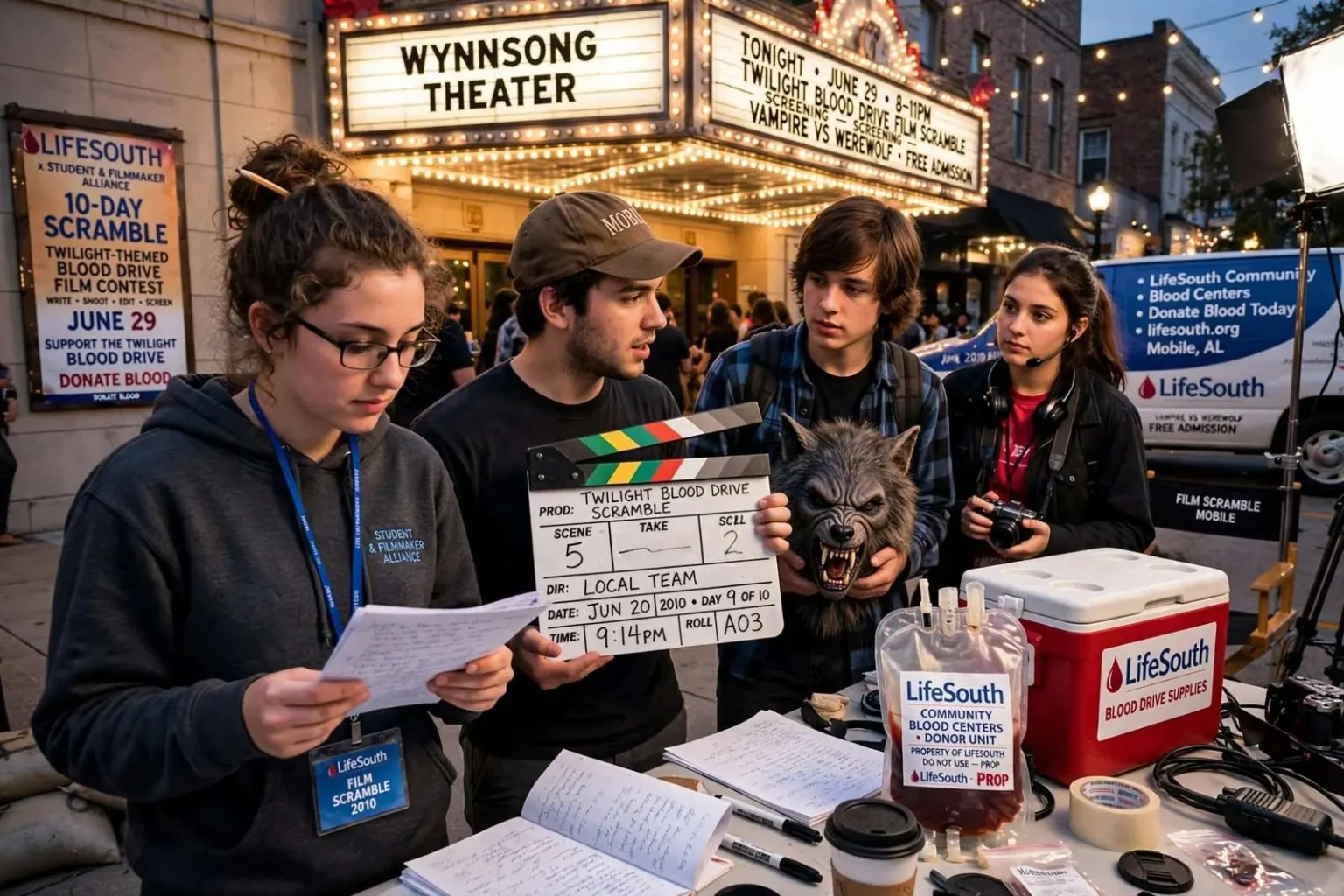
LifeSouth Community Blood Centers teamed up with the Student and Filmmaker Alliance to stage a short-film contest timed to the June 30, 2010, opening of “The Twilight Saga: Eclipse,” the third film in the popular vampire-romance franchise. The event, part of the local Mobile Film Scramble series, challenged area filmmakers to build a movie around the same blood-donation cause that inspired the tie-in Twilight Blood Drive.
Participating teams had just 10 days to write, shoot, and edit five-minute short films with a vampire or werewolf theme, echoing Eclipse’s central rivalry between the Cullen family and the Quileute werewolf pack. Each entry was required to feature a LifeSouth prop somewhere in the film, tying the fan-driven contest directly back to the blood center’s donation campaign.
The premise put a playful spin on a serious subject. The Twilight franchise, built on Stephenie Meyer’s bestselling novels, had turned vampires and blood into box-office phenomena, and the film adaptation of Eclipse was among the most anticipated releases of the summer. LifeSouth’s organizers saw an opening: a phenomenon that made “blood” the word on millions of teenagers’ lips could also make blood donation something young people would talk about — and, ideally, do.
The Scramble Format
The finished films screened June 29 from 8 to 11 p.m. at Wynnsong Theater, where an audience watched the entries and voted for their favorites. The scramble format, in which local filmmakers race against a tight deadline to produce a themed short film, has been used repeatedly in the Mobile area to spotlight homegrown filmmaking talent. Teams typically learn the rules and theme, then scatter to write, cast, shoot and cut their films before the deadline — an exercise in creative problem-solving as much as moviemaking.
The format has grown popular with film communities nationwide precisely because of those constraints. A ten-day clock strips away the endless revisions that stall independent projects and forces crews to settle for what they can actually shoot. Required elements — here, a LifeSouth prop that had to appear on screen — level the playing field, since every team must build its story around the same mandate. Judges and audiences get variety, and organizers get films that all serve the same message.
For the Student and Filmmaker Alliance, the event doubled as a networking opportunity. Alliance-style groups bring together students, hobbyists and working professionals who might otherwise never share a set, and a scramble gives newcomers a low-stakes way to learn camera work, lighting, editing and festival-style screening etiquette. The June screening gave participants the rare treat of seeing their work on a real theater screen with a paying-attention audience.
The Blood Drive Behind the Films
Organizers said the broader aim of pairing the film contest with the movie’s release was to raise awareness of blood donation and encourage participation in the Twilight Blood Drive, using the franchise’s popularity among young moviegoers to draw attention to a public health need. Blood supplies traditionally tighten in the summer months, when schools — a major source of mobile blood drives — are out of session and regular donors travel on vacation. Hospitals do not pause for the season, so community blood centers spend every summer trying to replace those missed collections.
Patient demand also makes the timing matter. Blood must be on the shelf before it is needed; transfusions for surgery patients, trauma victims, cancer patients and mothers with childbirth complications cannot wait for a donation cycle. That is why centers run themed campaigns and community events: each new donor brought in by one campaign may return on his or her own in the months that follow, and every unit collected in late June helps stabilize the local supply heading into the holiday weekend.
About LifeSouth
LifeSouth Community Blood Centers serves donors and hospitals across the Southeast, including the Mobile area, and has regularly partnered with local organizations to run themed donation drives tied to pop-culture events. The nonprofit community blood center operates donor centers and conducts blood drives throughout the region, collecting from volunteer donors and supplying hospitals whose patients depend on that steady stream of donations.
Themed campaigns have become a standard tool in the blood banking world. By wrapping a donation drive in a movie release, a holiday or a local festival, centers reach audiences who might never respond to a routine appeal. The Twilight tie-in exemplified the approach: meet young people inside their enthusiasm, then hand them the simple, genuinely heroic act of giving blood. For the donors who showed up, the connection was literal — the “vampire” theme turned on its head, with humans choosing to give rather than take.
Mobile’s Growing Film Community
The contest also fit within Mobile’s wider effort to grow a film culture on the Gulf Coast. The city and the surrounding area have long hosted commercial and documentary production, and local organizations have spent years building infrastructure for independent filmmakers — screening series, workshops and competitions that give area residents a reason to pick up a camera. Events like the Mobile Film Scramble feed that ecosystem, turning a one-night screening into an ongoing community of crews who know each other and collaborate on the next project.
For audiences, the June 29 screening offered something a multiplex usually does not: movies made a few blocks from where they were shown, by people they might know. The vampire and werewolf theme gave the entries a common visual language, but each team’s approach differed — horror, comedy, romance and parody all had room under the same umbrella. The audience vote crowned the evening, and the feedback loop of a live screening is one of the format’s chief attractions for the filmmakers themselves.
What Comes Next for Donors and Filmmakers
The Twilight Blood Drive continued beyond the screening, with donation opportunities tied to the film’s opening weekend at the end of June. Organizers encouraged moviegoers to make the connection permanent — the fictional Cullens famously chose not to take blood, and the campaign asked fans to follow suit in the most constructive way possible by giving some of theirs.
As for the films, the entries from the scramble join the growing catalog of shorts produced in Mobile-area competitions, several of which go on to regional festivals. The collaboration between LifeSouth and the Student and Filmmaker Alliance demonstrated the model: a health cause, a pop-culture hook and a hard deadline, producing both new donations for the blood supply and new work from Gulf Coast filmmakers.
Residents interested in future scrambles can watch for the Alliance’s announcements, and those interested in donating can contact LifeSouth’s Mobile-area donor centers. In the meantime, the June contest gave the city a night of local cinema and, ideally, a few more units of blood on the shelf — proof that even a vampire craze can end in something useful.
Why Summer Is the Hardest Season for the Blood Supply
The timing of the campaign was no accident. Summer has long been the most difficult stretch of the year for community blood centers. High school and college campuses sit empty, removing the blood drives that anchor many collection schedules. Families travel, thunderstorms and hurricanes disrupt planned drives, and potential donors simply fall out of their routines. Meanwhile, trauma cases typically rise as highway traffic increases, putting extra pressure on hospital inventories at exactly the moment donations slow down.
Blood centers respond with whatever creative tools they have. Themed drives tied to blockbuster films, sports events and holidays have proven effective at pulling in first-time donors, particularly younger ones who have never before considered rolling up a sleeve. First donations matter beyond the moment: donors who give once, have a good experience and feel appreciated become the repeat donors that the supply ultimately depends on. A campaign that fills the calendar in late June can echo through the entire year if even a fraction of those first-timers come back.
A Lesson in Low-Budget Filmmaking
For the competing teams, the ten-day scramble compressed the whole filmmaking process into a single sprint. Scripts were drafted around schedules that had to accommodate work and summer classes; locations were borrowed from friends and family; actors were recruited from within the crews. The five-minute limit rewarded tight storytelling, and the vampire-versus-werewolf rivalry at the heart of Eclipse gave teams a natural dramatic structure — two sides, one conflict, and a LifeSouth prop that had to land somewhere in the middle of it.
Entries ranged across the genre map, as scrambles usually do. Some teams played the premise straight with fangs and contact lenses; others went comedic, or turned the prop into a punchline. What united them was the deadline discipline the scramble format demands, and the shared knowledge that a theater audience would be sitting in judgment on June 29.
The night at Wynnsong closed with the audience vote and, organizers hoped, a line of new donors ready to book appointments with LifeSouth. Either way, the contest showed how a city’s film community and its health organizations can pull in the same direction — each getting from the other something it could not easily produce alone.


