
LoDa ArtWalk October 2011: Gallery Openings and New Exhibitions Fill Lower Dauphin
A rundown of the Oct. 14, 2011 LoDa ArtWalk in downtown Mobile: new exhibitions, gallery anniversaries, Papercuts at Space 301 and Artoberfest highlights.
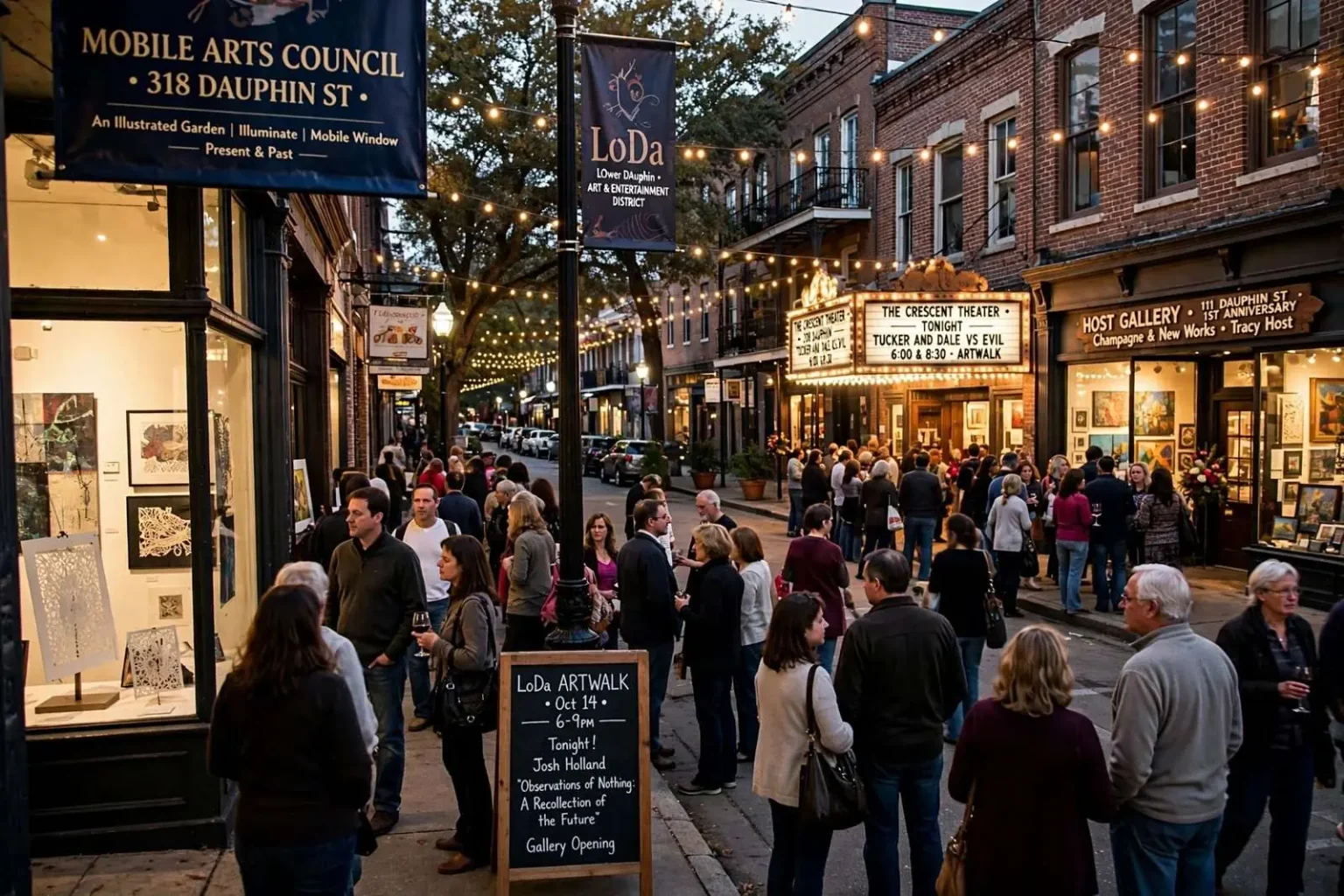
Downtown Mobile’s LoDa ArtWalk returned Friday, October 14, 2011, from 6 to 9 p.m., stretching along the LOwer DAuphin Street arts district with new exhibitions, opening receptions and live entertainment across a dozen galleries and venues. The monthly stroll had become the anchor of downtown Mobile’s cultural calendar by 2011, the night each month when the district’s galleries, studios, theaters and storefronts threw open their doors together and the sidewalks filled with collectors, families and the simply curious.
New Openings Along Dauphin Street
Mobile-based artist Josh Holland debuted “Observations of Nothing: A Recollection of the Future,” an exhibition of digital print and mixed media pieces. Holland’s show typified the kind of work ArtWalk was built to surface — ambitious, contemporary and made by a working artist living in the city itself, presented on the street where the city’s art audience already gathers.
The Mobile Arts Council at 318 Dauphin Street mounted a three-show reception — “An Illustrated Garden,” “Illuminate” and “Mobile Window – Present and Past” — pairing work by 18 students of Val Webb with pieces by Rachael Ellzey and paintings by Derald Eastman; the shows remained on view through October 28. The triple opening gave the council’s galleries one of the month’s fullest rosters, and the inclusion of so many student pieces alongside established names reflected the organization’s long-standing role as an incubator as much as an exhibitor.
Space 301 at 301 Conti Street opened “Papercuts,” an international exhibition of contemporary paper-cutting featuring artists from Australia, France, the Czech Republic, Iran, Canada and the United States, curated by Reni Gower. A show of that geographic reach was a genuine coup for the downtown venue, bringing an ancient craft tradition — paper-cutting being one of the world’s oldest folk art forms — into conversation with contemporary gallery practice.
The Crescent Theater at 208 Dauphin Street began a daily run of the cult comedy “Tucker and Dale vs Evil,” screening at 6 and 8:30 p.m. with weekend matinees through October 20. The single-screen arthouse had become a beloved ArtWalk fixture, giving strollers a film option in the middle of the gallery circuit, and the booking of a festival crowd-pleaser fit the theater’s reputation for programming that mainstream multiplexes passed over.
Receptions and Anniversaries
The Host Gallery at 111 Dauphin Street celebrated its first anniversary with champagne, chocolate and new works by Tracy Host. A first birthday is a meaningful milestone for a small downtown gallery, where the economics are always delicate, and the celebration doubled as a thank-you to the ArtWalk audience that had sustained the space through its first year.
At Art(ology) on Dauphin Street, featured artist Kathy Friedline headlined the month’s display. The gallery had carved out a niche on the street with rotating featured artists, giving ArtWalk regulars a reason to see something new every month even in a space of modest size.
Kangal Gallery in the Sail Loft on North Royal Street hosted an open house with featured artists Sharon Hawkins and Brenda Lomax and harp-and-violin music from the Atkinson Duo. The Sail Loft venue, just off the main Dauphin strip, extended the walk’s footprint toward the river and gave the evening a soundtrack — live chamber music drifting through an open house remains one of the more elegant combinations the district has offered.
Cathedral Square Gallery’s “Artoberfest” reception gathered work from more than 60 local artists, spotlighting Joe Formwalt and Phyllis Cleaver with music by Mallory Searcy and a wine tasting. The October event had become one of the gallery’s signature nights, and a roster of 60-plus artists made it effectively a snapshot of the entire local art scene hung on a single set of walls.
Painter Amy Bolt showed work hosted above the Crescent Theater, reachable by the building’s outdoor spiral staircase. The climb itself became part of the experience — one of those small, discovery-flavored details that distinguish a working arts district from a strip of commercial galleries.
The night also marked the debut of Bruco-Collective Artisan Bottega, a new artisan art space opening above a downtown storefront. Collective spaces like it served a distinct function in the district’s ecosystem, offering working artisans shared space and a retail window without the overhead of a standalone gallery — and giving ArtWalk maps one more stop.
The District Behind the Walk
By October 2011, LoDa — the shorthand for LOwer DAuphin — had completed a decade-long transformation from a stretch of underused storefronts into the city’s designated arts and entertainment district. The revival rested on exactly the mix on display that night: artist studios, independent galleries, the Crescent Theater, restaurants and bars, and the institutions — the Mobile Arts Council and Space 301 — that anchored the block with year-round programming. The city’s designation of the district allowed for the kind of lively street nights that ArtWalk embodies.
ArtWalk’s format — a second-Friday evening when galleries coordinate their openings — gave artists deadlines, gave galleries a shared audience and gave downtown a recurring appointment. For visitors, the experience is cumulative: no single venue is the destination, but a dozen open doors along a few walkable blocks make an evening’s outing that repeated monthly builds a genuine following. Collectors who discovered an artist during one ArtWalk could return the next month to watch the work change.
The October 2011 edition also illustrated the range the walk had achieved. An international paper-cutting show at Space 301, student work at the Arts Council, a cult comedy at the Crescent, artisan crafts above a storefront and chamber music in the Sail Loft — all in one three-hour window — covered more artistic territory than most cities many times Mobile’s size could assemble on a single Friday night.
What It Meant for Downtown
The economics of a night like October 14 mattered as much as the art. ArtWalk nights reliably produced the busiest sidewalks downtown outside of Mardi Gras, sending crowds past restaurants, bars and shops that stayed open late to catch the overflow. For galleries, the walk was the monthly sales event; for the district’s newer spaces, it was the difference between being found and being invisible. Each debut — like that of the Bruco-Collective Artisan Bottega — represented another owner betting that the walk’s foot traffic could support a business.
For artists, the walk shortened the distance between making work and selling it. A painter showing above the Crescent Theater or a featured artist at a small gallery on Dauphin could meet buyers face to face, gauge reactions and build a local following without gallery representation in a distant city. That direct connection is what sustains working artists in mid-sized cities, and ArtWalk institutionalized it once a month.
It also cultivated an audience. Children who grew up walking the district with their parents, students from the area’s colleges who made the stroll a ritual, visitors who timed trips around the second Friday — all of it compounded into the community support that keeps galleries, theaters and arts councils alive. The October 2011 roster, from a 60-artist Artoberfest to a single painter’s stair-climb exhibit, showed a district functioning exactly as designed: artists showing, audiences looking, and a downtown street transformed into the city’s living room for an evening.
The shows noted above ran into late October at the Mobile Arts Council, with the district already turning its attention to the next month’s walk — the rhythm by which LoDa had become, and remains, the heart of Mobile’s art scene.
“Tucker and Dale vs Evil” itself deserves a note in the evening’s ledger. The horror-comedy, about two well-meaning West Virginia hillbillies mistaken for killers by a pack of college students, had built its reputation on the festival circuit before reaching audiences in theaters willing to program it. The Crescent’s run gave Mobile audiences access to a title that wider commercial booking had largely passed by — precisely the role the theater filled on Dauphin Street, and a reminder that ArtWalk’s offerings extended beyond the visual arts into film.
“Papercuts” carried a similar claim to significance. Paper-cutting traditions stretch across centuries and continents — from Polish wycinanki to Chinese window decorations to Mexican papel picado — and the exhibition gathered contemporary artists pushing the folk form into fine-art territory. For Space 301’s audience, the show offered both familiarity and surprise: a craft many visitors recognized from their own cultural backgrounds, executed at a scale and ambition that recast it entirely.
The Venues That Carried the Night
Each of the evening’s venues played a distinct role in the district’s infrastructure. The Mobile Arts Council functioned as the scene’s institutional hub — its galleries on Dauphin serving as the proving ground where emerging artists exhibited alongside established names. Space 301, with its Conti Street footprint, handled exhibitions of national and international scope that no commercial gallery in the city could stage. The commercial galleries — Host, Art(ology), Kangal, Cathedral Square — ran on sales, connecting working artists directly with buyers month after month.
The layering mattered. A district with only commercial galleries becomes a marketplace; a district with only institutions becomes a museum; LoDa by 2011 was both, and the mix gave ArtWalk nights their texture. A stroller could buy a painting, see student work, watch a cult film and hear a harp duo — and in doing so support every layer of the city’s art economy in a single evening.
The Atkinson Duo’s harp-and-violin set at Kangal Gallery also reflected the cross-pollination between the city’s music and visual art communities. Musicians performing at gallery openings had become an ArtWalk staple, giving classical and acoustic players a listening audience outside the concert hall and giving galleries an atmosphere that plain quiet could not match. It was one more way the walk knit the district’s separate scenes into a single night out.


