
Looking back at Hurricane Frederic’s destruction on Dauphin Island
Dr. John Dindo of the Dauphin Island Sea Lab recalls the devastation Hurricane Frederic unleashed on Dauphin Island in 1979.
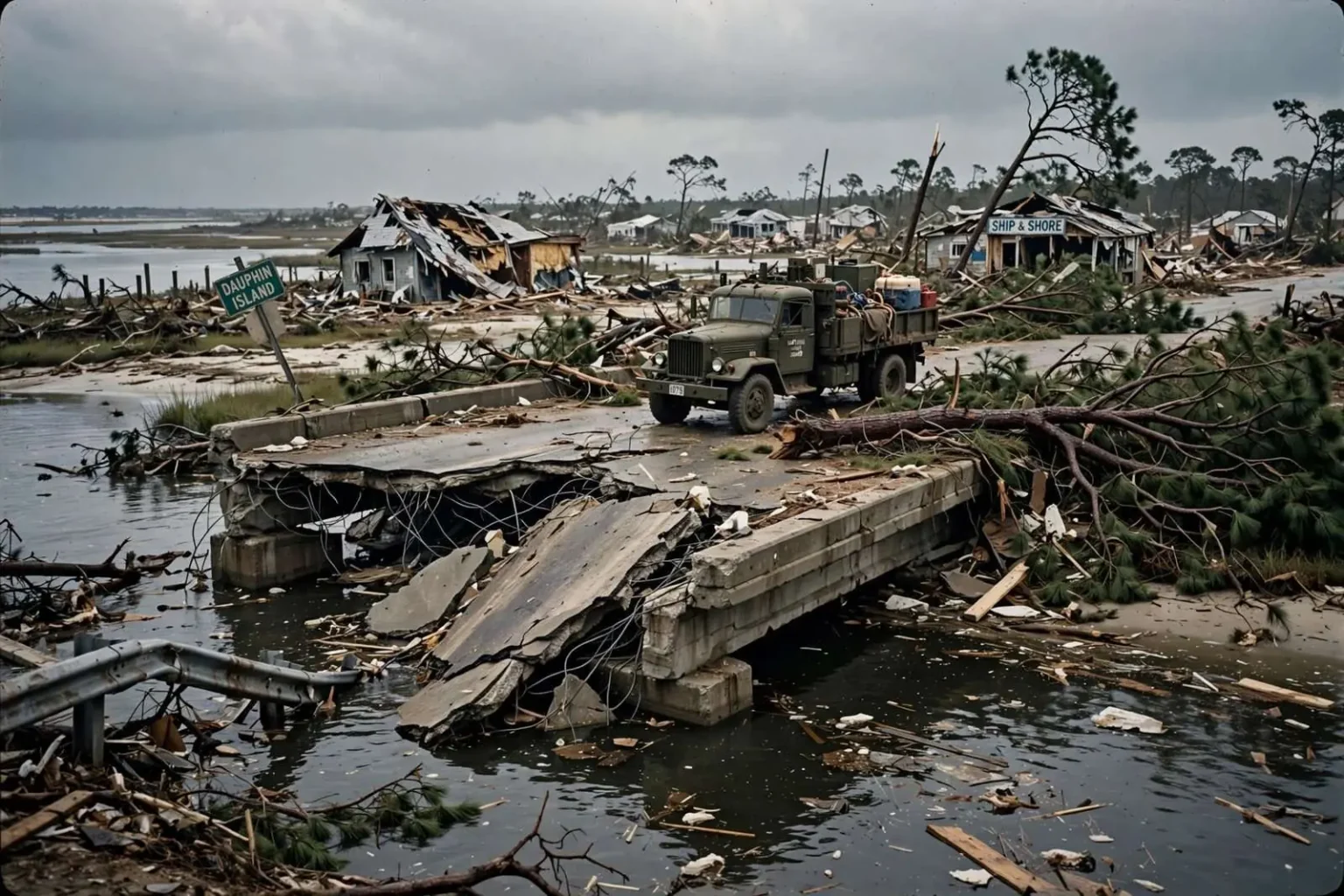
After Hurricane Frederic, the residents of Dauphin Island were met by pure devastation. Those who left the island couldn’t get back, and those who rode out the storm on the island say they will surely never ride out a storm like Frederic again.
“What took men years to build on Dauphin Island took Frederic hours to destroy,” said Dr. John Dindo, assistant director at the Dauphin Island Sea Lab, where he has worked for 43 years. “Unofficial estimates are the hurricane did 25 million dollars damage to the west end of the island alone.”
Dindo was at the lab during the storm but also volunteered with the fire department. The man who owned Ship and Shore, Mr. Ben Burger, had fire trucks and an old National Guard deuce-and-a-half that he loaded with generators and water. Dindo drove the truck off the island that afternoon expecting to return the next day — but the bridge was gone.
“The Dauphin Island Bridge back then was about 10-12 feet off the water. A concrete bridge, but about 10-12 feet off of the water,” Dindo said. “What happened is the roadbed actually got lifted up by the waves and deposited right there in the water.” The only route on and off the island didn’t make it.
Riding it out in a freezer
Burger and Billy Patronas, one of the island’s first town council members, stayed at the store to avoid the storm and rode it out inside the walk-in freezer. When the storm finally passed, residents found pure devastation.
“Every roof on every one of our buildings got peeled off,” Dindo said. “When the roofs left, all the pebbles on the roofs broke out every window. Then when the rain came, all the buildings got soaked.”
Buildings were toppled and roads destroyed. Bienville Boulevard, the island’s main east-west street, was impassable, its median and sides lined with downed pine trees, and crews had to cut a single lane to get through.
“One house would be right here and that would be wiped out and the next door neighbor’s house would still be standing,” Dindo recalled.
The storm that reshaped the coast
Frederic made landfall on the night of September 12, 1979, as a Category 3 hurricane, its eye passing almost directly over the western end of Dauphin Island before driving ashore near the Alabama-Mississippi line. The storm hurled a storm surge across the low-lying barrier island, swept homes from their pilings and rearranged the sand that forms the island’s west end. Along the mainland, Mobile Bay communities suffered widespread destruction, and the city of Mobile itself endured weeks without power, some of the longest outages in Alabama history.
As someone who knows hurricanes, Dindo has spent the decades since Frederic measuring the island’s changes, first as a young researcher and now as one of the Sea Lab’s most senior scientists. The Dauphin Island Sea Lab, the state’s marine science education and research facility at the island’s east end, weathered the storm alongside the rest of the community, and its campus became part of the recovery effort in the storm’s aftermath.
The damage figures attached to the west end alone, the unofficial 25 million dollars Dindo cites, only hint at the broader toll. Insurance assessments after Frederic ranked the storm among the costliest in United States history at the time, with damage spread across coastal Alabama and Mississippi, and the hurricane became a defining event for a generation of Gulf Coast residents who had never experienced a direct hit from a major storm.
The bridge and the isolation
The loss of the Dauphin Island Bridge cut the island off from the mainland at the moment its residents most needed help. The old low-rise concrete span across the Gulf of Mexico, connecting the island to the mainland at Cedar Point, sat barely above the water, and Frederic’s surge lifted its roadbed and dumped it into the bay. For days, the island’s only link to the outside world was by boat, and the fire truck loaded with generators and water that Dindo drove off the island became part of a supply effort staged from the mainland side.
Those who stayed behind, like Burger and Patronas sheltering in the walk-in freezer at Ship and Shore, survived the storm’s peak in improvised refuges. The freezer’s thick insulated walls offered protection from the wind, and stories like theirs became part of the island’s folklore in the years after. When residents finally emerged, they found the scene Dindo describes: peeled roofs, windows shattered by roof gravel, buildings soaked by days of rain.
The isolation shaped the recovery. Without the bridge, heavy equipment and materials arrived by barge, and residents who had evacuated waited on the mainland until authorities could manage access. The Federal Emergency Management Agency, still a young organization in 1979, coordinated the disaster response, and the Frederic experience became a case study in how a barrier island community copes with losing its single connection to the mainland.
What the island rebuilt
The island rebuilt in the years that followed, and the Frederic experience rewrote its building practices. New construction was elevated, roof standards tightened and the town’s leaders, among them veterans like Patronas, carried the storm’s lessons into zoning and development decisions. A new high-rise Dauphin Island Bridge eventually replaced the low concrete span, built high above the water precisely so that no storm surge could repeat what happened to the roadbed in 1979.
Bienville Boulevard recovered as well, though long-time residents note that the mature pine trees that once lined its median and edges were gone, changing the character of the island’s main street. The lots where houses vanished under Frederic’s surge became part of the debate over rebuilding on the west end, a stretch of the island that remains vulnerable to every storm that has come since.
At the Sea Lab, Dindo’s perspective spans the island’s entire modern history. Forty-three years of work at the facility have given him a researcher’s eye for the changes Frederic set in motion, from the movement of sand on the west end to the shifts in the island’s ecology as the dunes and maritime forest regenerated. His memories of the storm, the drive off the island in Ben Burger’s deuce-and-a-half, the sight of the missing bridge, the pebbled glass in every window, are preserved in the oral histories that islands like Dauphin Island pass down.
Frederic’s lasting lessons
Frederic remains the benchmark storm for coastal Alabama, the event against which every later hurricane is measured. When Hurricane Ivan came ashore near the same stretch of Gulf Coast in 2004, and when Katrina devastated the region a year later, Dauphin Island residents compared the damage, the surges and the recovery timelines directly to 1979. The west end of the island, where Frederic did its unofficial 25 million dollars of damage, has been overwashed by nearly every major storm since, and each event renews the questions Frederic first raised about rebuilding on a barrier island that storm surge rearranges by design.
The storm also changed how the Gulf Coast prepares. Emergency management officials across Mobile and Baldwin counties point to Frederic as the disaster that forced the region to take evacuation planning seriously, since residents who stayed behind on the island in 1979 survived conditions that easily could have turned fatal. The rise of modern forecasting, mandatory evacuation zones and the hardening of infrastructure like the bridge all trace back to the lessons of that September night.
The island today
Today’s Dauphin Island is a town of roughly 1,300 residents that swells each summer with visitors drawn to its beaches, the Audubon Bird Sanctuary, Fort Gaines and the public fishing pier. The Sea Lab anchors the island’s east end, its aquarium and research facilities drawing school groups from across Alabama, and Dindo’s decades of work there have made him one of the coast’s most familiar scientific voices on storms, sea level and the changing shoreline.
For the people who lived through Frederic, though, the island’s story is measured against that one night. The trees that fell across Bienville Boulevard, the houses that vanished while their neighbors stood, the freezer that sheltered two men through a Category 3 landfall and the bridge that carried the island’s last truck to safety before the water took the roadbed, these are the details residents pass on to newcomers, usually with the same warning Dindo and his neighbors offer: no one who saw Frederic will ever ride out a storm like it again.
The devastation of 1979 has long since been cleared away, and visitors to the island today see the rebuilt cottages, the elevated new construction and the high bridge, not the wreckage. But the memory shapes the island still, in its building codes, its evacuation habits and its stubborn awareness that the Gulf can take back in hours what took men years to build.