Lt. Gov. Ainsworth says he would vote no on a toll for the Mobile River Bridge
Lt. Gov. Will Ainsworth said he would vote no on a toll for the proposed Mobile River Bridge and Bayway project.
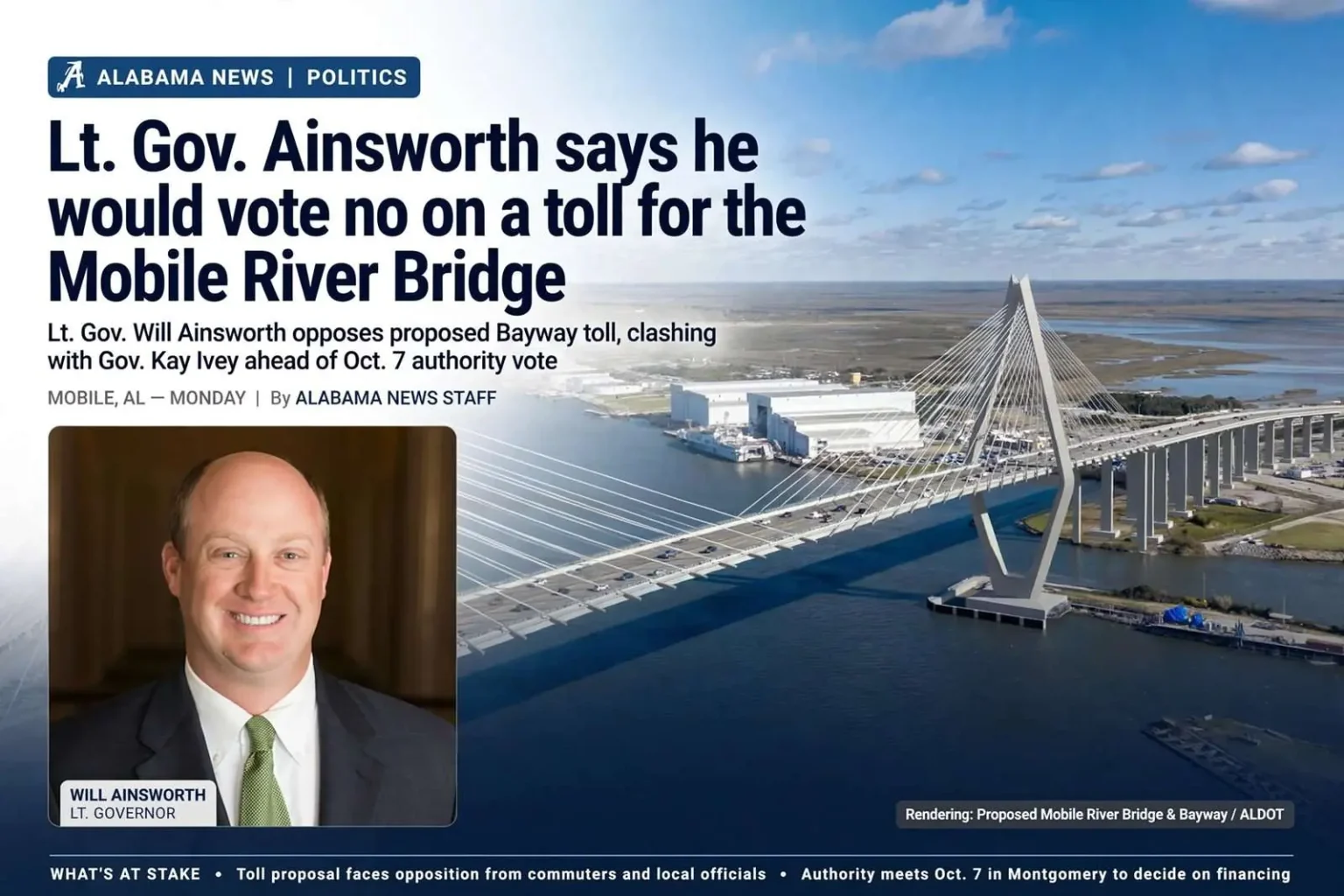
Alabama Lt. Gov. Will Ainsworth said Monday he would oppose a toll on the proposed Mobile River Bridge and Bayway project, aligning himself with the commuters who have filled public meetings and comment periods in opposition to paying to cross the Mobile Bay Causeway.
Ainsworth, who sits on the Alabama Toll Road, Bridge and Tunnel Authority, posted a video to social media saying that if the question comes to a vote, he will be “proud to vote no.” His statement came weeks after Gov. Kay Ivey called tolls on the new bridge a necessity, setting up a public split between two of the state’s top elected officials on the most contested transportation project in south Alabama.
The authority is scheduled to meet Oct. 7 in Montgomery. The bridge and Bayway project has been a flashpoint on the Mobile side of the bay, where commuters have resisted paying to cross.
What the project would build
The Mobile River Bridge and Bayway project, developed by the Alabama Department of Transportation, proposes a new bridge over the Mobile River connecting to a rebuilt, elevated Bayway along the Mobile Bay Causeway — a corridor that carries Interstate 10 traffic between Mobile and the Eastern Shore. The current route funnels the George Wallace Tunnel under the Mobile River, where the roadway drops into twin tubes that bottleneck daily and carry traffic far below interstate capacity standards.
The corridor handles not just local commuters but a national freight flow. I-10 is one of the country’s major east-west interstates, and its Gulf Coast segment moves commercial traffic between Florida, the port complex of Mobile and points west.Congestion in the tunnel and along the Causeway has worsened for years as the region’s population and port volume have grown, and ALDOT has argued the current infrastructure cannot absorb projected traffic without a second crossing.
The proposed financing model is where the controversy lives. ALDOT’s plan calls for tolling the new bridge and Bayway — with tolls proposed in the range of a few dollars for passenger vehicles, higher for trucks — to pay for construction costs estimated in the hundreds of millions of dollars. No toll revenue would be collected on the existing tunnel route under the plan, but drivers using the new crossing would pay at each pass.
Ainsworth’s position
Ainsworth’s announcement carried weight beyond an ordinary politician’s opinion. As president of the Alabama Senate and a member of the Alabama Toll Road, Bridge and Tunnel Authority, he sits within the very body that would decide how the project moves forward. His video statement — that he would be “proud to vote no” if the toll question came before him — put that institutional influence behind the anti-toll side.
The lieutenant governor framed his opposition around the burden tolls would place on working families and commuters who cross the bay daily for work, school and medical care. That argument echoes the position taken by Eastern Shore and Mobile residents who have dominated public comment sessions on the project since ALDOT rolled out its plans. Opponents argue that a toll on the bay crossing functions as a tax on living in one part of the metro area and working in another.
His statement also landed in the middle of a statewide political conversation. Ainsworth, a Republican from Guntersville, has been mentioned as a future gubernatorial candidate, and the Mobile Bay toll has become a signature local issue that resonates far beyond Baldwin and Mobile counties as a symbol of opposition to tolling public infrastructure.
The governor’s different view
Gov. Kay Ivey had come down on the other side weeks earlier, calling tolls on the new bridge a necessity. From the governor’s office, the argument runs through decades of transportation funding shortfalls: Alabama’s fuel taxes — among the lowest in the nation until modest increases passed in 2019 — never generated enough revenue to build a crossing of this scale, and federal funding covers only a fraction of major new infrastructure. Without a toll, ALDOT’s position has been that the project simply does not get built.
Supporters of the toll plan point to the alternative: continued congestion through the tunnel, longer commutes, stalled freight, and a corridor that constrains the region’s growth. They note that toll revenue would come disproportionately from the commercial traffic that stresses the corridor hardest, and that drivers who want to avoid the toll can keep using the existing tunnel, which would remain free.
The divide between the governor and lieutenant governor reflected a genuine policy disagreement about how Alabama pays for big projects — but it also played out politically. On the Mobile side of the bay, where opposition to the toll is intense and near-universal among local officials of both parties, Ainsworth’s statement aligned him with the community’s mood while Ivey’s position drew sharp local criticism.
The authority’s role
The Alabama Toll Road, Bridge and Tunnel Authority occupies a narrow but powerful place in the process. Created by state law, the authority can issue revenue bonds backed by tolls, a financing mechanism that allows major projects to proceed without direct state appropriations. Any toll proposal for the Mobile River Bridge would pass through the authority’s hands, which is why Ainsworth’s seat on the board matters and why his “proud to vote no” pledge was more than rhetorical.
The authority’s Oct. 7 meeting in Montgomery was scheduled as the project’s financing debate continued. What the authority decides — whether to advance the toll plan, delay it, or seek alternatives — shapes ALDOT’s next steps on a project that has already consumed years of study, environmental review and public comment.
Between the governor’s office, ALDOT, the authority and the Legislature, no single official controls the outcome. The project requires financing decisions, environmental clearance and ultimately the political will to build. That diffusion of power is what made Ainsworth’s public opposition notable: enough opposition in enough of those seats can stall a project even when the engineering case for it is strong.
Why the toll became a flashpoint
The Mobile Bay crossing is not just any road. The Causeway and its Bayway carry everyone who lives on one side of the bay and works, shops or attends school on the other, and the communities along the Eastern Shore — Daphne, Spanish Fort, Fairhope — have grown on the promise of an easy drive into Mobile. A daily toll would insert a recurring cost into thousands of household budgets, and the arithmetic is simple: a commuter crossing twice a day at the proposed rates would pay well over a thousand dollars a year.
Opponents organized quickly once ALDOT’s plans became public. Public meetings in Daphne, Spanish Fort and Mobile drew crowds that filled auditoriums, and online petitions gathered tens of thousands of signatures. Local legislators from the affected districts, along with county commissioners and city councils on both sides of the bay, passed resolutions opposing the toll. The intensity of the response made the toll one of the most visible transportation controversies in Alabama in years.
The flashpoint also had a geographic edge. Baldwin County’s explosive growth has made it one of the fastest-growing counties in the state, and much of that population commutes west. Residents saw the toll proposal as a direct charge on the growth that has defined the Eastern Shore for two decades — and Mobile residents who work on the shore saw the mirror image.
Alternatives and the road ahead
Toll opponents have pushed alternatives: tolling trucks only, using the state’s increased fuel tax revenue, phasing the project, or redesigning it to a scale the state can afford without user fees. ALDOT has responded that none of the alternatives closes the funding gap on the timeline the corridor’s traffic demands. The debate over those numbers — and over the assumptions behind them — has filled comment periods and legislative hearings.
The Oct. 7 authority meeting in Montgomery was the next scheduled formal step in that debate. Whatever its outcome, the project’s fate rests on resolving a fundamental tension: the state’s transportation needs on the bay crossing are real and growing, but the political tolerance for charging drivers to cross the bay has proven to be nearly zero on the Mobile side.
Ainsworth’s video statement gave that opposition its most prominent institutional voice to date. Coming weeks after Gov. Ivey defended the tolls as a necessity, the lieutenant governor’s “proud to vote no” pledge transformed the project’s financing question into an open dispute at the top of Alabama’s government — one that commuters on both sides of Mobile Bay will be watching as the authority convenes in Montgomery.
For the residents who would pay it, the stakes are concrete: the price of a commute, the cost of doing business, the accessibility of a hospital or a job across the bay. That is why a financing mechanism designed in Montgomery has produced its loudest response in the towns strung along the Causeway — and why the October meeting’s toll deliberation drew attention well beyond the capital.