Lucedale butcher shop branches out into franchising
The Blind Butcher Shoppe in Lucedale, Mississippi is launching a franchising effort with plans that include the Mobile and coastal areas.
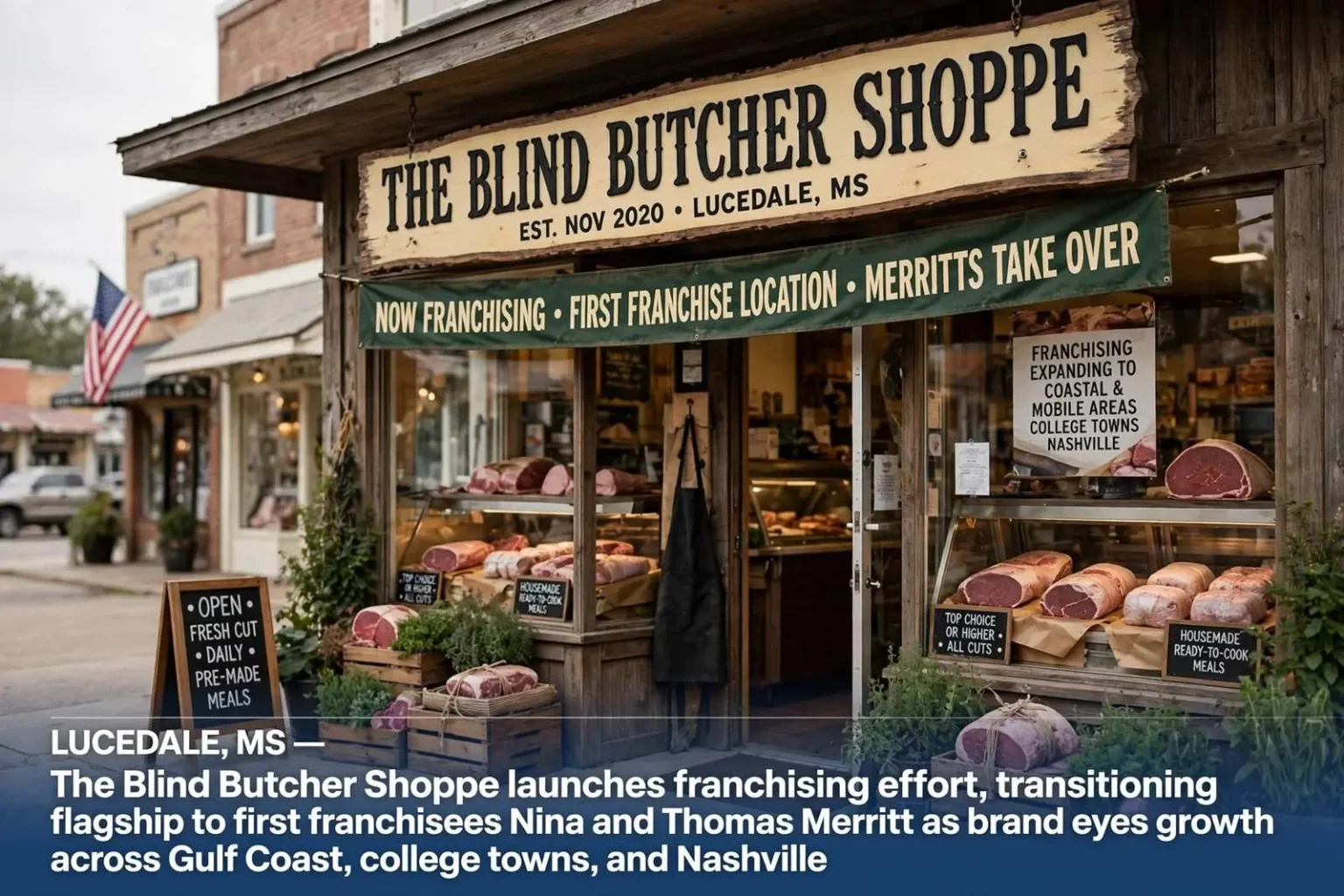
A Lucedale, Mississippi butcher shop is taking its business model on the road, launching a franchising effort that could put its name on storefronts across the country. The Blind Butcher Shoppe opened in November 2020 after founder Bri Mixon, a nurse practitioner, decided to leave hospital work during the pandemic and fill what she saw as a gap in her community. In the years since, the shop has grown from a single storefront in the George County seat into a business with ambitions well beyond south Mississippi.
The move to franchising is the kind of step most small-town businesses never take, and it puts Lucedale on a list of communities that have exported a business concept rather than just local products. The original Lucedale location was officially transitioned this week to the business’s first franchise, with locals Nina and Thomas Merritt taking over as the inaugural franchisees. The transition keeps the flagship store operating under familiar local hands while freeing the brand’s leadership to pursue growth in new markets.
Expansion plans target the coastal and Mobile areas, college towns and Nashville. That list reflects a deliberate strategy: grow first in the neighboring Gulf Coast markets where the shop’s reputation already travels by word of mouth, then push into university communities and a major metropolitan music hub where specialty food retail has a proven customer base.
From hospital work to the butcher block
The Blind Butcher Shoppe’s origin story is rooted in the disruption of 2020. Bri Mixon was working as a nurse practitioner when the pandemic upended daily life across the Gulf Coast, and she saw an unmet need in her hometown: a true full-service butcher shop with consistent quality. She left hospital work and opened the shop in November 2020, betting that customers in Lucedale and the surrounding communities would drive the extra mile for professionally cut, well-sourced meat rather than settling for supermarket cases.
The bet paid off. The shop built its reputation on a straightforward quality standard: all of the shop’s cuts are rated top-choice or higher. That commitment to grading means customers know what they are getting before they reach the counter, an assurance that set the shop apart in a market where meat quality can vary widely from one shopping trip to the next.
The kitchen side of the business grew into a draw of its own. The shop’s kitchen turns out gourmet and pre-made items daily, giving busy households across George County and neighboring areas a ready answer to the weeknight dinner question. Ready-to-cook meals, prepared sides, and specialty items turned a meat counter into a destination, and destination retailers are precisely the kind of concept that franchises well.
Why franchising, and why now
As the customer base grew, shoppers began asking about expansion. That kind of organic demand is the classic starting point for a franchising effort: rather than pushing the brand into new territory on its own capital, a company licenses its name, systems, and supplier relationships to owner-operators who put down roots in their own communities.
For franchisees, the appeal is a proven model without the trial-and-error period. Nina and Thomas Merritt know the Lucedale market as residents, and taking over the original location gives them a store with an established customer base, trained procedures, and a brand identity that already carries weight across south Mississippi. Their role as inaugural franchisees makes them the test case for every market that follows.
The franchise structure also changes the pace of growth. A company opening its own stores must fund each buildout, hire each staff, and manage each location from Lucedale. Franchising distributes those responsibilities to local owners who have a personal stake in the performance of their store, and it lets the brand enter multiple markets in parallel rather than one at a time.
Lucedale itself makes an unlikely-looking, but logical, home base for a franchise brand. The town of a few thousand residents sits on Highway 98 about an hour from both the Mississippi Gulf Coast and Mobile, positioned to draw shoppers from a multi-county radius that includes Pascagoula, Moss Point, and the Alabama line. Rural customers in that corridor have long driven significant distances for specialty food and services, and a shop that gives them a reason to stay local captures spending that would otherwise leave the region.
George County’s population has grown steadily as the wider Gulf Coast region has expanded inland, and new rooftops along the Highway 98 and Highway 63 corridors bring exactly the kind of customers who sustain a quality-focused meat market. A business that scales with that growth, rather than waiting for it to arrive, is positioning itself ahead of the curve.
What the expansion means for the Mobile area
The mention of the coastal and Mobile areas in the expansion plans is notable for readers on the Alabama side of the line. Mobile County shoppers already cross into Mississippi for groceries, fireworks, and other purchases, and a Blind Butcher Shoppe location on the Alabama side would formalize a brand relationship that already exists informally. For local commercial real estate, each new franchise location represents a small-business tenant with a proven operating history, often in second-generation retail space that larger chains pass over.
College towns on the target list offer a different fit. University communities reward quick, quality meal solutions for students, young families, and game-day hosting, and a shop that produces ready-made items daily aligns naturally with that rhythm. Nashville, meanwhile, is one of the fastest-growing metros in the Southeast, with a hospitality economy and a dining culture that celebrates specialty food concepts. Breaking into a market of that size would mark the brand’s transformation from a regional success into a true franchise operation.
The story also fits a broader post-pandemic pattern across the Gulf South. The same disruption that pushed Bri Mixon out of hospital work pushed thousands of professionals into entrepreneurship, and a meaningful share of those ventures proved durable enough to scale. Health care workers in particular brought an understanding of discipline, standards, and service under pressure, qualities that translate directly to food safety and retail operations.
Keeping quality through growth
The central challenge for any butcher shop franchise is protecting quality as the footprint grows. A single location’s reputation rests on the discipline of its counter staff and kitchen; a franchise system must replicate that discipline in stores run by different owners in different markets. The shop’s stated grading standard, top-choice or higher on every cut, works as a system-wide rule precisely because it is simple, measurable, and visible to any customer who walks in the door.
Centralized sourcing and supplier relationships are the other half of that equation. Franchised butcher operations typically lean on negotiated supply agreements so that a customer in a new market receives the same product as one standing at the original Lucedale counter. How well the Blind Butcher Shoppe formalizes those systems will determine whether the first franchise transition becomes the first of many or a cautionary tale.
For now, the Merritts’ takeover of the original location signals confidence on both sides of the deal. A founding owner does not hand her flagship store to franchisees lightly, and first-time franchisees do not take on a transition store without believing the model holds up. The next milestone will be the first ground-up location in a new market, and the expansion map, coastal Alabama, college towns, and Nashville, suggests the brand intends to move quickly.
Customers who built the shop’s following will notice little at the counter in the short term. The transition changes ownership and structure, not the daily routine of cutting, grinding, smoking, and preparing the pre-made items that regulars plan their weeks around. That continuity is the point: a franchise brand is only worth licensing if the experience it sells is consistent, and the first franchise transition is where that promise gets proven.
The wider south Mississippi and coastal Alabama retail community will be watching as well. Small-town success stories that export a franchise model remain rare, and the Blind Butcher Shoppe’s progress will be a case study in whether rural Gulf Coast concepts can compete in metropolitan markets. Every element of the original formula, the top-choice grading floor, the daily kitchen output, the personal service of a hometown counter, now has to survive replication.
From a November 2020 opening in a county-seat town to a franchising launch with a multi-state target list, the trajectory is unmistakable. The Blind Butcher Shoppe spent its first years proving the model in Lucedale. The next phase will test whether what worked on the corner of a small Mississippi town can work in Mobile, in a college town, and in Nashville, with local owners in each place carrying the name forward.
For residents of Lucedale, the transition brings a measure of civic pride alongside a practical question, answered for now by the Merritts’ local roots: the shop that became a regional name remains in hometown hands. For the founder, the franchising effort converts years of pandemic-era risk into a platform for growth. And for the expanding circle of communities on the brand’s target map, a butcher shop from Lucedale is about to find out how far its reputation travels.